Tirzepatide
GIP / GLP-1 dual receptor agonist
Overview
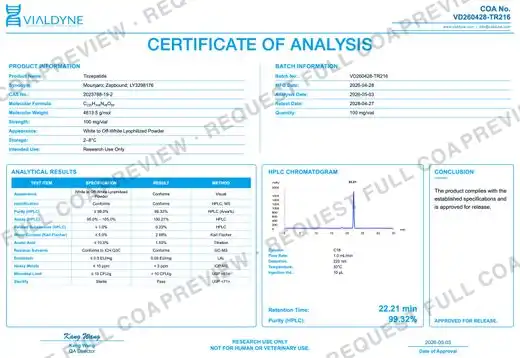
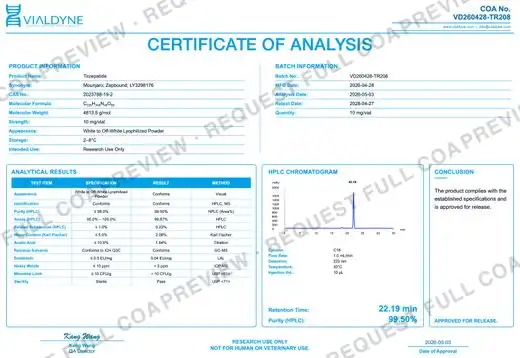
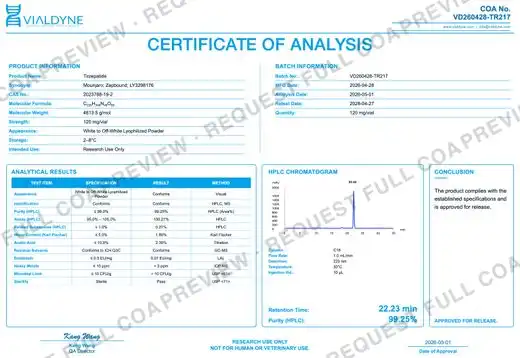
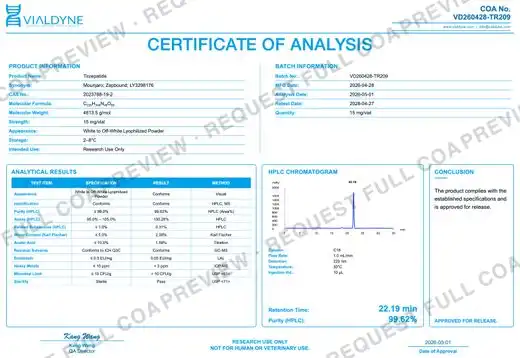
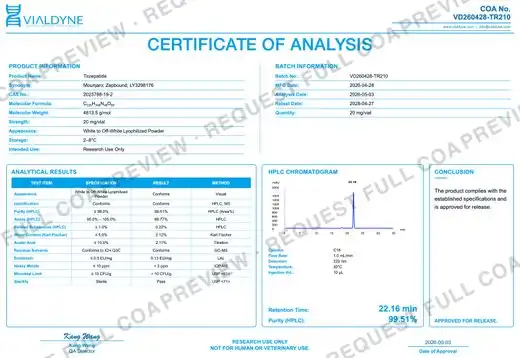
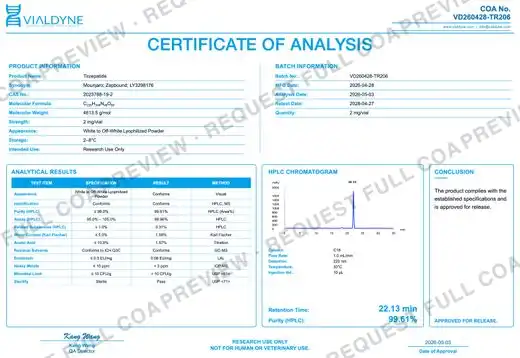
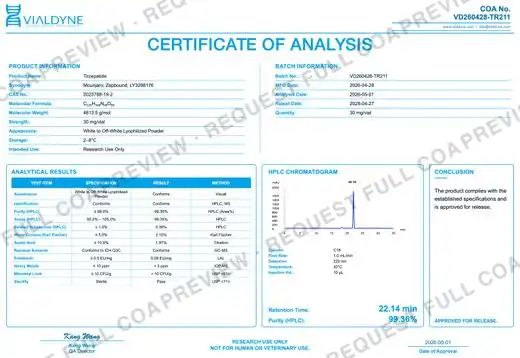
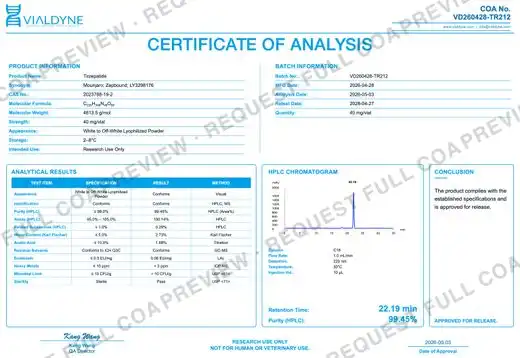
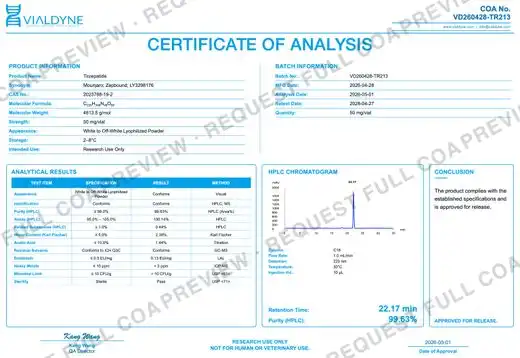
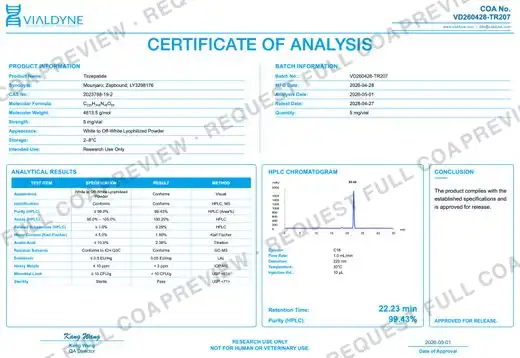
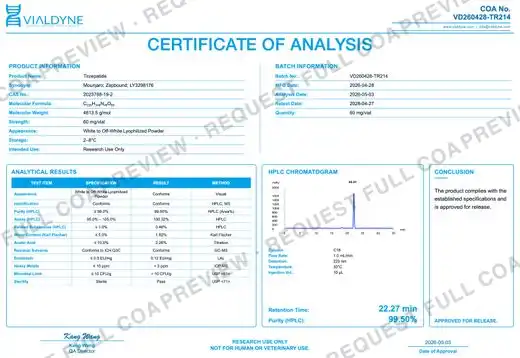
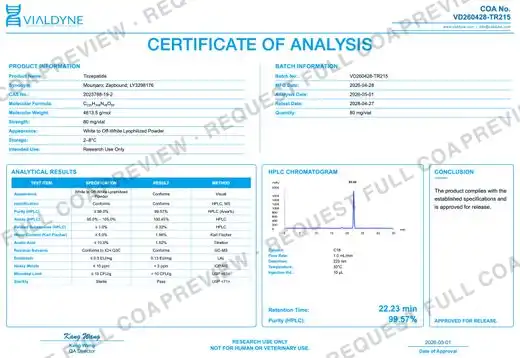
For 503A patient-specific compounders and 503B outsourcing facilities, Tirzepatide arrives as a fully-characterised 39-residue GIP / GLP-1 balanced dual agonist API. The defining structural feature is a C20 fatty-diacid attached to a lysine side chain, which mediates reversible serum-albumin binding and locks in the once-weekly PK that separates this molecule from the earlier GLP-1 mono-agonist generation. The same active drives the FDA-approved finished products Mounjaro (T2DM) and Zepbound (chronic weight management); the bulk API supplied here is the upstream feedstock, not a finished dosage form. Every Vialdyne lot of lyophilised Tirzepatide acetate is released at ≥99.0% HPLC main-peak area, with a batch COA bundling RP-HPLC peak integration, ESI-MS identity within 0.5 Da of the 4813.45 Da theoretical, Karl Fischer water determination, and counter-ion quantitation. LAL endotoxin per USP <85>, microbial limits per USP <61>/<62>, and full LC-MS/MS sequence confirmation are available as documented add-ons on the same lot and are the recommended scope when qualifying a new supplier for sterile compounding. The fill ladder spans 2 mg to 120 mg across twelve nominal strengths so a single qualified supplier covers everything from pilot work to weekly dispensing inventory; sterile-filled presentations and pre-blended Tirzepatide + Cagrilintide co-lyophilisates can be arranged under a project-specific change-control with full ICH-Q1A stability commitment.
Who buys this, and why
Most buyers in this category are 503A and 503B compounding pharmacies fulfilling metabolic and weight-management protocols, plus research labs investigating GLP-1 / GIP / GCG receptor pharmacology. The procurement decision usually hinges on three things: documented purity at scale, a regulatory team that can respond on destination-market questions in writing, and the ability to supply consistent counter-ion form (acetate by default) across recurring orders.
Primary buyer fit: 503A / 503B compounding pharmacies and academic and contract research laboratories.
Specifications
- CAS
- 2023788-19-2
- Molecular Formula
- C225H348N48O68
- Molecular Weight
- 4813.45 g/mol
- Appearance
- White lyophilized powder
- Purity (HPLC)
- ≥ 99.0%
- Common vial sizes
- 2 mg, 5 mg, 10 mg, 15 mg, 20 mg, 30 mg, 40 mg, 50 mg, 60 mg, 80 mg, 100 mg, 120 mg
- MOQ
- On request
- Lead time
- 7–14 days
- Storage
- -20°C, protect from light
Documentation available on request
- Certificate of Analysis (COA)
- HPLC Chromatogram
- Mass-spec identity (ESI-MS)
- Counter-ion / residual solvent
- Bacterial endotoxin (LAL, USP <85>)
- Microbial limits (USP <61>/<62>)
- Stability data on request
- 503A / 503B documentation support
Regulatory note
Sold as a bulk active for research and for compounding-pharmacy formulation where local regulations permit. The Tirzepatide finished drug is FDA-approved (Mounjaro / Zepbound); the bulk active itself is not currently on the 503A bulks list, and compounding eligibility depends on the destination market's current shortage / regulatory posture, which buyers are responsible for verifying at the time of dispense.
Frequently asked questions
What is Tirzepatide's CAS number?▾
The CAS Registry number is 2023788-19-2, molecular formula C225H348N48O68, average MW 4813.45 g/mol. Structurally it is a 39-amino-acid sequence carrying a C20 fatty-diacid albumin-binder on a lysine side chain. The full identity stack (sequence, CAS, formula, theoretical MW, isotope envelope) is reproduced on every released batch COA and on the SDS.
How does Tirzepatide differ from Semaglutide in chemistry and pharmacology?▾
Receptor scope is the headline difference: Semaglutide is a selective GLP-1 mono-agonist, whereas Tirzepatide is a balanced co-agonist of GIP and GLP-1 receptors. The backbone is also longer (39 residues vs 31), and the lipidation chemistry differs, Tirzepatide uses a C20 diacid, Semaglutide a C18 diacid, with related but distinct linker geometry. Both are dosed once-weekly because both rely on albumin-binding for half-life extension; the dual-receptor mechanism is what produces the larger HbA1c and body-weight reductions seen in head-to-head Phase 3 readouts.
What salt form does Vialdyne ship Tirzepatide in, and why?▾
Acetate is the standard counter-ion released from our process. Compounding pharmacies should default to acetate because residual TFA from older purification routes is documented to confound cell-based potency assays and is harder to clear from the final dosage form. TFA-salt material is available only on explicit written request with a documented downstream need, and the lot certificate will flag the counter-ion change for the pharmacy's QA file.
What vial sizes are available, and which are typical for compounding workflows?▾
Twelve nominal strengths are catalogued: 2, 5, 10, 15, 20, 30, 40, 50, 60, 80, 100, and 120 mg. The 5-20 mg fills are the workhorses for 503A patient-specific compounding because they map cleanly onto the typical reconstitution-and-aliquot worksheets; the 40-120 mg fills support 503B batch dispensing and weekly clinic inventory builds. Custom strengths, ISO-class sterile fills, and co-lyophilised Tirzepatide + Cagrilintide presentations are scoped under a separate change-control with stability commitment per ICH-Q1A.
Related peptides