Retatrutide
GIP / GLP-1 / glucagon tri-agonist
Overview
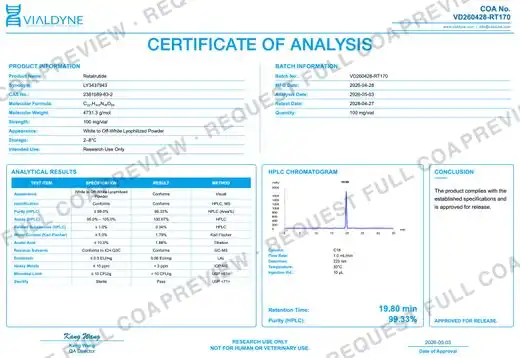
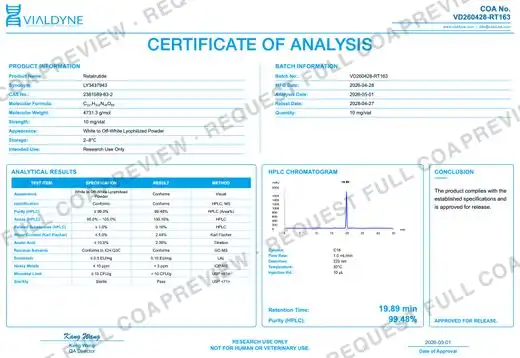
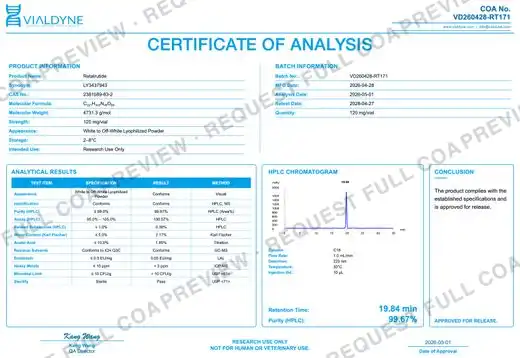
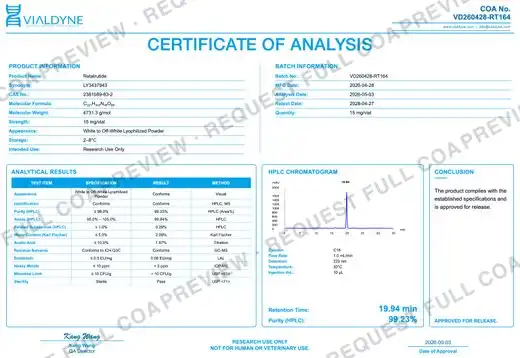
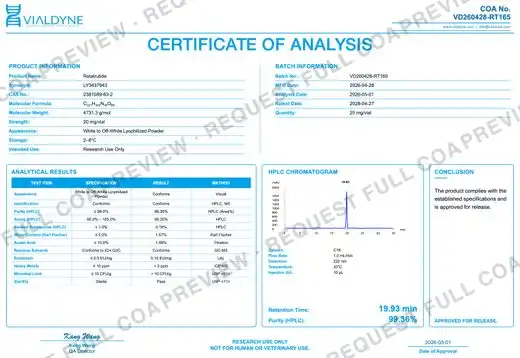
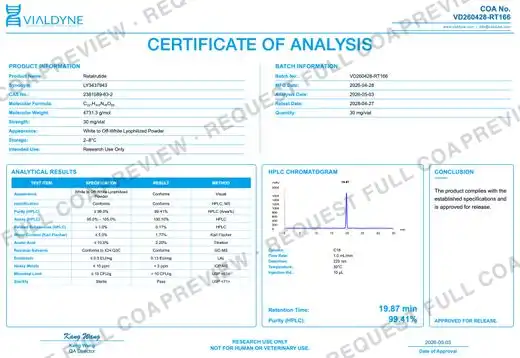
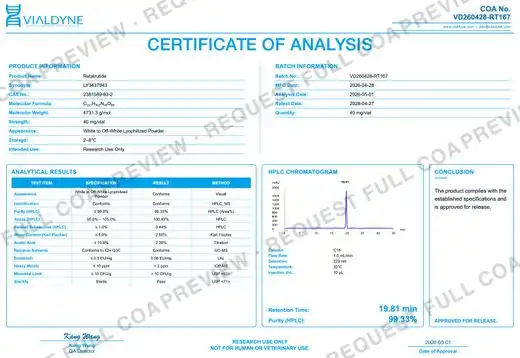
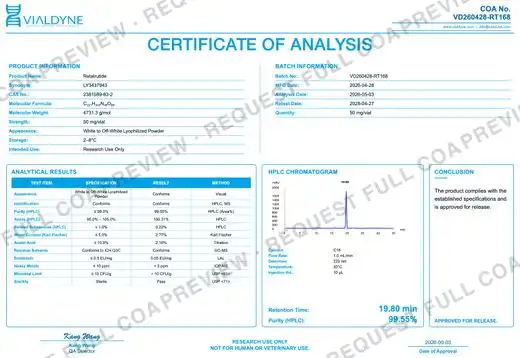
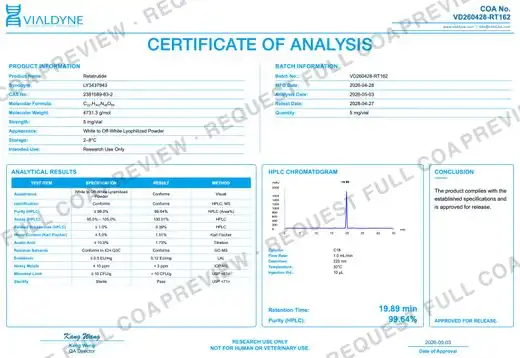
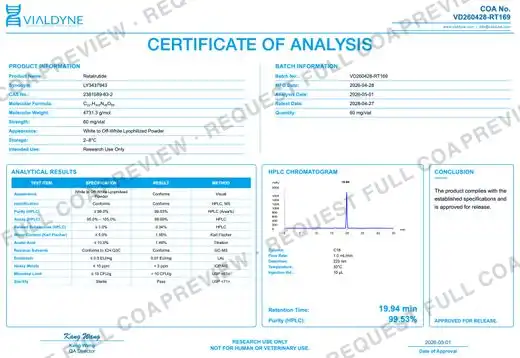
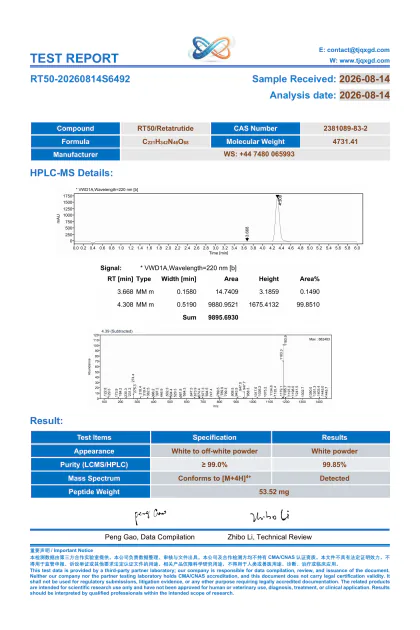
Retatrutide (Eli Lilly's LY3437943) is an investigational 39-residue tri-agonist that engages GIP, GLP-1, and glucagon receptors in a single molecule. Adding the glucagon arm is what separates this asset from the GIP/GLP-1 dual agonists (Tirzepatide) and the GLP-1/glucagon dual agonists (Mazdutide, Survodutide); the glucagon component contributes hepatic energy expenditure on top of the incretin-driven glycaemic and satiety effects, and is the mechanistic reason for the unusually large weight-reduction deltas reported across the Phase 2 program. Vialdyne releases lyophilised Retatrutide acetate against a ≥99.0% main-peak HPLC specification, with a batch packet that includes RP-HPLC peak integration, ESI-MS identity, Karl Fischer water, and counter-ion quantitation. For 503A and 503B compounding traffic and any downstream parenteral use, LAL endotoxin (USP <85>) and bioburden (USP <61>/<62>) are documented as add-on tests on the same lot, no re-sampling. Eight nominal strengths from 5 to 60 mg map onto both bench-scale aliquots and weekly dispensing inventories. Because aggregate world production volume for Retatrutide is still a fraction of what Semaglutide or Tirzepatide command, per-mg pricing is steeper at small quantities but normalises once a repeat order is locked against a defined synthesis route, ask for the 100 g and 1 kg tier sheet at the qualification stage.
Who buys this, and why
Most buyers in this category are 503A and 503B compounding pharmacies fulfilling metabolic and weight-management protocols, plus research labs investigating GLP-1 / GIP / GCG receptor pharmacology. The procurement decision usually hinges on three things: documented purity at scale, a regulatory team that can respond on destination-market questions in writing, and the ability to supply consistent counter-ion form (acetate by default) across recurring orders.
Primary buyer fit: 503A / 503B compounding pharmacies and academic and contract research laboratories.
Specifications
- CAS
- 2381089-83-2
- Appearance
- White lyophilized powder
- Purity (HPLC)
- ≥ 99.0%
- Common vial sizes
- 5 mg, 10 mg, 15 mg, 20 mg, 30 mg, 40 mg, 50 mg, 60 mg
- MOQ
- On request
- Lead time
- 10–18 days
- Storage
- -20°C, protect from light
Documentation available on request
- Certificate of Analysis (COA)
- HPLC Chromatogram
- Mass-spec identity (ESI-MS)
- Counter-ion / residual solvent
- Bacterial endotoxin (LAL, USP <85>)
- Microbial limits (USP <61>/<62>)
- Stability data on request
- 503A / 503B documentation support
Regulatory note
Investigational compound currently in clinical development; not approved as a finished drug in any jurisdiction. Sold as a bulk active for research and, in markets where regulations permit, for compounding-pharmacy use under the receiving pharmacy's quality system. Buyers are responsible for verifying compounding eligibility against the destination market's current regulatory posture.
Frequently asked questions
How is Retatrutide pharmacologically different from Tirzepatide?▾
The headline distinction is the glucagon receptor. Tirzepatide is a dual GIP/GLP-1 co-agonist; Retatrutide adds GCGR engagement, producing tri-mechanism activity. The glucagon arm contributes hepatic-energy-expenditure modulation that the dual class lacks, which in Phase 2 readouts has translated into larger weight-reduction magnitudes than any prior peptide in the metabolic space, including Tirzepatide at matched exposures. Both share a 39-residue scaffold and use C20 fatty-diacid lipidation for albumin-mediated half-life extension, but the receptor-binding determinants and the linker geometry diverge.
What's the typical research and compounding context for Retatrutide today?▾
Investigational status governs everything. In any jurisdiction, the receiving pharmacy needs to confirm that an unapproved active can be compounded under their local rules, and that the patient-specific or batch-level documentation chain is intact. Three buyer profiles dominate current Retatrutide demand: translational and pre-clinical labs studying tri-agonist receptor pharmacology, 503A compounding pharmacies operating in permissive frameworks under physician prescription, and regulatory-track sponsors assembling IND or comparable submission packages. For the third group we can release the raw chromatograms and mass-spec data files alongside the COA so they drop directly into a CMC dossier.
Why is bulk Retatrutide pricing higher per-mg than Tirzepatide or Semaglutide?▾
Three drivers stack. First, world aggregate production volume is still small relative to the GLP-1 mono-agonists, so unit cost has not yet amortised. Second, the synthesis is more demanding, the longer SPPS run requires tighter purification cycles to clear deletion sequences that elute close to the target peak. Third, first-quote economics build in single-run synthesis cost rather than amortised repeat-run cost. Pricing improves materially at the 100 g and 1 kg break points and tightens further once a recurring schedule is locked against a defined route, so it is worth pricing both spot and 12-month commit at the qualification stage.
Related peptides