FDA PCAC: 7 peptides under review. Read →

Vialdyne

Semaglutide

GLP-1 receptor agonist

≥ 99.0%CAS 910463-68-2Metabolic & GLP-1

Overview

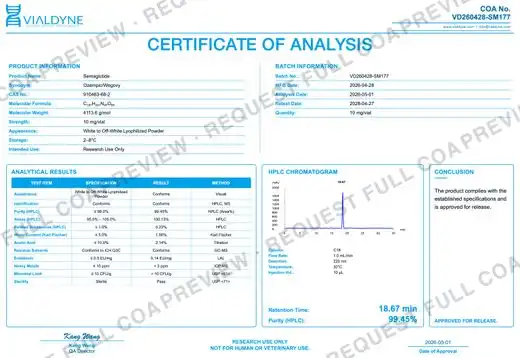
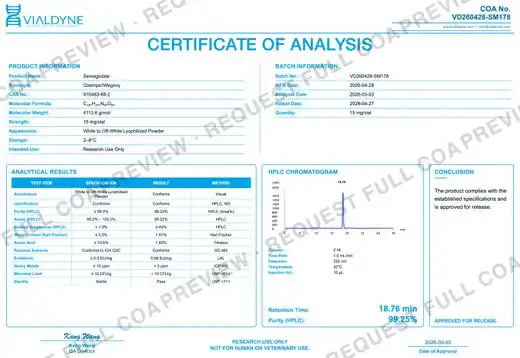
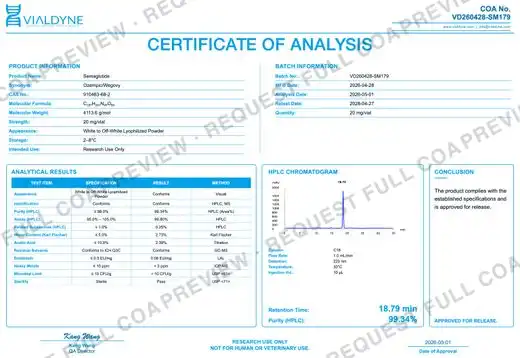
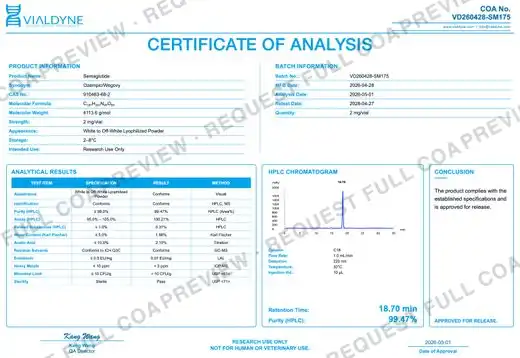
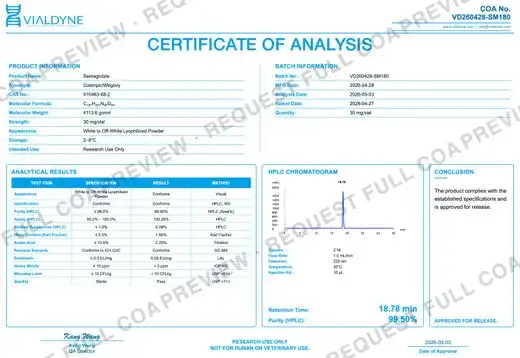
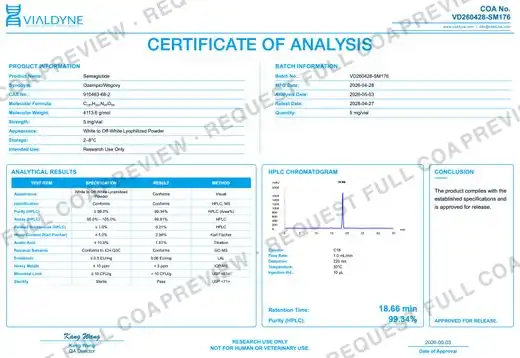
Semaglutide is the workhorse 31-amino-acid GLP-1 receptor agonist of the current era. Two engineered substitutions (Aib at position 8, Arg at position 34) plus a γGlu-2xOEG-linked C18 fatty-diacid on Lys26 give the molecule its DPP-4 resistance and reversible albumin binding, which together produce the once-weekly PK profile. The same API underpins three approved finished products: subcutaneous Ozempic for T2DM, subcutaneous Wegovy for chronic weight management, and oral Rybelsus paired with SNAC absorption enhancer, plus the corresponding EU equivalents. For compounding pharmacy buyers, every Vialdyne lot of Semaglutide acetate is released against a ≥99.0% HPLC main-peak specification. The standard batch packet includes RP-HPLC peak integration, ESI-MS within 0.5 Da of the 4113.58 g/mol average, Karl Fischer water, and counter-ion quantitation. For 503A and 503B sterile-compounding scope, LAL endotoxin per USP <85> and microbial limits per USP <61>/<62> are validated add-on tests on the same lot, no re-sampling, and the documentation supports both EU GMP Annex 1 aseptic-process expectations and US 503B outsourcing-facility QA files. Seven standard fill strengths from 2 to 50 mg map onto pilot, weekly dispensing, and small-batch outsourcing workflows. For practitioners building CagriSema-style fixed combinations, use the dedicated co-lyophilised CagriSema SKU rather than mixing two reconstituted vials, the amylin component is surface-active in dilute aqueous solution and the co-lyophilised cake preserves the released ratio.

Who buys this, and why

Most buyers in this category are 503A and 503B compounding pharmacies fulfilling metabolic and weight-management protocols, plus research labs investigating GLP-1 / GIP / GCG receptor pharmacology. The procurement decision usually hinges on three things: documented purity at scale, a regulatory team that can respond on destination-market questions in writing, and the ability to supply consistent counter-ion form (acetate by default) across recurring orders.

Primary buyer fit: 503A / 503B compounding pharmacies and academic and contract research laboratories.

Specifications

CAS
910463-68-2
Molecular Formula
C187H291N45O59
Molecular Weight
4113.58 g/mol
Appearance
White lyophilized powder
Purity (HPLC)
≥ 99.0%
Common vial sizes
2 mg, 5 mg, 10 mg, 15 mg, 20 mg, 30 mg, 50 mg
MOQ
On request
Lead time
7–14 days
Storage
-20°C, protect from light

Documentation available on request

  • Certificate of Analysis (COA)
  • HPLC Chromatogram
  • Mass-spec identity (ESI-MS)
  • Counter-ion / residual solvent
  • Bacterial endotoxin (LAL, USP <85>)
  • Microbial limits (USP <61>/<62>)
  • Stability data on request
  • 503A / 503B documentation support

Regulatory note

Finished Semaglutide drug products (Ozempic, Wegovy, Rybelsus) are FDA-approved; the bulk active itself is not on the 503A bulks list as of the current cycle. Compounding eligibility depends on the destination market's current shortage / regulatory posture, which buyers are responsible for verifying at the time of dispense.

Frequently asked questions

What's the actual chemistry of Semaglutide that drives its once-weekly profile?

Three engineered features carry the PK profile. Position 8 carries an Aib substitution (in place of Ala) that blocks the standard DPP-4 cleavage site. Position 34 carries Arg in place of Lys, which keeps off-target lipidation out of the synthesis step. And Lys26 carries the load-bearing modification: a C18 fatty-diacid attached through a γGlu-2xOEG spacer, which mediates reversible albumin binding and extends half-life from the minutes-scale of native GLP-1 to roughly seven days. Tirzepatide and Retatrutide were designed using the same general lipidation playbook, but with different fatty-acid chain lengths and slightly different linker geometries.

What's the difference between subcutaneous and oral Semaglutide formulations?

The API is identical across all three approved finished products; the formulation chemistry is what changes. The subcutaneous presentations (Ozempic, Wegovy) deposit Semaglutide directly into adipose tissue, where the albumin-binding kinetics give predictable absorption. The oral presentation (Rybelsus) co-formulates Semaglutide with SNAC (sodium N-(8-[2-hydroxybenzoyl]amino)caprylate), a permeation enhancer that locally raises gastric pH, briefly increases gastric epithelial permeability, and shields the peptide from proteolysis long enough for transcellular absorption. The bulk active released by Vialdyne is suitable for compounding into either route, subject to the receiving pharmacy's own stability work and any state-board route-specific compounding rules.

How should Semaglutide be reconstituted for compounding use?

For multi-dose vial workflows, reconstitute in bacteriostatic water for injection (BWFI); for single-use sterile prep, use sterile water for injection (SWFI). The cake will go into solution within about a minute with a gentle swirl; never vortex, the resulting foam entrains air and accelerates surface-mediated aggregation, which can show up as a slow potency loss that the standard release HPLC will not flag. Working solutions should be sub-divided immediately into single-use aliquots and held at -20 C. In compounding-pharmacy use, the freeze-thaw cycle count is the dominant operational driver of measured-potency loss, slow temperature drift is a much smaller contributor, so the practical rule is: thaw once, dispense, and refreeze the residual no more than twice.