Cagrilintide
Long-acting amylin analog
Overview
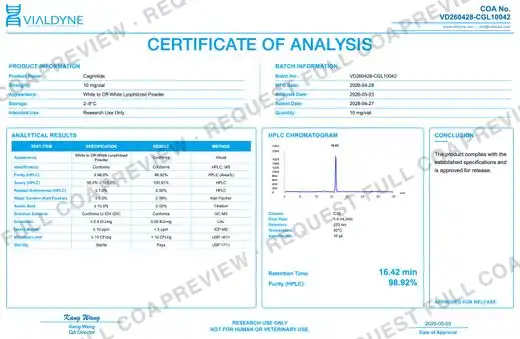
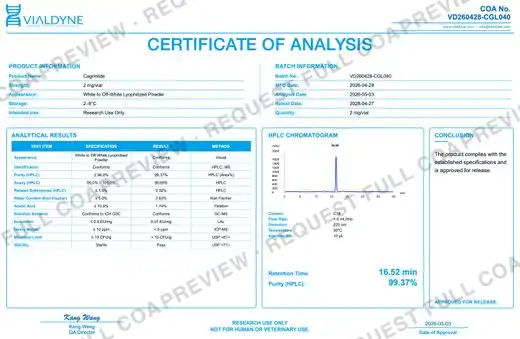
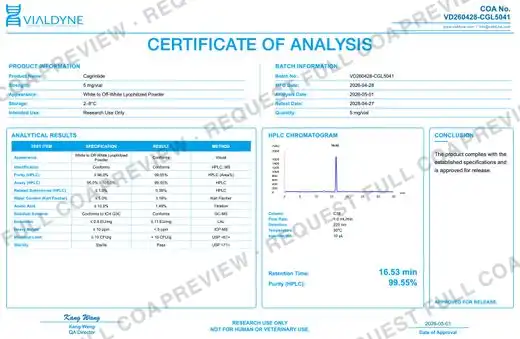
Cagrilintide (Novo Nordisk NN9838) is a 37-residue long-acting amylin analogue. The lipidation strategy mirrors the approach used on Semaglutide, an albumin-binding fatty-acid handle that pulls plasma half-life into a once-weekly dosing range, but the receptor pharmacology is entirely separate: this molecule engages the amylin receptor and the broader calcitonin-receptor family, both of which feed into satiety, gastric emptying, and energy balance through pathways anatomically distinct from GLP-1 signalling. The clinical centre of gravity for Cagrilintide is the CagriSema fixed combination with Semaglutide (Novo Nordisk's Phase 3 REDEFINE program), where the amylin-axis and GLP-1-axis effects layer rather than compete. For compounding pharmacy buyers, Vialdyne releases lyophilised Cagrilintide acetate against a ≥99.0% main-peak HPLC specification with a batch COA covering RP-HPLC, ESI-MS identity, Karl Fischer water, and counter-ion. Two procurement paths exist for CagriSema-style preparations: the standalone Cagrilintide vials, for pharmacies that prefer to control the blend ratio in their own cleanroom; or the pre-blended co-lyophilised CagriSema SKU, with the released ratio certified on the batch COA. The co-lyophilised path is the preferred default. Amylin-class peptides are known to be surface-active and to aggregate at solid-liquid interfaces when held in dilute aqueous solution, the co-lyophilised cake locks the ratio at the freeze-drying step and avoids the in-solution drift window that solution-phase mixing introduces.
Who buys this, and why
Most buyers in this category are 503A and 503B compounding pharmacies fulfilling metabolic and weight-management protocols, plus research labs investigating GLP-1 / GIP / GCG receptor pharmacology. The procurement decision usually hinges on three things: documented purity at scale, a regulatory team that can respond on destination-market questions in writing, and the ability to supply consistent counter-ion form (acetate by default) across recurring orders.
Primary buyer fit: academic and contract research laboratories and 503A / 503B compounding pharmacies.
Specifications
- CAS
- 1415456-99-3
- Purity (HPLC)
- ≥ 99.0%
- Common vial sizes
- 2 mg, 5 mg, 10 mg
- MOQ
- On request
- Lead time
- 10–18 days
- Storage
- -20°C, protect from light
Documentation available on request
- Certificate of Analysis (COA)
- HPLC Chromatogram
- Mass-spec identity (ESI-MS)
- Counter-ion / residual solvent
- Bacterial endotoxin (LAL, USP <85>)
- Microbial limits (USP <61>/<62>)
- Stability data on request
- 503A / 503B documentation support
Regulatory note
Investigational compound (Novo Nordisk NN9838); not approved as a finished drug at the time of writing. Sold as a bulk active for research and, in markets where regulations permit, for compounding-pharmacy use. The CagriSema combination is in Phase 3 development.
Frequently asked questions
Why is Cagrilintide almost always discussed in combination with Semaglutide?▾
Two separate signalling axes converge on the same clinical endpoint, but through different anatomy. Amylin acts at the area postrema and across the calcitonin-receptor family; GLP-1 acts at the arcuate-nucleus GLP-1R and peripheral targets. Because the inputs are parallel rather than redundant, layering the two produces additive effects on satiety, gastric-emptying rate, and weight reduction that neither monotherapy reaches at its own ceiling dose. The Phase 2 REDEFINE-2 readouts crystallised this, the dose-equivalent weight-reduction signal was materially larger than Semaglutide monotherapy and motivated the Phase 3 expansion.
Should I order Cagrilintide as a standalone or as a pre-blended CagriSema vial?▾
It depends on where the blending step needs to live. Compounding pharmacies and 503B outsourcing facilities preparing a defined CagriSema dosage form are best served by the pre-blended co-lyophilised CagriSema SKU, the released-batch COA certifies the actual ratio in the vial (within tight tolerance) rather than just the theoretical ratio, which simplifies the QA-file evidence for a finished-product release. Standalone Cagrilintide vials make sense when the pharmacy or sponsor needs to vary the ratio between batches under its own quality system, or when bench-scale receptor-pharmacology work calls for ratio titration.
What stability and handling considerations apply specifically to amylin-class peptides?▾
Amylin and its analogues are surface-active by nature, this is the same physical chemistry that drives native amylin to fibrillate in the pancreatic islet under disease conditions, and it carries over to the synthetic analogue. The lyophilised cake is stable across the standard 24-month re-test window at -20 C, but in-solution behaviour is the more sensitive part of the workflow. Reconstituted material should be used promptly, sub-divided into single-use aliquots immediately, and held in low-bind plasticware where possible; long-hold frozen working stocks should be avoided. Repeat freeze-thaw is the dominant cause of measured-potency loss, not slow temperature drift, so the operational rule is to minimise thaw cycles rather than to optimise freezer setpoint.
Related peptides