Tesamorelin
GHRH analog · approved for HIV-associated lipodystrophy
Overview
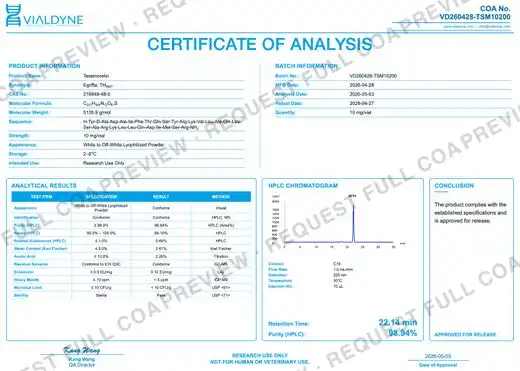
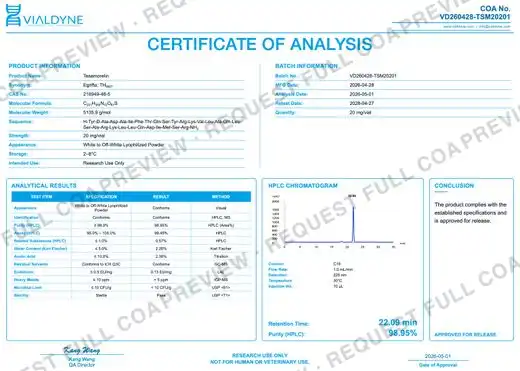
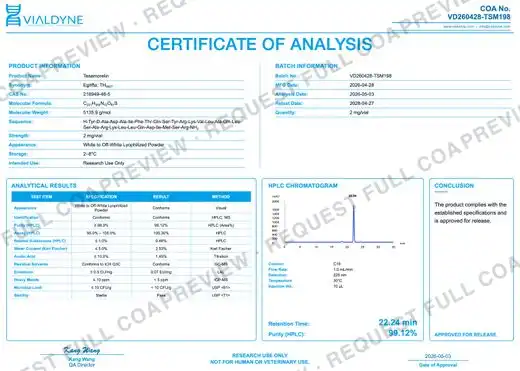
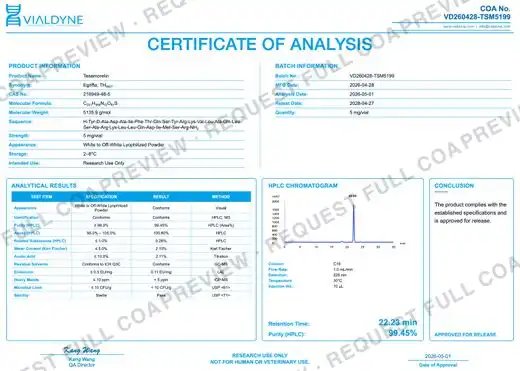
Tesamorelin is a 44-residue synthetic GHRH analogue carrying an N-terminal trans-3-hexenoyl modification that blocks DPP-4 cleavage and extends plasma half-life well beyond native GHRH or unmodified Sermorelin. It stands as the only FDA-approved member of the GHRH-analogue class, marketed as Egrifta for HIV-associated lipodystrophy, with the approved label specifically covering reduction of excess visceral abdominal adipose tissue in lipodystrophic HIV-positive patients. For compounding pharmacy buyers, Vialdyne releases Tesamorelin acetate as a lyophilised powder against a ≥99.0% main-peak HPLC specification. At 44 residues, the sequence sits at the upper-middle of routine SPPS, and the release packet centres on peak-integration RP-HPLC plus ESI-MS confirming the N-terminal hexenoyl-modified mass, which is the diagnostic identity check. LC-MS/MS sequence verification is the qualification add-on we recommend at first-time pharmacy onboarding, the positional integrity of the hexenoyl group is load-bearing for biological activity, and intact-mass spec alone cannot localise the modification with complete confidence. Most catalogue volume moves as the standalone Tesamorelin vial for visceral-fat compounding and research, or as the pre-blended co-lyophilised Tesamorelin-plus-Ipamorelin presentation under the tesa-ipa-blend SKU for dual-pathway GH-axis preparations.
Who buys this, and why
GH-axis peptides ship to two main buyer types: compounding pharmacies dispensing under physician supervision, and research labs studying somatotropic-axis pharmacology. Pharmacies typically want sterile-filled vials with the full release packet (sterility, endotoxin, CCI); labs typically want bulk lyophilized powder with sequence verification. Blends (the CJC-1295 / Ipamorelin combination is the canonical example) are usually co-lyophilized rather than solution-mixed for potency stability.
Primary buyer fit: 503A / 503B compounding pharmacies and academic and contract research laboratories.
Specifications
- CAS
- 218949-48-5
- Sequence
- YADAIFTNSYRKVLGQLSARKLLQDIMSR
- Appearance
- White lyophilized powder
- Purity (HPLC)
- ≥ 99.0%
- Common vial sizes
- 2 mg, 5 mg, 10 mg, 20 mg
- MOQ
- On request
- Lead time
- 10–18 days
- Storage
- -20°C, protect from light
Documentation available on request
- Certificate of Analysis (COA)
- HPLC Chromatogram
- Mass-spec identity (ESI-MS)
- Counter-ion (acetate vs TFA)
- Sterile-fill release pack (sterility, CCI, fill-weight)
- Bacterial endotoxin (LAL, USP <85>)
- Stability data on request
- SDS / MSDS
Regulatory note
The finished Tesamorelin drug (Egrifta) is FDA-approved for HIV-associated lipodystrophy. The bulk active itself is not on the 503A bulks list; compounding eligibility for off-label or other indications depends on the destination market's current shortage / regulatory posture.
Frequently asked questions
How is Tesamorelin different from the other GHRH analogues?▾
Regulatory status separates it cleanly. Tesamorelin is the only FDA-approved GHRH analogue currently marketed as a finished drug; Sermorelin held an approval (Geref) that has since been discontinued, and CJC-1295 (in both DAC and no-DAC forms) has no approval in any major market. Mechanistically, the N-terminal trans-3-hexenoyl modification gives Tesamorelin better protease resistance than unmodified Sermorelin and a half-life roughly comparable to CJC-1295 no-DAC, but at lower mass-equivalent dosing because the hexenoyl is a compact modification rather than the larger four-residue substitution panel used in CJC-1295. The visceral-fat-reduction clinical context (HIV-associated lipodystrophy) generated most of the rigorous PK and clinical-outcome data in the GHRH-analogue family.
What's the recommended analytical packet for first-time Tesamorelin qualification?▾
For first-time supplier qualification, the minimum scope is: (1) RP-HPLC chromatogram with peak integration showing ≥99.0% main-peak area, (2) ESI-MS confirming the modified mass at ~5135.8 Da, the +163 Da delta versus unmodified Sermorelin 1-29 (~3358 Da via a different SPPS chemistry actually 3358 Da) is the diagnostic signature of the hexenoyl modification, with the dominant species sitting at the modified mass, (3) LC-MS/MS sequence verification covering the N-terminal residues to confirm hexenoyl positional integrity, and (4) water content plus counter-ion quantitation. For any 503A or 503B compounding scope add LAL endotoxin per USP <85> and microbial limits per USP <61>/<62> on the same lot.
Can Tesamorelin be combined with Ipamorelin like CJC-1295 is?▾
Yes. The GHRH-receptor agonist plus GHSR agonist combination logic applies equally well with Tesamorelin in the GHRH seat. Vialdyne ships pre-blended co-lyophilised Tesamorelin + Ipamorelin vials directly under the tesa-ipa-blend SKU at the catalogue 10 + 5 mg total ratio, with non-standard ratios scoped under change-control. The mechanistic rationale mirrors CJC-1295 + Ipamorelin: two parallel input pathways converging on the same somatotroph cell population produce additive GH-release magnitudes beyond either component alone.
Related peptides
Buyers who view Tesamorelin also ask about:
29-mer
Sermorelin
≥99.0%GHRH 1-29 fragment
- CAS
- 86168-78-7
- Vial
- 2 mg–10 mg
CJC-1295 (no DAC)
≥99.0%Modified GRF 1-29 · GHRH analog
- CAS
- 863288-34-0
- Vial
- 2 mg–10 mg
Tesamorelin + Ipamorelin Blend (15 mg)
≥99.0%GH-axis blend (Tesamorelin + Ipamorelin), 15 mg total
- CAS
- —
- Vial
- 15 mg