Sermorelin
GHRH 1-29 fragment
Overview
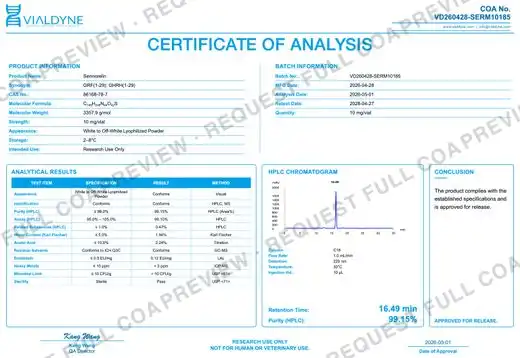
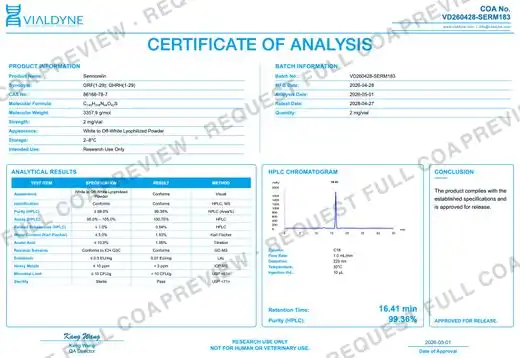
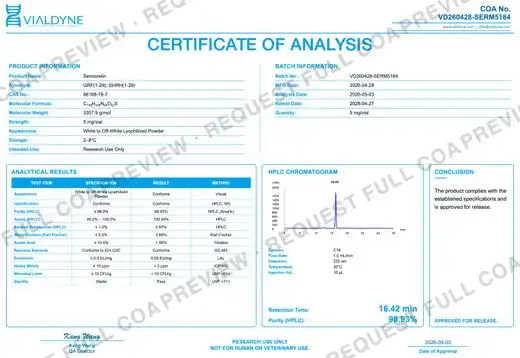
Sermorelin is the unmodified 29-residue N-terminal fragment of native human GHRH (residues 1-29). The fragment retains the full receptor-binding activity of the parent 44-residue molecule, which is why Sermorelin became the historical reference compound against which every engineered GHRH analogue (CJC-1295, Tesamorelin, Modified GRF 1-29) has subsequently been benchmarked. Serum half-life is limited to roughly 10-12 minutes by DPP-4 cleavage at the Tyr1-Ala2 bond, and that exact PK constraint is what drove the subsequent design work behind the CJC-1295 family's substitution chemistry. Sermorelin itself was previously approved as a prescription drug (Geref) for paediatric GH-deficiency diagnostic use. Vialdyne releases Sermorelin acetate as a lyophilised powder against a ≥99.0% main-peak HPLC specification. The 29-residue length sits well within reliable SPPS range, and the standard release packet covers RP-HPLC peak integration, ESI-MS identity, Karl Fischer water, and counter-ion quantitation. In compounding-pharmacy practice, Sermorelin fits two niches: pulsatile-pattern GH-axis preparations where the short half-life is the right tool (the rapid clearance preserves natural GH pulse architecture), and short-acting clinical compounding where sustained elevation is undesirable. For sustained-action profiles, the CJC-1295 with DAC SKU is the appropriate alternative.
Who buys this, and why
GH-axis peptides ship to two main buyer types: compounding pharmacies dispensing under physician supervision, and research labs studying somatotropic-axis pharmacology. Pharmacies typically want sterile-filled vials with the full release packet (sterility, endotoxin, CCI); labs typically want bulk lyophilized powder with sequence verification. Blends (the CJC-1295 / Ipamorelin combination is the canonical example) are usually co-lyophilized rather than solution-mixed for potency stability.
Primary buyer fit: academic and contract research laboratories and 503A / 503B compounding pharmacies.
Specifications
- CAS
- 86168-78-7
- Sequence
- YADAIFTNSYRKVLGQLSARKLLQDIMSR
- Purity (HPLC)
- ≥ 99.0%
- Common vial sizes
- 2 mg, 5 mg, 10 mg
- MOQ
- On request
- Lead time
- 7–14 days
- Storage
- -20°C, protect from light
Documentation available on request
- Certificate of Analysis (COA)
- HPLC Chromatogram
- Mass-spec identity (ESI-MS)
- Counter-ion (acetate vs TFA)
- Sterile-fill release pack (sterility, CCI, fill-weight)
- Bacterial endotoxin (LAL, USP <85>)
- Stability data on request
- SDS / MSDS
Regulatory note
Sold as a bulk active for research and for compounding-pharmacy formulation where local regulations permit (notably 503A / 503B in the United States and analogous regimes elsewhere). Not a finished dosage form. Sterile-filled vials are available with full release documentation; the buyer is responsible for verifying scheduling and dispense requirements in the destination market.
Frequently asked questions
How does Sermorelin compare to CJC-1295 and Tesamorelin?▾
All three engage the same GHRH receptor, but the PK engineering diverges. Sermorelin is the native GHRH(1-29) fragment with no protease-resistance modifications, so its roughly 10-minute serum half-life mirrors the native peptide. CJC-1295 (no DAC) adds four substitutions that block DPP-4 cleavage and stretch half-life to about 30 minutes while preserving the pulsatile signalling pattern. Tesamorelin adds an N-terminal trans-3-hexenoyl group that similarly slows protease attack and extends half-life, and is the only FDA-approved member of the family (Egrifta, for HIV-associated lipodystrophy). At the far end of the half-life spectrum is CJC-1295 with DAC, whose albumin conjugation pushes half-life to roughly a week.
Why is Sermorelin's short half-life sometimes the preferred property?▾
Because feedback architecture matters. GH-release feedback loops respond to pulse pattern, not just average exposure, so sustained-elevation models produce downstream biology that diverges from physiological pulse-pattern models. Sermorelin's rapid clearance is what makes it the cleanest tool for pulse-pharmacology work, dose-response within a single GH pulse, and acute receptor characterisation. For sustained-elevation contexts where dosing convenience or chronic exposure is the goal, the longer-acting CJC-1295 (no DAC) or CJC-1295 with DAC is the better fit.
Can Sermorelin be combined with a GHSR-pathway agonist like Ipamorelin?▾
Mechanistically yes. The GHRH-pathway plus GHSR-pathway dual-agonist logic that defines CJC-1295 + Ipamorelin applies identically to Sermorelin + Ipamorelin: combining a GHRH-receptor agonist with a GHSR agonist produces additive GH-release magnitudes beyond either component alone. The reason CJC-1295 + Ipamorelin dominates published compounding-pharmacy practice over Sermorelin + Ipamorelin is purely the PK match, CJC-1295's longer half-life overlaps Ipamorelin's envelope more cleanly than Sermorelin's does. For short-pulse research applications, however, the Sermorelin combination is mechanistically equivalent and is the appropriate tool.
Related peptides
Buyers who view Sermorelin also ask about:
CJC-1295 (no DAC)
≥99.0%Modified GRF 1-29 · GHRH analog
- CAS
- 863288-34-0
- Vial
- 2 mg–10 mg
Ipamorelin
≥99.0%Ghrelin / GHSR pathway GH-release peptide
- CAS
- 170851-70-4
- Vial
- 2 mg–10 mg
29-mer
Tesamorelin
≥99.0%GHRH analog · approved for HIV-associated lipodystrophy
- CAS
- 218949-48-5
- Vial
- 2 mg–20 mg