CJC-1295 (no DAC)
Modified GRF 1-29 · GHRH analog
Overview
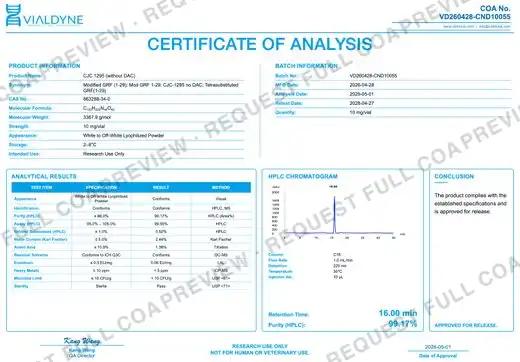
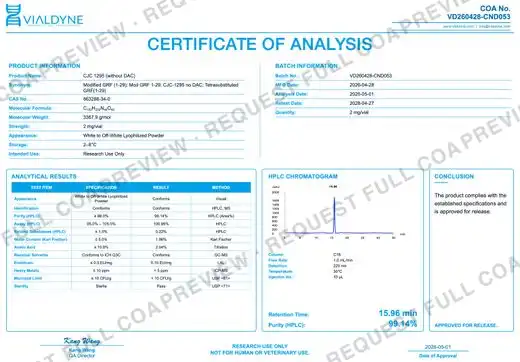
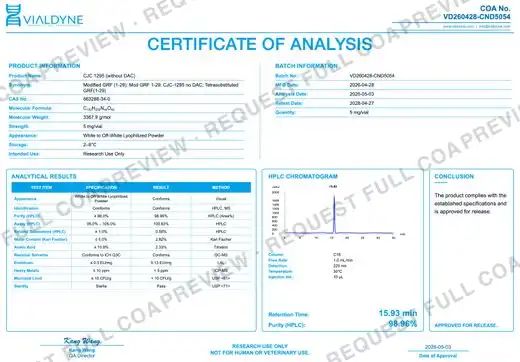
CJC-1295 without DAC, also catalogued as Modified GRF 1-29 or ModGRF 1-29, is a 29-residue GHRH analogue carrying four engineered substitutions (Tyr1 to D-Ala, Ala8 to Gln, Ala15 to Ala, Met27 to Leu) that block DPP-4 cleavage and slow serum protease degradation. Receptor pharmacology is GHRH-receptor-mediated, and the resulting GH-release pattern is pulsatile and closely resembles native physiological secretion, in contrast to the DAC variant, whose covalent albumin conjugation pushes plasma half-life into the once-weekly range and flattens the pulse architecture. For compounding pharmacy buyers, Vialdyne releases CJC-1295 no-DAC as the lyophilised acetate against a ≥99.0% main-peak HPLC specification. The no-DAC form is most commonly paired with a GHSR-axis agonist (Ipamorelin, occasionally GHRP-2 or GHRP-6) in dual-pathway compounding protocols; the canonical CJC-1295 + Ipamorelin pairing is supplied directly as a pre-blended co-lyophilised vial under the cjc-1295-ipamorelin SKU, which removes the in-cleanroom blending step and certifies the actual ratio on the released-batch COA. The companion [CJC-1295 + Ipamorelin pharmacology article](/insights/cjc-1295-ipamorelin-blend-pharmacology-guide) covers the dual-pathway rationale in detail. Catalogue strengths are 2, 5, and 10 mg; the 2 and 5 mg fills are the typical dispensing vials in 503A workflows.
Who buys this, and why
GH-axis peptides ship to two main buyer types: compounding pharmacies dispensing under physician supervision, and research labs studying somatotropic-axis pharmacology. Pharmacies typically want sterile-filled vials with the full release packet (sterility, endotoxin, CCI); labs typically want bulk lyophilized powder with sequence verification. Blends (the CJC-1295 / Ipamorelin combination is the canonical example) are usually co-lyophilized rather than solution-mixed for potency stability.
Primary buyer fit: academic and contract research laboratories and 503A / 503B compounding pharmacies.
Specifications
- CAS
- 863288-34-0 (DAC form has same CAS-class but distinct identifier, confirm via COA)
- Purity (HPLC)
- ≥ 99.0%
- Common vial sizes
- 2 mg, 5 mg, 10 mg
- MOQ
- On request
- Lead time
- 7–14 days
- Storage
- -20°C, protect from light
Documentation available on request
- Certificate of Analysis (COA)
- HPLC Chromatogram
- Mass-spec identity (ESI-MS)
- Counter-ion (acetate vs TFA)
- Sterile-fill release pack (sterility, CCI, fill-weight)
- Bacterial endotoxin (LAL, USP <85>)
- Stability data on request
- SDS / MSDS
Regulatory note
Sold as a bulk active for research and for compounding-pharmacy formulation where local regulations permit (notably 503A / 503B in the United States and analogous regimes elsewhere). Not a finished dosage form. Sterile-filled vials are available with full release documentation; the buyer is responsible for verifying scheduling and dispense requirements in the destination market.
Frequently asked questions
What's the difference between CJC-1295 with DAC and without DAC?▾
The backbone is the same Modified GRF 1-29 sequence in both, but the DAC version carries an additional maleimido-propionyl modification at Lys30. In serum, the maleimide forms a covalent bond with the free thiol of Cys34 on human serum albumin, producing a circulating peptide-albumin conjugate that extends half-life from roughly 30 minutes (no-DAC) to about 6-8 days (DAC). The pharmacology is therefore fundamentally different: no-DAC produces a pulsatile GH-release pattern that mirrors physiological secretion, while DAC produces sustained GH elevation that overrides the natural pulse architecture. Most 503A compounding workflows and pulse-pharmacology research use the no-DAC form; sustained-elevation contexts are where DAC fits.
Why is CJC-1295 almost always combined with Ipamorelin in practice?▾
Because two receptor pathways converge on the same somatotroph cells and produce additive output. CJC-1295 signals through the GHRH receptor; Ipamorelin signals through the GHSR (ghrelin receptor). Combining a GHRH-pathway agonist with a GHSR-pathway agonist produces a measurably larger GH pulse than either component alone at matched individual doses. The standard combined-product ratio is 1:1 by mass (2+2 mg or 5+5 mg per vial are the typical fills). Vialdyne ships this as a pre-blended co-lyophilised vial under the cjc-1295-ipamorelin SKU, which is operationally preferred over having the receiving pharmacy combine two reconstituted vials inside the cleanroom because the released-batch COA certifies the actual ratio in the cake rather than just the nominal target.
How is CJC-1295 typically reconstituted and stored after opening?▾
The lyophilised cake dissolves cleanly in bacteriostatic water for injection at standard reconstitution concentrations. Solution stability at -20 C as single-use aliquots is reasonable, but the dominant operational driver of measured-potency loss in this class is freeze-thaw cycling, not slow temperature drift, so the practical guidance is to sub-divide immediately after reconstitution into the smallest workable single-use volumes and cap the cumulative thaw count at three or fewer per aliquot. The lyophilised vial itself rolls under the standard 24-month re-test window at -20 C, and the released-batch COA carries the documented re-test date for pharmacies planning recurring procurement cycles.
Related peptides
Buyers who view CJC-1295 (no DAC) also ask about:
Ipamorelin
≥99.0%Ghrelin / GHSR pathway GH-release peptide
- CAS
- 170851-70-4
- Vial
- 2 mg–10 mg
CJC-1295 + Ipamorelin
≥99.0%GH-axis blend (CJC-1295 no DAC + Ipamorelin)
- CAS
- —
- Vial
- 10 mg
29-mer
Sermorelin
≥99.0%GHRH 1-29 fragment
- CAS
- 86168-78-7
- Vial
- 2 mg–10 mg
CJC-1295 with DAC
≥99.0%Long-acting GHRH analog with Drug Affinity Complex
- CAS
- 863288-34-0
- Vial
- 2 mg · 5 mg