FDA PCAC: 7 peptides under review. Read →

Vialdyne

CJC-1295 with DAC

Long-acting GHRH analog with Drug Affinity Complex

≥ 99.0%CAS 863288-34-0GH-Axis Peptides

Overview

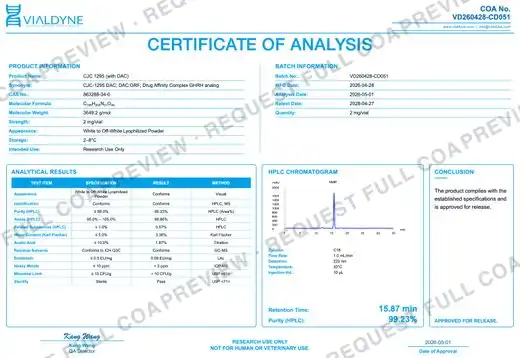
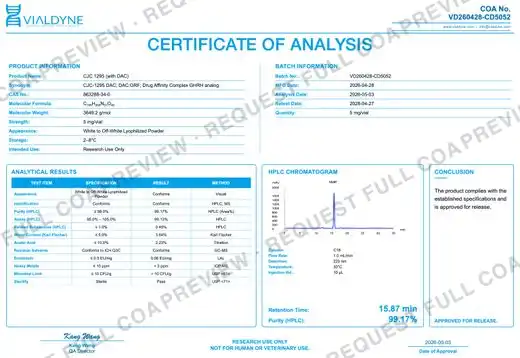
CJC-1295 with DAC is the long-acting member of the Modified GRF 1-29 family. The structural difference is a maleimido-propionyl group at Lys30 that reacts covalently with Cys34 of human serum albumin in vivo, the Drug Affinity Complex (DAC) mechanism that gives the SKU its name. The resulting peptide-albumin conjugate circulates with kinetics close to albumin itself, stretching plasma half-life from roughly 30 minutes (no-DAC) to about 6-8 days and supporting once-weekly dosing in both compounding and research contexts. Vialdyne releases CJC-1295 with DAC as the lyophilised acetate against a ≥99.0% main-peak HPLC specification. The DAC variant carries a more demanding analytical burden than the no-DAC form: the maleimido group has to remain intact at the labelled position to retain in vivo albumin-binding activity, and a partially hydrolysed maleimide passes the standard HPLC purity gate at near-identical retention time but is pharmacokinetically inactive. The standard release packet covers peak-integration RP-HPLC plus ESI-MS at the modified mass; an intact-maleimide reactivity assay using a reference thiol target (typically cysteine or N-acetyl-cysteine) is offered as a documented add-on and is the recommended qualification test both at first-time pharmacy onboarding and on any batch where stability comes into question. The DAC PK profile fits sustained-elevation GH preparations and weekly-dosing compounding workflows; for pulse-pharmacology contexts the no-DAC CJC-1295 SKU is the appropriate alternative.

Who buys this, and why

GH-axis peptides ship to two main buyer types: compounding pharmacies dispensing under physician supervision, and research labs studying somatotropic-axis pharmacology. Pharmacies typically want sterile-filled vials with the full release packet (sterility, endotoxin, CCI); labs typically want bulk lyophilized powder with sequence verification. Blends (the CJC-1295 / Ipamorelin combination is the canonical example) are usually co-lyophilized rather than solution-mixed for potency stability.

Primary buyer fit: academic and contract research laboratories and 503A / 503B compounding pharmacies.

Specifications

CAS
863288-34-0
Appearance
White lyophilized powder
Purity (HPLC)
≥ 99.0%
Common vial sizes
2 mg, 5 mg
MOQ
On request
Lead time
10–18 days
Storage
-20°C, protect from light

Documentation available on request

  • Certificate of Analysis (COA)
  • HPLC Chromatogram
  • Mass-spec identity (ESI-MS)
  • Counter-ion (acetate vs TFA)
  • Sterile-fill release pack (sterility, CCI, fill-weight)
  • Bacterial endotoxin (LAL, USP <85>)
  • Stability data on request
  • SDS / MSDS

Regulatory note

Sold as a bulk active for research and for compounding-pharmacy formulation where local regulations permit (notably 503A / 503B in the United States and analogous regimes elsewhere). Not a finished dosage form. Sterile-filled vials are available with full release documentation; the buyer is responsible for verifying scheduling and dispense requirements in the destination market.

Frequently asked questions

What does the 'DAC' modification actually do at a molecular level?

DAC stands for Drug Affinity Complex. The chemistry is a maleimido-propionyl group attached at Lys30 of the Modified GRF 1-29 backbone. Once in circulation, the maleimide reacts covalently with the free thiol of Cys34 on human serum albumin, producing a long-circulating peptide-albumin conjugate. Human serum albumin has a plasma half-life of roughly 19 days, so the conjugated peptide inherits similar circulation kinetics, dramatically extended from the ~30-minute half-life of the unmodified no-DAC form. The same in vivo bioconjugation strategy underwrites several approved peptide drugs in other therapeutic areas.

How should I choose between CJC-1295 with DAC and without DAC?

PK profile, not potency, is the selection axis. The no-DAC form delivers a ~30-minute half-life and a pulsatile GH-release pattern that preserves natural pulse architecture, typical dosing is every several hours. The DAC form delivers a ~6-8 day half-life and sustained GH elevation, which overrides the natural pulse pattern but supports once-weekly dosing. Research workflows that need pulse pharmacology or natural GH-release-pattern modelling require the no-DAC form, the DAC version eliminates the pulse signal entirely. Sustained-elevation research and any 503A compounding context where weekly dosing is the operational goal point to the DAC form.

Why is intact-maleimide confirmation an important analytical concern for the DAC form?

Because the DAC mechanism depends entirely on the maleimide remaining covalent-reactive. A hydrolysed maleimide, which can form during improper storage or handling, opens to the carboxylic acid and loses albumin-conjugation activity, but it sits at near-identical RP-HPLC retention time and a very similar mass, so the standard release HPLC and ESI-MS will not catch the difference. The diagnostic test is a reactivity assay against a reference thiol such as cysteine or N-acetyl-cysteine, which directly confirms the maleimide is still functional. This is the qualification test we recommend at first-time supplier onboarding and on any batch where the receiving pharmacy has stability questions.