FDA PCAC: 7 peptides under review. Read →

Vialdyne

CJC-1295 + Ipamorelin

GH-axis blend (CJC-1295 no DAC + Ipamorelin)

≥ 99.0% per componentCAS (blend)Custom Blends & OEM

Overview

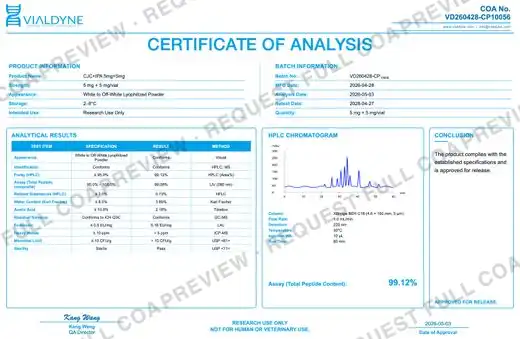
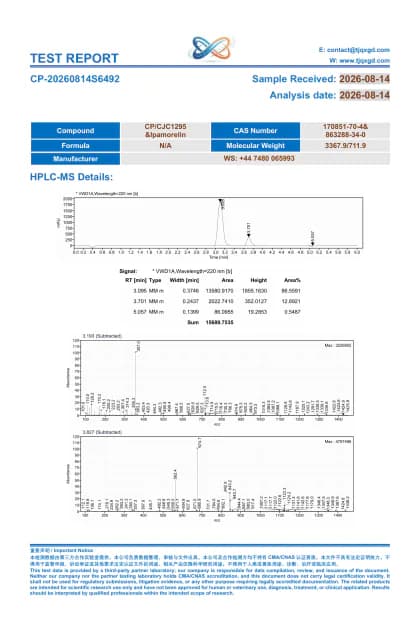
The CJC-1295 + Ipamorelin co-lyophilised vial is the workhorse GH-axis preparation in 503A compounding workflows, and the most-cited dual-pathway formulation in the published clinical-pharmacology literature. The mechanism rests on two parallel signalling inputs that converge on the same somatotroph cell population. CJC-1295 (no DAC, the Modified GRF 1-29 form) acts at the GHRH receptor, mimicking the hypothalamic GHRH input. Ipamorelin acts at the GHSR (ghrelin receptor), mimicking the alternative ghrelin-driven secretagogue input. Because the two downstream cascades reinforce rather than compete inside the somatotroph, the combination produces GH-release magnitudes well in excess of either component dosed alone at matched amounts, the synergy is the entire rationale for the blend. Vialdyne releases the blend as a co-lyophilised vial against a ≥99.0% main-peak HPLC specification per component. The catalogue ratio is 1:1 by mass (5 + 5 mg per 10 mg total vial); alternate ratios (2+5, 5+10, 10+10) and larger total fills are scoped under a project-specific change-control. The co-lyophilised path is preferred over having the receiving pharmacy reconstitute and combine two separate vials, both peptides are short-half-life, the in-solution ratio drifts during preparation, and the co-lyophilised cake locks the ratio at the freeze-drying step. The released-batch COA certifies both component purities individually and the in-vial ratio rather than just the nominal ratio.

Who buys this, and why

Custom-blend buyers are almost always OEM clients building a branded product around a specific ratio of two or more peptides. The development workflow is collaborative: ratio target, analytical method to verify it, stability protocol in the chosen carrier, and packaging selection are all defined in the OEM brief before the first commercial run. Sample-stage volumes are usually 5-10 g of finished blend; commercial MOQ depends on the components.

Primary buyer fit: 503A / 503B compounding pharmacies and medical aesthetic clinics and med spas.

Specifications

CAS
(blend)
Purity (HPLC)
≥ 99.0% per component
Common vial sizes
10 mg
MOQ
On request
Lead time
10–18 days
Storage
-20°C, protect from light

Documentation available on request

  • Certificate of Analysis (COA)
  • Ratio-verification HPLC
  • Mass-spec identity of each component
  • Stability of the blend (matrix-specific)
  • Bacterial endotoxin (LAL, USP <85>)
  • Sterile-fill documentation (where applicable)
  • SDS / MSDS
  • Private-label / OEM specification sheet

Regulatory note

Sold as a multi-peptide active for research and for OEM-formulated finished products under the receiving brand's regulatory framework. Blend composition, finished-product safety, labeling claims, and notification responsibilities remain with the brand owner. Component-level analytical data is supplied for every batch.

Frequently asked questions

Why is the CJC-1295 + Ipamorelin combination considered the canonical GH-axis blend?

Two receptors, one cell type, additive output. CJC-1295 (no DAC) engages the GHRH receptor on anterior-pituitary somatotrophs; Ipamorelin engages the GHSR (ghrelin) receptor on the same somatotroph population. Because the downstream signalling cascades reinforce rather than compete at the cell level, the acute GH pulse from the combination typically runs 4-5x larger than either component alone at matched individual doses. Our companion [CJC-1295 + Ipamorelin pharmacology article](/insights/cjc-1295-ipamorelin-blend-pharmacology-guide) walks through the full pharmacology rationale, ratio considerations, and the analytical-packet specifics that matter at first-time pharmacy qualification.

Can I substitute Sermorelin or Tesamorelin for CJC-1295 in this blend?

Mechanistically yes, the GHRH-receptor arm can be filled by any of the three GHRH-class agonists, and all three pair with Ipamorelin to deliver the same dual-pathway logic. The Tesamorelin + Ipamorelin co-lyophilised SKU (tesa-ipa-blend) ships at a 10 + 5 mg ratio reflecting the higher mass-equivalent dosing typically used for Tesamorelin in compounding protocols. Sermorelin + Ipamorelin is supportable but less commonly requested in commercial preparations because Sermorelin's shorter half-life maps less cleanly onto Ipamorelin's PK profile. The CJC-1295 (no DAC) + Ipamorelin pairing remains the most-requested combination because the half-life envelopes overlap most neatly.