FDA PCAC: 7 peptides under review. Read →

Vialdyne

Tesamorelin + Ipamorelin Blend (15 mg)

GH-axis blend (Tesamorelin + Ipamorelin), 15 mg total

≥ 99.0% (component-wise for blends)CAS (blend, components have individual CAS numbers)Custom Blends & OEM

Overview

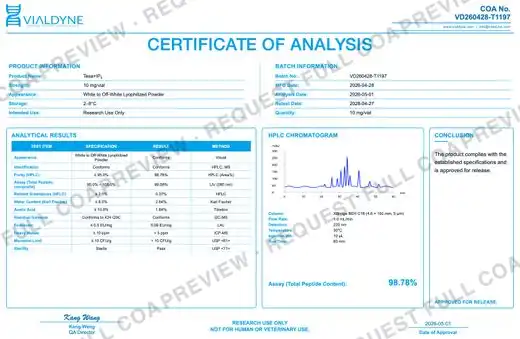
The Tesamorelin + Ipamorelin co-lyophilised vial applies the same dual-pathway GH-axis logic as the canonical CJC-1295 + Ipamorelin SKU, but substitutes Tesamorelin in the GHRH-receptor seat. Two practical consequences flow from the substitution. First, Tesamorelin is the only FDA-approved member of the GHRH-analogue class as a finished drug (Egrifta, for HIV-associated lipodystrophy), giving the bulk active a regulatory and clinical pedigree that CJC-1295 lacks. Second, Tesamorelin's half-life and pharmacokinetic envelope differ slightly from CJC-1295 no-DAC, which translates to somewhat different GH-release kinetics inside dual-pathway compounding protocols. The underlying mechanism, GHRH-receptor activation plus GHSR-receptor activation converging on the same somatotroph cells, is preserved. Vialdyne releases this blend as a co-lyophilised 15 mg total-mass vial against a ≥99.0% main-peak HPLC specification per component. The default split is 10 mg of the Tesamorelin component paired with 5 mg of the Ipamorelin component, reflecting the typical mass-equivalent imbalance that 503A compounding protocols use when Tesamorelin is the GHRH-receptor agonist in play. Non-standard ratios are scoped under a project-specific change-control. The released-batch COA certifies both component purities individually and the actual in-vial ratio rather than just the nominal target.

Who buys this, and why

Custom-blend buyers are almost always OEM clients building a branded product around a specific ratio of two or more peptides. The development workflow is collaborative: ratio target, analytical method to verify it, stability protocol in the chosen carrier, and packaging selection are all defined in the OEM brief before the first commercial run. Sample-stage volumes are usually 5-10 g of finished blend; commercial MOQ depends on the components.

Primary buyer fit: 503A / 503B compounding pharmacies and academic and contract research laboratories.

Specifications

CAS
(blend, components have individual CAS numbers)
Purity (HPLC)
≥ 99.0% (component-wise for blends)
Common vial sizes
15 mg
MOQ
On request
Lead time
14–21 days
Storage
-20°C, protect from light

Documentation available on request

  • Certificate of Analysis (COA)
  • Ratio-verification HPLC
  • Mass-spec identity of each component
  • Stability of the blend (matrix-specific)
  • Bacterial endotoxin (LAL, USP <85>)
  • Sterile-fill documentation (where applicable)
  • SDS / MSDS
  • Private-label / OEM specification sheet

Regulatory note

Sold as a multi-peptide active for research and for OEM-formulated finished products under the receiving brand's regulatory framework. Blend composition, finished-product safety, labeling claims, and notification responsibilities remain with the brand owner. Component-level analytical data is supplied for every batch.

Frequently asked questions

Why does the Tesa+Ipa blend use a 10+5 mg ratio instead of 1:1 like CJC-1295+Ipamorelin?

Receptor-binding affinity per mg differs between the two GHRH-receptor agonists, and the published compounding-pharmacy dosing reflects that asymmetry, Tesamorelin is typically dosed at higher mass-equivalent levels than CJC-1295 to reach comparable receptor engagement. The 10 + 5 mg co-lyophilised ratio matches the mass-equivalent split most commonly used in Tesamorelin-based dual-pathway protocols. Non-standard ratios can be scoped under a project-specific change-control if a clinical or research protocol calls for a different split; the catalogue 10+5 is the conservative default aligned with the bulk of the published combination dosing in this family.

Is the Tesa+Ipa blend appropriate for 503A compounding workflows?

Compounding eligibility has to be evaluated against the destination market's posture for each component individually, and then for the combination. Tesamorelin (Egrifta) is the only FDA-approved GHRH-analogue, giving the bulk active a regulatory pedigree the other components lack. Ipamorelin, at the time of writing, is not on the 503A bulks list. The receiving pharmacy is responsible for confirming the dispense path against current state-board requirements and any active shortage-list or interim-policy posture at the moment of dispense. For the broader 503A vs 503B framing, see the [compounding pathway guide](/insights/503a-vs-503b-compounding-pharmacy-peptides).