What the label states, the lot delivers — net peptide mass, not gross powder weight, purity reported as measured rather than rounded up, and a Certificate of Analysis for every lot.
Net peptide mass, not powder weight; purity as measured, not rounded up; a COA per lot.
Net peptide + purity not rounded up. COA per lot.
FDA PCAC reviews 7 peptides for the 503A bulks list (BPC-157, KPV, TB-500, MOTs-C, Emideltide, Semax, Epitalon). Read our compounder's decision tree. Read our briefing →
FDA PCAC reviews 7 peptides for the 503A bulks list in July. Read →
FDA PCAC: 7 peptides under review. Read →

GLP-1 / glucagon dual receptor agonist (IBI362 / LY3305677)
Vialdyne buyer fit
This Vialdyne page is intentionally positioned for compounding-pharmacy, clinic, and regulated procurement teams evaluating Mazdutide. It is not the broad research monograph for this SKU; the page emphasizes buyer qualification, release testing, documentation depth, and whether the active fits the destination-market workflow before pricing.
Overview
Mazdutide, carrying development codes IBI362 (Innovent) and LY3305677 (Eli Lilly), is an investigational dual co-agonist hitting both the GLP-1 receptor and the glucagon receptor. Receptor scope is what marks it inside the multi-agonist landscape: it sits between the GIP/GLP-1 dual agonist Tirzepatide and the GIP/GLP-1/glucagon tri-agonist Retatrutide, engaging the GLP-1 and glucagon arms only, with no GIP component. This positioning makes the molecule the right tool when research needs to isolate the glucagon-pathway contribution from the GIP contribution inside the dual / tri-agonist family. Development is led by Innovent Biologics in China under license from Eli Lilly, currently in the Phase 3 DREAMS program for chronic weight management and T2DM; Chinese NMPA approval is on a faster track than Western markets. For research and pre-clinical buyers, Vialdyne releases Mazdutide acetate as a lyophilised powder against a ≥99.0% main-peak HPLC specification. The batch COA covers RP-HPLC peak integration, ESI-MS identity, Karl Fischer water, and counter-ion quantitation. LC-MS/MS sequence verification is offered as a documented add-on and is the recommended test at first-time pharmacy qualification: the close structural similarity within the dual-agonist class means cross-supplier identity confusion is an operationally real risk if mass-spec is the only identity gate. The 10 mg standard fill fits bench-scale aliquot work; larger fills for extended programs are scoped under change-control.
Applications & buyer fit
Most buyers in this category are 503A and 503B compounding pharmacies fulfilling metabolic and weight-management protocols, plus research labs investigating GLP-1 / GIP / GCG receptor pharmacology. The procurement decision usually hinges on three things: documented purity at scale, a regulatory team that can respond on destination-market questions in writing, and the ability to supply consistent counter-ion form (acetate by default) across recurring orders.
Sourced for
Buyer fit
Documentation that ships
Procurement note: Supplied as a documented active in acetate counter-ion form by default; the buyer verifies current scheduling and compounding eligibility for the destination market.
Primary buyer fit: academic and contract research laboratories.
Specifications
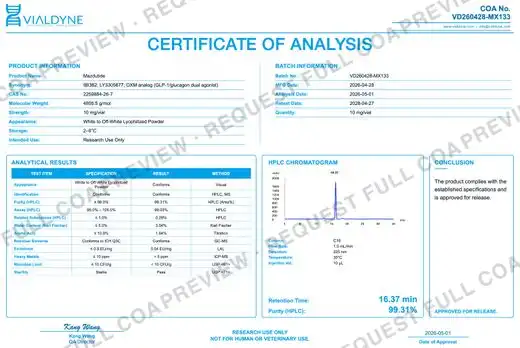
Certificate of Analysis
Published released-batch COAs for Mazdutide, every lot HPLC-verified. These are previews — request the full high-resolution certificate for any lot.
Browse all published COAsRegulatory note
Not yet approved as a finished drug at the time of writing, this is an investigational compound in Phase 3 development under Innovent / Eli Lilly. It is supplied for research use only. Any commonly cited CAS should be confirmed against the batch COA.
Selected literature
Frequently asked questions
For EU and US buyers the molecule is still investigational, so there is no finished-drug approval or compendial monograph to anchor a specification, and a pharmacy must write and defend its own identity-and-purity acceptance criteria against each batch certificate. Confirm the specific molecule sourced against the released-lot COA before benchmarking any work to a clinical data set, because the GLP-1/glucagon receptor pair it targets is shared by other co-agonists that differ in sequence and lipidation. File the development-partner and regulatory-status context alongside the certificate to support the research-use determination your jurisdiction requires.
Store the sealed lyophilised vial at -20 C, dry, until use, with the re-test date documented on the released-batch certificate. Reconstitute in bacteriostatic water at a working concentration, sub-divide into single-use aliquots immediately, and keep cumulative freeze-thaws at three or fewer, since thaw count drives measured-potency loss more than gradual temperature drift. For identity, request ESI-MS at the expected modified-peptide mass plus RP-HPLC main-peak integration and sequence confirmation. Because sibling co-agonists share the same receptor coverage, per-batch mass and sequence verification is what prevents an inadvertent substitution in an analytical or research workflow.
Related peptides
GLP-1 / glucagon dual receptor agonist (BI 456906)
GIP / GLP-1 / glucagon tri-agonist
GIP / GLP-1 dual receptor agonist