What the label states, the lot delivers — net peptide mass, not gross powder weight, purity reported as measured rather than rounded up, and a Certificate of Analysis for every lot.
Net peptide mass, not powder weight; purity as measured, not rounded up; a COA per lot.
Net peptide + purity not rounded up. COA per lot.
FDA PCAC reviews 7 peptides for the 503A bulks list (BPC-157, KPV, TB-500, MOTs-C, Emideltide, Semax, Epitalon). Read our compounder's decision tree. Read our briefing →
FDA PCAC reviews 7 peptides for the 503A bulks list in July. Read →
FDA PCAC: 7 peptides under review. Read →

GLP-1 / glucagon dual receptor agonist (BI 456906)
Vialdyne buyer fit
This Vialdyne page is intentionally positioned for compounding-pharmacy, clinic, and regulated procurement teams evaluating Survodutide. It is not the broad research monograph for this SKU; the page emphasizes buyer qualification, release testing, documentation depth, and whether the active fits the destination-market workflow before pricing.
Overview
Survodutide, carrying the development code BI 456906, is an investigational dual co-agonist hitting the GLP-1 and glucagon receptors. The clinical-development program runs through a Boehringer Ingelheim / Zealand Pharma partnership and is in Phase 3 for both chronic weight management and metabolic-liver indications, MASH (metabolic-associated steatohepatitis) chief among them. Receptor coverage maps to GLP-1R plus GCGR with no GIP arm, mirroring Mazdutide and contrasting with the GIP-containing dual / tri-agonist class. That positioning makes the molecule useful in two distinct ways: as a research tool for studying glucagon-pathway pharmacology isolated from GIP signalling, and as a clinical asset for indications where glucagon-mediated hepatic energy expenditure delivers therapeutic value. For research-lab buyers, Vialdyne releases Survodutide acetate as a lyophilised powder against a ≥99.0% main-peak HPLC specification. The catalogue 10 mg fill covers bench-scale aliquot work in the typical research context. The release packet leans particularly hard on ESI-MS identity confirmation, the structural proximity to other GLP-1 / glucagon dual co-agonists means catalogue-level cross-supplier confusion is an operationally real failure mode, and LC-MS/MS sequence verification is the recommended add-on for any first-time procurement to lock in positive identity before the lot enters the QA file.
Applications & buyer fit
Most buyers in this category are 503A and 503B compounding pharmacies fulfilling metabolic and weight-management protocols, plus research labs investigating GLP-1 / GIP / GCG receptor pharmacology. The procurement decision usually hinges on three things: documented purity at scale, a regulatory team that can respond on destination-market questions in writing, and the ability to supply consistent counter-ion form (acetate by default) across recurring orders.
Sourced for
Buyer fit
Documentation that ships
Procurement note: Supplied as a documented active in acetate counter-ion form by default; the buyer verifies current scheduling and compounding eligibility for the destination market.
Primary buyer fit: academic and contract research laboratories.
Specifications
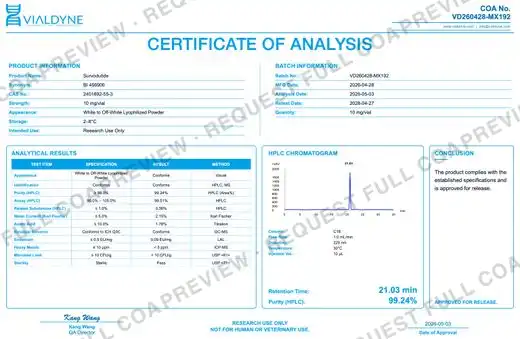
Certificate of Analysis
Published released-batch COAs for Survodutide, every lot HPLC-verified. These are previews — request the full high-resolution certificate for any lot.
Browse all published COAsRegulatory note
An investigational compound advancing through Phase 3 development at Boehringer Ingelheim / Zealand Pharma, this has not been approved as a finished drug. Supply is for research use only. Although a CAS is commonly cited, verify it per batch COA.
Selected literature
Frequently asked questions
Keep the sealed lyophilised vial frozen at -20 C, protected from moisture, until the working session, with the re-test date carried on the released-batch certificate. As a lipidated dual co-agonist it should not be reconstituted until point of use; once in solution, split into single-use aliquots at once and treat freeze-thaw cycle count as the dominant driver of measured-potency loss, holding cumulative thaws to three or fewer per aliquot. Log any transit temperature excursion in the receiving record, since that is the trigger for an out-of-schedule potency check before the lot is cleared for use.
Because it and its nearest sibling occupy the identical GLP-1R plus GCGR receptor space yet differ in sequence and lipidation chemistry, receptor-coverage description alone cannot distinguish the two at receiving inspection. Anchor identity on ESI-MS at the expected lipidated-peptide mass together with RP-HPLC main-peak integration, and add sequence confirmation by peptide-mapping to verify the specific backbone. Match those results, and the counter-ion and water-content figures, to the released-lot certificate before benchmarking any model against a clinical data reference. That per-batch verification, not the development-partner label, is what protects against an inadvertent swap.
Related peptides