FDA PCAC: 7 peptides under review. Read →

Vialdyne

HGH (Somatropin · Human Growth Hormone)

Recombinant human growth hormone · heavily regulated biological

≥ 99.0%CAS 12629-01-5Custom Blends & OEM

Overview

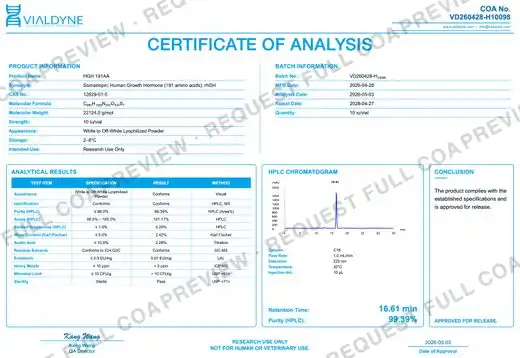
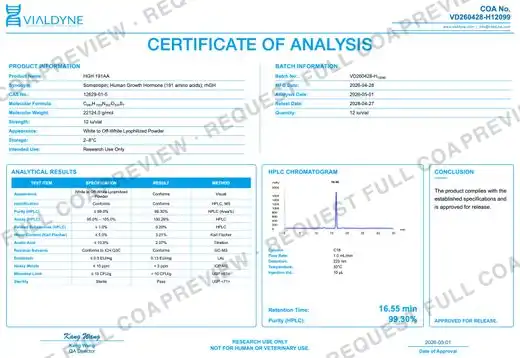
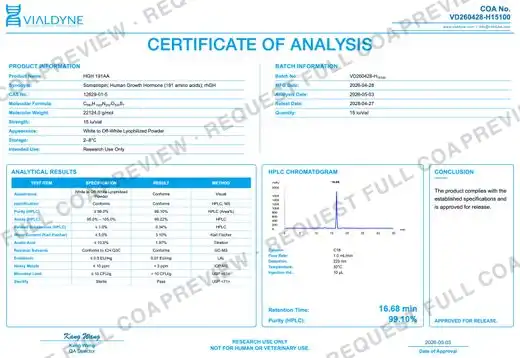
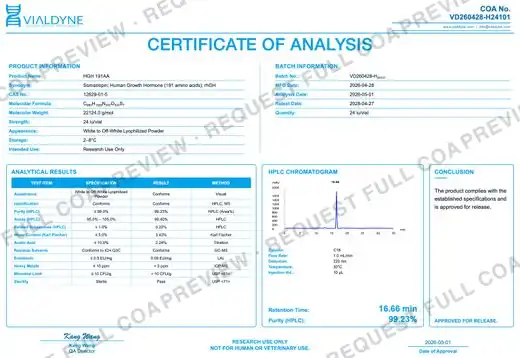
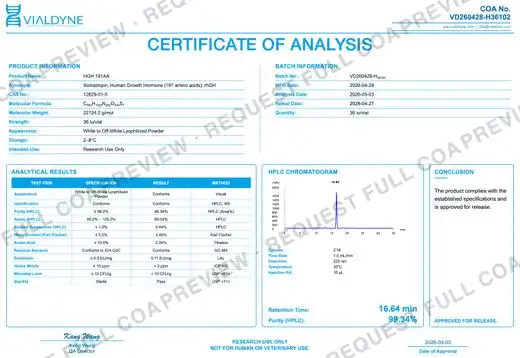
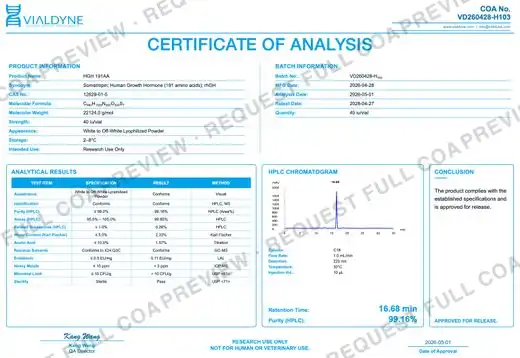
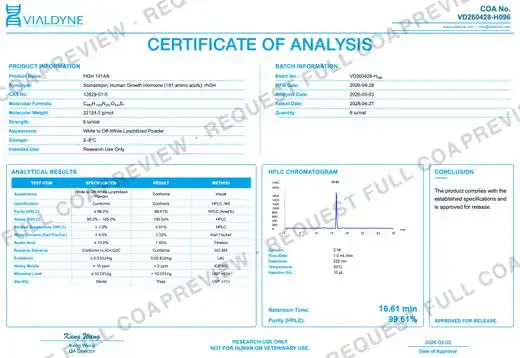
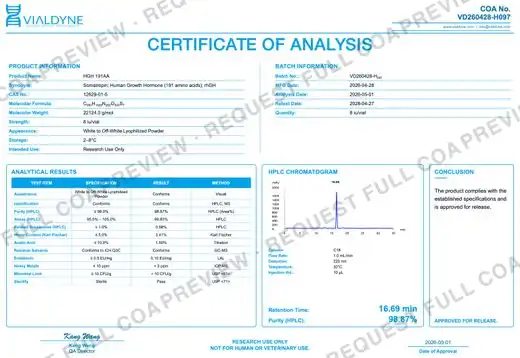
Human Growth Hormone (Somatropin) is a recombinant 191-residue protein-hormone biological. The production route runs through either an E. coli or a mammalian-cell expression system, depending on the manufacturer. The 22 kDa protein carries the same primary sequence as native pituitary-derived human growth hormone, and recombinant material has fully displaced the older cadaver-derived product in approved therapeutic use since the late 1980s, when the cadaver-derived form was pulled from market after documented Creutzfeldt-Jakob disease transmission. HGH is regulated as a prescription drug across essentially every major jurisdiction. Approved branded finished products include Genotropin and Humatrope; Norditropin and Saizen; Omnitrope plus a growing biosimilar slate. As a class, HGH ranks among the most tightly controlled peptide biologicals in the global trade. Vialdyne distributes recombinant HGH (Somatropin) as a lyophilised vial against a ≥99.0% main-peak HPLC specification, with release restricted to qualified pharmacy and distributor accounts that hold the appropriate import-and-dispensing licensing in the receiving jurisdiction. Every order requires upfront compliance review, prescriber documentation where applicable, and import authorisation prior to acceptance. Because HGH is a biological product rather than a chemical entity, the analytical packet diverges materially from synthetic-peptide release work. Tests bundled into the release scope: chemical purity by RP-HPLC, size verification by SDS-PAGE, sequence confirmation through tryptic peptide-mapping coupled to LC-MS, functional folding verified through cell-proliferation or receptor-binding bioassay, and full release testing covering LAL endotoxin, bioburden, and host-cell-protein impurities. Eight nominal strengths from 6 to 40 IU cover the clinical and research dispensing landscape. Our companion [peptide COA field guide for buyers](/insights/reading-a-peptide-coa-buyers-field-guide) covers the analytical-packet differences between biological products and synthetic peptides in more depth.

Who buys this, and why

Custom-blend buyers are almost always OEM clients building a branded product around a specific ratio of two or more peptides. The development workflow is collaborative: ratio target, analytical method to verify it, stability protocol in the chosen carrier, and packaging selection are all defined in the OEM brief before the first commercial run. Sample-stage volumes are usually 5-10 g of finished blend; commercial MOQ depends on the components.

Primary buyer fit: regional distributors and re-sellers.

Specifications

CAS
12629-01-5
Purity (HPLC)
≥ 99.0%
Common vial sizes
6 IU, 8 IU, 10 IU, 12 IU, 15 IU, 24 IU, 36 IU, 40 IU
MOQ
On request
Lead time
21–45 days
Storage
Refrigerated 2–8°C, protect from light

Documentation available on request

  • Certificate of Analysis (COA)
  • Ratio-verification HPLC
  • Mass-spec identity of each component
  • Stability of the blend (matrix-specific)
  • Bacterial endotoxin (LAL, USP <85>)
  • Sterile-fill documentation (where applicable)
  • SDS / MSDS
  • Private-label / OEM specification sheet

Regulatory note

Highly regulated recombinant protein hormone. Sold only to qualified buyers with appropriate licensing in their jurisdiction. Order requires full compliance review, prescriber documentation, and import authorization prior to acceptance.

Frequently asked questions

Why is HGH analyzed differently from synthetic peptides?

Because the manufacturing process is fundamentally different. Synthetic peptides come off a solid-phase peptide synthesizer with a defined chemistry that RP-HPLC and mass spec characterise well. HGH comes out of recombinant expression in living cells (E. coli or mammalian) and is therefore a biological product, with all the additional failure modes that biological products carry: correct chemistry but wrong folding, glycosylation variants, deamidation isoforms, host-cell-protein impurities, none of which a synthetic-peptide release packet is designed to catch. The HGH release packet therefore adds SDS-PAGE for size confirmation, peptide-mapping for sequence verification, bioactivity assay for functional folding, LAL endotoxin for the E. coli expression system, and host-cell-protein ELISA. Treating HGH like a synthetic peptide at the QC level misses exactly the analytical methods that matter most for biological-product safety and efficacy.

What's the difference between CAS 12629-01-5 and CAS 9002-72-6 for growth hormone?

Manufacturing source. CAS 12629-01-5 designates recombinant somatropin, the modern process material with a defined 191-residue sequence matching native human GH. CAS 9002-72-6 designates pituitary-derived growth hormone, the historical material isolated from cadaver pituitaries. The two share the same primary amino-acid sequence, but the source distinction is safety-critical: the cadaver-derived material was withdrawn from the market in the 1980s following documented transmission of Creutzfeldt-Jakob disease to recipients. Modern HGH supply is exclusively recombinant. The 9002-72-6 reference still appears in some older literature, but should never appear on a current-product COA, if it does, the lot should be quarantined pending source confirmation.