FDA PCAC: 7 peptides under review. Read →

Vialdyne

CagriSema

Cagrilintide + Semaglutide combination

≥ 99.0% (component-wise for blends)CAS (blend, components have individual CAS numbers)Custom Blends & OEM

Overview

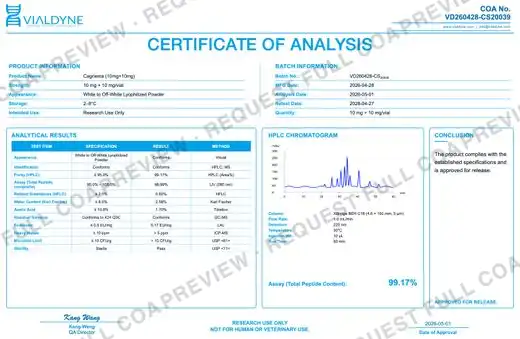
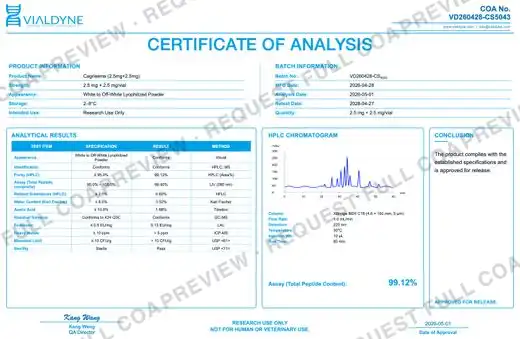
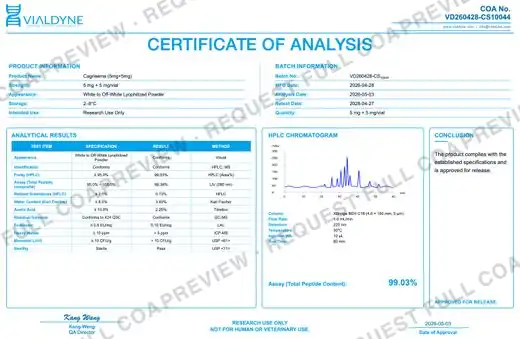
CagriSema is the fixed-combination presentation pairing the long-acting amylin analogue Cagrilintide with the GLP-1 receptor agonist Semaglutide, sitting in Phase 3 development inside Novo Nordisk's REDEFINE program for chronic weight management. It represents the next generation of GLP-1-anchored weight pharmacology: layering an amylin-axis mechanism (acting on the area postrema and across the calcitonin-receptor family) over the established GLP-1 receptor mechanism. Because the two signalling pathways are anatomically separate and pharmacologically distinct, the combined dose produces additive weight-reduction effects beyond what maximal-dose Semaglutide monotherapy delivers in dose-equivalent comparisons. The catalogue default ratio is 1:1 by mass of Cagrilintide to Semaglutide; non-standard ratios are available for research workflows characterising ratio-dependent biology. For compounding pharmacy buyers, Vialdyne releases CagriSema as a pre-blended co-lyophilised vial against a ≥99.0% main-peak HPLC specification per component. The batch is released against a documented in-vial ratio rather than total mass alone. Co-lyophilisation is the right method here, not solution-phase mixing inside the cleanroom: amylin-class peptides have a well-documented surface-aggregation sensitivity in dilute aqueous solution, and the co-lyophilised cake locks the ratio at the freeze-drying step before that aggregation window opens. The released-batch COA certifies both component purities individually plus the actual ratio inside the vial (typically within ±5% of nominal). Three fill strengths, 5, 10, and 20 mg total, cover bench-scale and compounding-pharmacy dispensing workflows.

Who buys this, and why

Custom-blend buyers are almost always OEM clients building a branded product around a specific ratio of two or more peptides. The development workflow is collaborative: ratio target, analytical method to verify it, stability protocol in the chosen carrier, and packaging selection are all defined in the OEM brief before the first commercial run. Sample-stage volumes are usually 5-10 g of finished blend; commercial MOQ depends on the components.

Primary buyer fit: 503A / 503B compounding pharmacies and academic and contract research laboratories.

Specifications

CAS
(blend, components have individual CAS numbers)
Purity (HPLC)
≥ 99.0% (component-wise for blends)
Common vial sizes
5 mg, 10 mg, 20 mg
MOQ
On request
Lead time
14–21 days
Storage
-20°C, protect from light

Documentation available on request

  • Certificate of Analysis (COA)
  • Ratio-verification HPLC
  • Mass-spec identity of each component
  • Stability of the blend (matrix-specific)
  • Bacterial endotoxin (LAL, USP <85>)
  • Sterile-fill documentation (where applicable)
  • SDS / MSDS
  • Private-label / OEM specification sheet

Regulatory note

Investigational combination product (Novo Nordisk REDEFINE program); not approved as a finished drug at the time of writing. Component-level analytical data and verified ratio supplied for every batch.

Frequently asked questions

Why is CagriSema co-lyophilized rather than mixed in solution?

Amylin-class peptides, Cagrilintide included, have a documented sensitivity to surface-mediated aggregation when held in dilute aqueous solution, the same physical chemistry that drives native amylin to form fibrils in the pancreatic islet under disease conditions. Co-lyophilising Cagrilintide with Semaglutide produces a stable solid-state cake where the ratio is locked in at the freeze-drying step and surface-aggregation effects don't manifest until reconstitution at point of use. Solution-phase mixing of separately-purchased vials is operationally possible but produces variable ratios and progressive amylin-component degradation over time. The pre-blended product also collapses the documentation chain: a single COA certifies both component purities and the verified in-vial ratio, simplifying the receiving pharmacy's QA file.

What's the mechanistic basis for combining Cagrilintide with Semaglutide?

Two distinct signalling axes converge on the same clinical endpoint. Cagrilintide binds at the amylin / calcitonin-receptor family in the area postrema, where it contributes to satiety signalling and gastric-emptying delay. Semaglutide binds at the GLP-1 receptor across the arcuate nucleus and peripheral tissue beds, where it contributes appetite suppression and insulinotropic effects. Because the two signalling cascades reinforce rather than compete, layering them produces additive weight-reduction effects beyond what either monotherapy reaches at its own ceiling dose. The clinical-program rationale, validated in the Phase 2 REDEFINE-2 readouts, is that the combination delivers larger weight-reduction signals than maximal-dose Semaglutide monotherapy.