What the label states, the lot delivers — net peptide mass, not gross powder weight, purity reported as measured rather than rounded up, and a Certificate of Analysis for every lot.
Net peptide mass, not powder weight; purity as measured, not rounded up; a COA per lot.
Net peptide + purity not rounded up. COA per lot.
FDA PCAC reviews 7 peptides for the 503A bulks list (BPC-157, KPV, TB-500, MOTs-C, Emideltide, Semax, Epitalon). Read our compounder's decision tree. Read our briefing →
FDA PCAC reviews 7 peptides for the 503A bulks list in July. Read →
FDA PCAC: 7 peptides under review. Read →

Co-lyophilised BPC-157 + TB-500 repair blend
Overview
The Wolverine Blend is the most-requested co-lyophilised repair presentation in the catalogue: BPC-157 and TB-500 combined in a single vial so the released ratio is fixed rather than left to the receiving pharmacy to reconstitute and mix. The two peptides are combined precisely because their mechanisms are complementary, BPC-157 acts through nitric-oxide-pathway modulation and growth-factor-receptor cross-talk, while TB-500 works through actin sequestration and cell-migration effects, which is why the pair recurs across tendon-ligament, soft-tissue, and GI-mucosal repair research protocols. Vialdyne releases the blend as a co-lyophilised cake against a ≥99.0% main-peak HPLC specification per component. The standard fill is 5 + 5 mg in a 10 mg vial and 10 + 10 mg in a 20 mg vial; non-standard ratios (10+5, 5+10) are scoped under a project-specific change-control. The released-batch COA certifies each component's purity individually and the actual in-vial ratio rather than the nominal target, so the document matches exactly what is in the cake. For the mechanism-and-analytics contrast between the two actives, see the [BPC-157 vs TB-500 comparison](/insights/bpc-157-vs-tb-500-side-by-side).
Applications & buyer fit
Custom-blend buyers are almost always OEM clients building a branded product around a specific ratio of two or more peptides. The development workflow is collaborative: ratio target, analytical method to verify it, stability protocol in the chosen carrier, and packaging selection are all defined in the OEM brief before the first commercial run. Sample-stage volumes are usually 5-10 g of finished blend; commercial MOQ depends on the components.
Sourced for
Buyer fit
Documentation that ships
Procurement note: Ratio target, the analytical method to verify it, stability protocol, and packaging are defined in the OEM brief before the first commercial run.
Primary buyer fit: 503A / 503B compounding pharmacies and academic and contract research laboratories.
Specifications
Certificate of Analysis
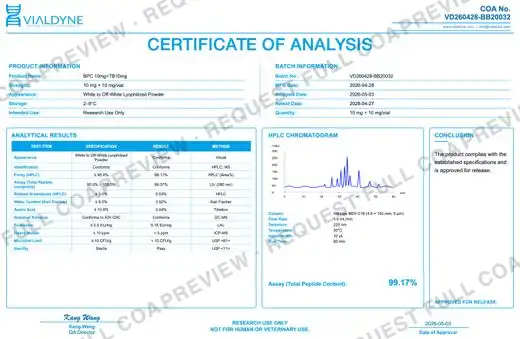
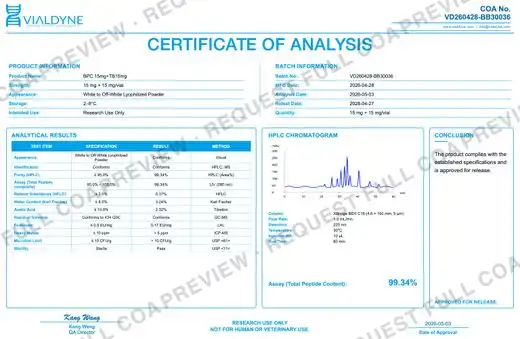
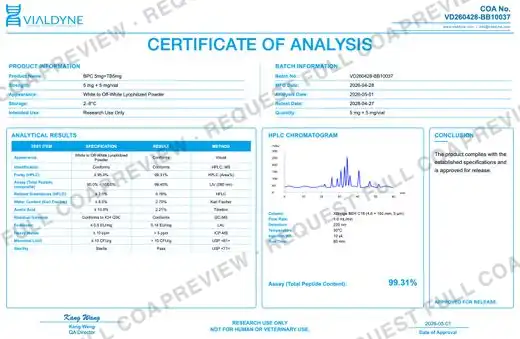
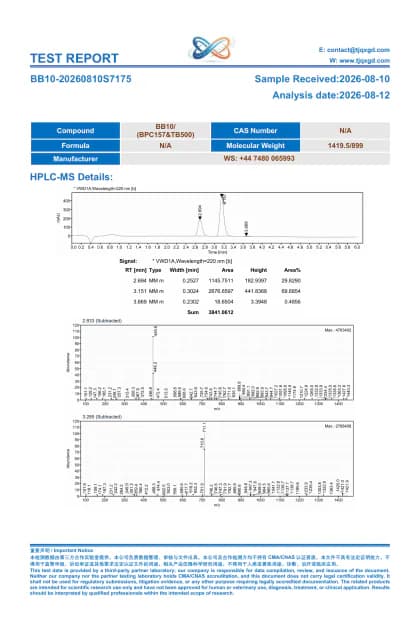
Published released-batch COAs for Wolverine Blend (BPC-157 + TB-500), every lot HPLC-verified. These are previews — request the full high-resolution certificate for any lot.
VerifiedRequest full COA →Wolverine Blend (BPC-157 + TB-500)
VD260428-BB20032 · 99.17%
VerifiedRequest full COA →Wolverine Blend (BPC-157 + TB-500)
VD260428-BB30036 · 99.34%
VerifiedRequest full COA →Wolverine Blend (BPC-157 + TB-500)
VD260428-BB10037 · 99.31%
Regulatory note
Research-use-only reference material; component peptides BPC-157 and TB-500 are both scheduled for FDA PCAC review against the 503A bulks-list criteria at the July 2026 meeting. Not for human or veterinary use; verify compounding eligibility against the destination market's posture for each component.
Frequently asked questions
The catalogue default is a 1:1 mass ratio, 5 + 5 mg in a 10 mg total vial, or 10 + 10 mg in a 20 mg total vial. Co-lyophilising the two peptides into one cake preserves that ratio and avoids the surface-activity and mixing-error problems of reconstituting two separate vials. Non-standard ratios (10+5, 5+10) can be scoped under a project-specific change-control. The released-batch COA certifies the actual in-vial ratio rather than just the nominal target.
Mechanistically the two are not interchangeable, BPC-157 modulates nitric-oxide and growth-factor-receptor pathways, while TB-500 sequesters actin to influence cell migration and tissue remodelling. The complementary mechanisms are why the pair is combined so frequently in repair-focused research protocols. The co-lyophilised SKU presents both in a single vial with one COA certifying both component purities and the ratio, which reduces the document-handling burden on the receiving QA file versus sourcing and combining two separate vials.
Related peptides
15-mer
Body Protection Compound 15-mer
43-mer
Thymosin β4 fragment
Skin-radiance multi-peptide research blend