FDA PCAC: 7 peptides under review. Read →

Vialdyne

BPC-157

Body Protection Compound 15-mer

≥ 99.0%CAS 137525-51-0Repair Peptides

Overview

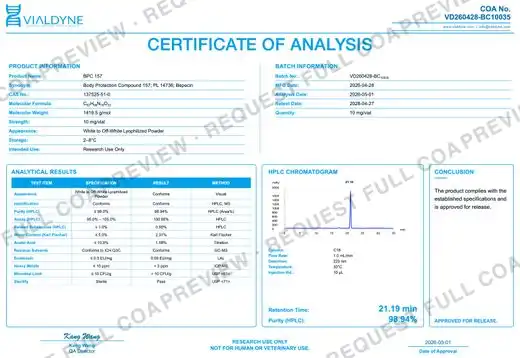
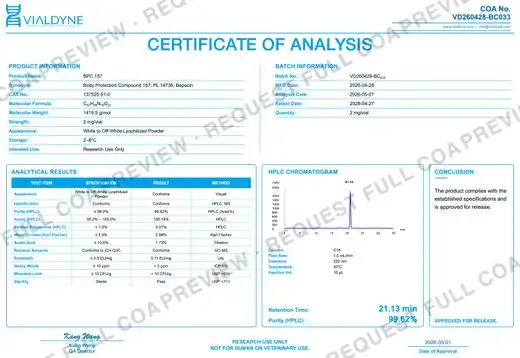
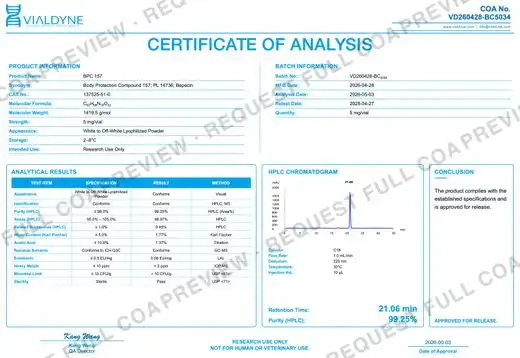
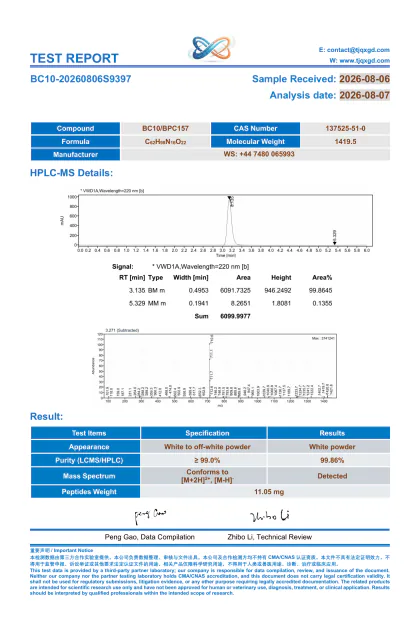
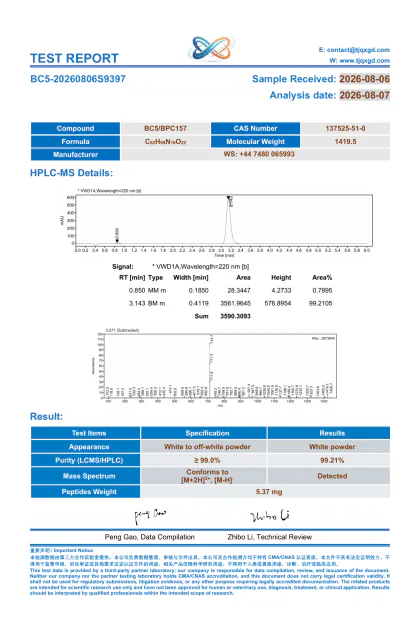
BPC-157 (Body Protection Compound 15-mer) is a 15-amino-acid sequence, GEPPPGKPADDAGLV, derived from a protective fragment originally isolated from human gastric juice. The unusually high proline content of the N-terminal half (four prolines in the first eight residues) kinks the backbone in a way that resists protease access, giving the molecule notable stability in gastric and serum environments and underwriting its use across tendon-ligament, GI mucosal, vascular endothelial, and bone-repair research models. For 503A patient-specific compounders watching the regulatory pipeline: BPC-157 is currently scheduled for FDA PCAC review at the July 2026 meeting against the 503A bulks-list criteria. The procurement and regulatory framing is broken out in two companion articles: our overview of the [503A vs 503B compounding pathways](/insights/503a-vs-503b-compounding-pharmacy-peptides), plus the dedicated [BPC-157 procurement playbook for pharmacies](/insights/bpc-157-sourcing-guide-compounding-pharmacies). Vialdyne releases BPC-157 acetate as a lyophilised powder against a ≥99.0% main-peak HPLC specification. The 15-residue sequence is reliably accessible by SPPS, but the closely-eluting truncation by-products require disciplined purification, so every batch ships with peak-integration RP-HPLC plus ESI-MS confirming the molecular weight inside 0.5 Da of the 1419.55 g/mol theoretical. LC-MS/MS sequence verification with a full b- and y-ion ladder is the recommended qualification add-on for any first-time pharmacy onboarding, ESI-MS alone confirms mass identity, but tandem MS directly proves the synthesised sequence matches the labelled sequence. BPC-157 also feeds the co-lyophilised Wolverine Blend (with TB-500) and the GLOW Blend (with TB-500 and GHK-Cu). For a direct mechanism-and-analytical comparison with TB-500, see the [BPC-157 vs TB-500 article](/insights/bpc-157-vs-tb-500-side-by-side).

Who buys this, and why

Repair peptides, BPC-157, TB-500, and related sequences, typically ship to research labs studying tissue-repair, gastrointestinal, or tendon-ligament models, and to compounding pharmacies that have validated the bulk active into their workflow. The synthesis itself is reliable, but analytical confirmation is where suppliers differ, buyers qualifying a new source should request sequence verification by tandem MS on the first batch and compare against the labelled sequence directly.

Primary buyer fit: 503A / 503B compounding pharmacies and academic and contract research laboratories.

Specifications

CAS
137525-51-0
Molecular Formula
C62H98N16O22
Molecular Weight
1419.55 g/mol
Sequence
GEPPPGKPADDAGLV
Appearance
White lyophilized powder
Purity (HPLC)
≥ 99.0%
Common vial sizes
2 mg, 5 mg, 10 mg
MOQ
On request
Lead time
7–14 days
Storage
-20°C, protect from light

Documentation available on request

  • Certificate of Analysis (COA)
  • HPLC Chromatogram
  • Mass-spec identity (ESI-MS)
  • Sequence verification (LC-MS/MS)
  • Water content (Karl Fischer)
  • Counter-ion analysis
  • SDS / MSDS
  • Stability data on request

Regulatory note

Currently under FDA PCAC review (July 2026) for inclusion on the 503A bulks list. Supplied for research and commercial use in compliance with the buyer's local regulations.

Frequently asked questions

What is the sequence of BPC-157, and why is it so stable?

Sequence is GEPPPGKPADDAGLV across 15 residues. The first eight residues alone contain four prolines (PPPGKP segment), and the resulting backbone geometry leaves few cleavage-accessible peptide bonds. The molecule therefore tolerates gastric and serum protease environments far better than typical short peptides, which is the same property that underwrites the published research on oral-route protocols. By contrast, TB-500 is restricted to injectable routes because its longer, more flexible backbone does not survive gastric exposure.

Is BPC-157 approved by the FDA, and what's the regulatory trajectory?

There is no approved finished drug containing BPC-157 in any major jurisdiction at the time of writing. The active is currently scheduled for FDA Pharmacy Compounding Advisory Committee (PCAC) review at the July 2026 meeting, with the proposed indication of ulcerative colitis, under consideration for inclusion on the 503A bulks list. If PCAC's recommendation is accepted by the FDA, 503A pharmacies would gain a clear path to patient-specific compounding using BPC-157. Until that happens, sales are restricted to bulk-active use in jurisdictions where local rules permit and to compounding under the receiving pharmacy's own regulatory analysis.

What's the difference between BPC-157 free base and BPC-157 acetate, and which does Vialdyne ship?

Acetate is the default salt released against the catalogue spec and is the form most pharmacies want, the chromatographic behaviour and reconstitution kinetics are well characterised. Free-base BPC-157 is occasionally requested where a downstream formulator needs to control the final counter-ion themselves. Per-mass biological activity is equivalent across the two; the practical differences are in RP-HPLC retention time (acetate elutes slightly earlier under typical gradient conditions) and in handling pH. Flag salt-form preference at the quote stage so the lot is reserved correctly.

Can BPC-157 be co-formulated with TB-500 in a single vial?

Yes, this is the Wolverine Blend SKU, one of the most-requested co-lyophilised presentations in the catalogue. Co-lyophilisation is operationally preferred over having the receiving pharmacy reconstitute and combine two separate vials, the released-batch COA certifies the actual ratio in the cake rather than the nominal ratio. Standard fill is 5 + 5 mg in a 10 mg total vial; non-standard ratios (10+5, 10+10, 5+10) can be scoped under a project-specific change-control. Adding GHK-Cu to the blend produces the GLOW Blend SKU, intended for compounding workflows that combine tissue-repair and integumentary endpoints in a single dispense.