What the label states, the lot delivers — net peptide mass, not gross powder weight, purity reported as measured rather than rounded up, and a Certificate of Analysis for every lot.
Net peptide mass, not powder weight; purity as measured, not rounded up; a COA per lot.
Net peptide + purity not rounded up. COA per lot.
FDA PCAC reviews 7 peptides for the 503A bulks list (BPC-157, KPV, TB-500, MOTs-C, Emideltide, Semax, Epitalon). Read our compounder's decision tree. Read our briefing →
FDA PCAC reviews 7 peptides for the 503A bulks list in July. Read →
FDA PCAC: 7 peptides under review. Read →

Thymic immune-modulation peptide(s)
Overview
Thymalin is a polypeptide complex extracted from calf (young bovine) thymus, developed by V.G. Morozov and V.Kh. Khavinson in Leningrad/St. Petersburg during the 1970s (Military Medical Academy / Institute of Bioregulation and Gerontology), and registered as a pharmaceutical drug in the USSR/Russia since 1982 (manufactured by Samson-Med). Thymalin is a heterogeneous mixture of short peptides ranging from 2-8 amino acids, with an overall molecular weight range of roughly 1,000-10,000 Da — it is not a single defined compound. Identified active fragments include the EW dipeptide (Glu-Trp, marketed separately as Thymogen), the KE dipeptide (Lys-Glu, marketed as Vilon), and the EDP tripeptide (Glu-Asp-Pro, marketed as Crystagen). As a thymic bioregulator, it accelerates T-lymphocyte maturation, restores the B/T lymphocyte ratio, and modulates pro-inflammatory cytokines. In Russia it is used clinically for immunodeficiency, immune recovery after chemo/radiotherapy, bronchial asthma, and disorders of tissue repair. Nearly all clinical evidence originates from the Khavinson research group, and no independent Western replication studies have been published. Vialdyne releases Thymalin as a lyophilized two distinct identities under one sku: thymalin is a heterogeneous peptide/protein extract mixture (no single molecular type applies); thymulin (fts) is a defined nonapeptide (linear, zinc-binding-dependent activity) against a ≥ 99.0% HPLC main-peak specification, with a batch-specific Certificate of Analysis covering RP-HPLC purity, mass-spec identity, water content, residual solvents, and endotoxin. Sequence / identity confirmation is documented on the released lot.
Applications & buyer fit
Buyers in this category are research labs studying immune-modulation, cytokine signaling, and antimicrobial activity. The defining QC requirement is bacterial-endotoxin control: many of the downstream assays (NF-κB reporters, macrophage activation panels, neutrophil-priming readouts) are themselves activated by endotoxin contamination, so a clean LAL on the specific batch is a precondition rather than a nice-to-have. LL-37 and related cationic antimicrobial peptides additionally benefit from low-bind plasticware during dilution.
Sourced for
Buyer fit
Documentation that ships
Procurement note: A clean LAL result on the specific lot is the defining requirement, since many downstream assays are themselves activated by endotoxin.
Primary buyer fit: academic and contract research laboratories.
Specifications
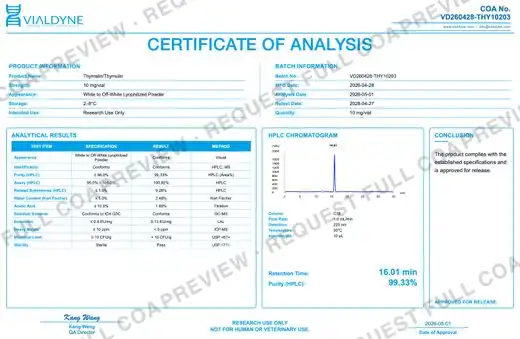
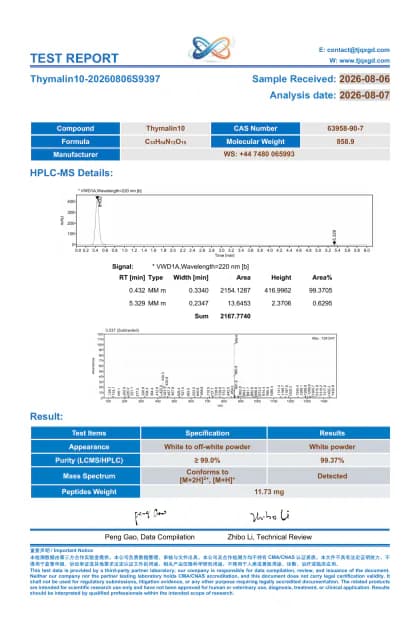
Certificate of Analysis
Published released-batch COAs for Thymalin, every lot HPLC-verified. These are previews — request the full high-resolution certificate for any lot.
Browse all published COAsRegulatory note
Research-use-only reference material; not for human or veterinary use.
Selected literature
Frequently asked questions
Because these are chemically different classes, incoming acceptance cannot use one template. Thymulin is a defined zinc-binding nonapeptide, so its acceptance criteria are single-molecule ones: identity by mass spectrometry, chromatographic purity against an area-percent limit, and water content. Thymalin is a bovine-thymus extract with no single-molecule identity, so acceptance rests on a compositional fingerprint matched to a reference profile plus microbial and endotoxin limits. A qualification file should therefore carry two distinct incoming-inspection procedures and reject the shortcut of applying peptide-purity limits to the extract, which has no meaningful single-peak purity value.
The synthetic nonapeptide is made by routine solid-phase synthesis and travels with a standard single-molecule release packet. The extract is animal-sourced, so its documentation should additionally address the bovine origin: country and species of the source tissue, veterinary and transmissible-encephalopathy compliance statements, and the batch fingerprint against the reference composition. Buyers qualifying a supplier should confirm the released certificate explicitly names which of the two materials the batch represents, since the labels are easily conflated, and should plan for the extract's longer procurement timeline driven by its animal-source supply chain rather than assuming parity with the synthetic peptide.