KPV
Lys-Pro-Val α-MSH C-terminal tripeptide
Overview
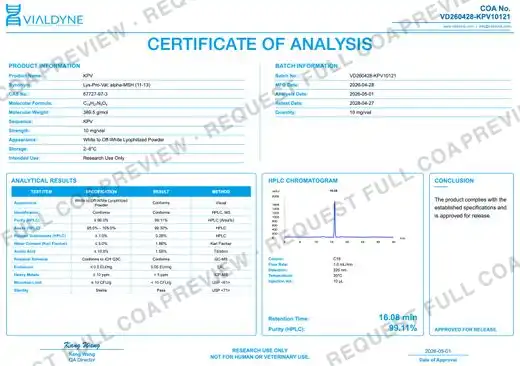
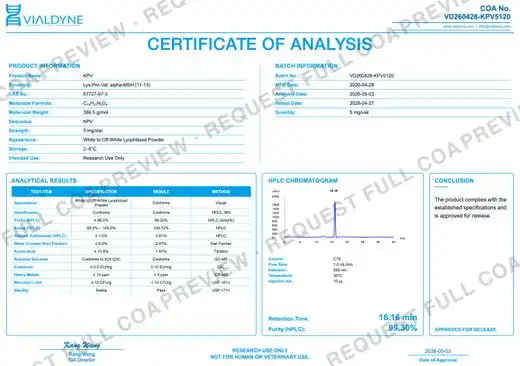
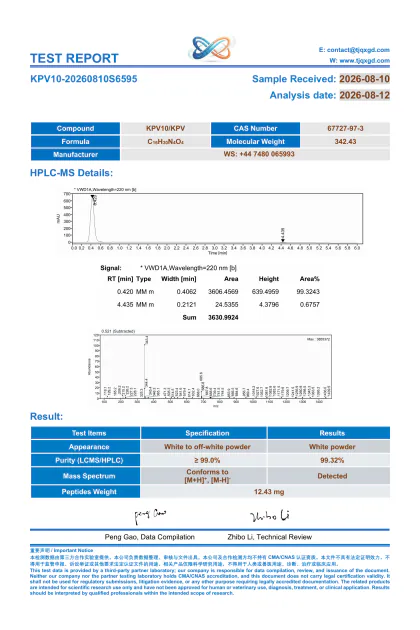
KPV is just three residues, Lys-Pro-Val, the C-terminal tripeptide of alpha-melanocyte-stimulating hormone (alpha-MSH). By stripping the parent down to its C-terminus, the molecule preserves a meaningful share of the anti-inflammatory activity while shedding the melanocortin-receptor-driven pigmentation pathway, the dissection that has made KPV the canonical minimal anti-inflammatory unit derived from melanocortin biology. The published research portfolio spans inflammatory bowel disease models, dermal wound-healing and inflammation endpoints, and oral-route delivery; short length plus a central proline residue together yield a degree of gastric stability that most peptide therapeutics simply do not have. For 503A pharmacies tracking the regulatory pipeline: KPV sits on the FDA PCAC July 2026 review schedule for evaluation against 503A bulks-list criteria, proposed indications wound healing and inflammatory conditions. For compounding pharmacy buyers, Vialdyne releases KPV as a lyophilised powder against a ≥99.0% main-peak HPLC specification. SPPS access to the three-residue sequence is trivially straightforward, so the standard release packet centres on peak-integration RP-HPLC plus ESI-MS identity. There is one important add-on consideration: any compounding or research preparation feeding into an inflammation-pathway readout (NF-kB reporters, cytokine panels, macrophage-activation assays) should require LAL endotoxin per USP <85> on the specific released lot, because the assay readout is itself endotoxin-sensitive and ambiguity in the EU/mg value will contaminate downstream interpretation. Catalogue strengths are 5 mg and 10 mg; larger fills are scoped under change-control for extended dispensing programs.
Who buys this, and why
Buyers in this category are research labs studying immune-modulation, cytokine signaling, and antimicrobial activity. The defining QC requirement is bacterial-endotoxin control: many of the downstream assays (NF-κB reporters, macrophage activation panels, neutrophil-priming readouts) are themselves activated by endotoxin contamination, so a clean LAL on the specific batch is a precondition rather than a nice-to-have. LL-37 and related cationic antimicrobial peptides additionally benefit from low-bind plasticware during dilution.
Primary buyer fit: 503A / 503B compounding pharmacies and academic and contract research laboratories.
Specifications
- CAS
- 67727-97-3
- Sequence
- KPV
- Purity (HPLC)
- ≥ 99.0%
- Common vial sizes
- 5 mg, 10 mg
- MOQ
- On request
- Lead time
- 7–14 days
- Storage
- -20°C, protect from light
Documentation available on request
- Certificate of Analysis (COA)
- HPLC Chromatogram
- Mass-spec identity (ESI-MS)
- Bacterial endotoxin (LAL, USP <85>)
- Microbial limits (USP <61>/<62>)
- Bioburden screening
- Sequence verification (LC-MS/MS)
- SDS / MSDS
Regulatory note
Currently under FDA PCAC review (July 2026) for inclusion on the 503A bulks list with the proposed indications of wound healing and inflammatory conditions.
Frequently asked questions
Why is KPV studied as a minimal anti-inflammatory unit of alpha-MSH?▾
Native alpha-MSH is a 13-residue peptide structured around two functional regions. The N-terminal melanocortin-receptor-binding sequence drives pigmentation pharmacology; the C-terminal Lys-Pro-Val tripeptide contributes anti-inflammatory activity. Isolating just the C-terminal tripeptide produces a molecule that keeps a useful share of the anti-inflammatory effect without the pigmentation-pathway engagement that would otherwise confound research and clinical interpretation. That dissection is exactly why KPV has become the canonical tool for studying melanocortin-system inflammation modulation in isolation from melanogenic signalling.
Is KPV unusual among peptides in having meaningful oral bioavailability?▾
Yes, and the chemistry explains why. Most peptides are degraded by gastric and intestinal proteases before reaching circulation, which is the structural reason peptide pharmacology defaults to injectable routes. KPV is a useful exception on two counts: the short three-residue length minimises the protease-accessible surface area, and the central proline kinks the backbone enough to slow proteolytic attack at the adjacent peptide bonds. Net result: meaningful gastric survival and enough transcellular absorption across intestinal epithelium to reach systemic circulation. This is the mechanistic substrate for the published work on oral KPV in inflammatory bowel disease models, where the molecule reaches inflamed gut tissue from the lumen side without requiring injection.
What endotoxin and bioburden testing should accompany KPV for inflammation research?▾
Endotoxin is a hard requirement for any KPV preparation feeding into an inflammation-pathway readout, the LPS that comes along with poorly-controlled material activates the same TLR-axis pathways the experiment is measuring, producing false-positive signal that the assay cannot decouple from the on-target effect. Recommended scope on any 503A or research lot: LAL endotoxin per USP <85> in EU/mg on the specific released batch, plus microbial limits per USP <61>/<62> for any preparation routed to in vivo or sterile-compounding use. Both are documented add-ons on the same lot, not standard release, and add roughly 3-5 business days to QC turnaround on the released-batch certificate.
Related peptides