What the label states, the lot delivers — net peptide mass, not gross powder weight, purity reported as measured rather than rounded up, and a Certificate of Analysis for every lot.
Net peptide mass, not powder weight; purity as measured, not rounded up; a COA per lot.
Net peptide + purity not rounded up. COA per lot.
FDA PCAC reviews 7 peptides for the 503A bulks list (BPC-157, KPV, TB-500, MOTs-C, Emideltide, Semax, Epitalon). Read our compounder's decision tree. Read our briefing →
FDA PCAC reviews 7 peptides for the 503A bulks list in July. Read →
FDA PCAC: 7 peptides under review. Read →

Pan-ERR agonist 'exercise-mimetic' small molecule
Overview
SLU-PP-332 is a small-molecule pan-agonist of the estrogen-related receptors (ERRα, ERRβ, ERRγ), the orphan nuclear receptors that govern mitochondrial biogenesis and oxidative metabolism in muscle and other high-energy tissues. Originating from nuclear-receptor pharmacology work associated with the Burris laboratory, it is studied as an 'exercise-mimetic' research tool: in preclinical models, ERR activation increases mitochondrial function and fatty-acid oxidation without a change in activity level, which is the basis for its appearance in metabolic-endurance and body-composition research. It is a small molecule, not a peptide. Vialdyne supplies SLU-PP-332 as a research reagent released against an HPLC purity specification with mass-spec identity confirmation; the released-batch COA covers HPLC purity, identification, water content, residual solvents, heavy metals, and microbial limits against a small-molecule reagent specification. As a relatively new research compound with limited cross-supplier standardisation, lot identity is documented on the COA and should be confirmed at order placement.
Applications & buyer fit
Most buyers in this category are 503A and 503B compounding pharmacies fulfilling metabolic and weight-management protocols, plus research labs investigating GLP-1 / GIP / GCG receptor pharmacology. The procurement decision usually hinges on three things: documented purity at scale, a regulatory team that can respond on destination-market questions in writing, and the ability to supply consistent counter-ion form (acetate by default) across recurring orders.
Sourced for
Buyer fit
Documentation that ships
Procurement note: Supplied as a documented active in acetate counter-ion form by default; the buyer verifies current scheduling and compounding eligibility for the destination market.
Primary buyer fit: academic and contract research laboratories.
Specifications
Certificate of Analysis
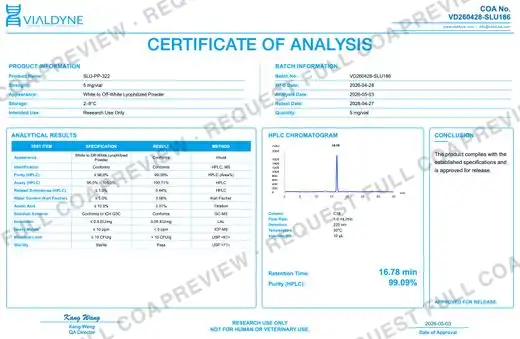
Published released-batch COAs for SLU-PP-332, every lot HPLC-verified. These are previews — request the full high-resolution certificate for any lot.
Browse all published COAsRegulatory note
Research-use-only small-molecule reagent (ERR agonist); an early-stage investigational compound, not approved in any jurisdiction and not for human or veterinary use.
Selected literature
Frequently asked questions
The term refers to compounds that reproduce some of the cellular adaptations of exercise, chiefly increased mitochondrial biogenesis and fat oxidation, through a pharmacological target rather than physical activity. SLU-PP-332 activates the estrogen-related receptors (ERRα/β/γ), transcription factors that drive oxidative-metabolism gene programs in muscle. In preclinical research, ERR activation raised mitochondrial function and fatty-acid oxidation, which is why the compound is described this way. The label is a research-context description, not a therapeutic claim.
No, it is a small-molecule nuclear-receptor agonist, not a peptide. It is released against a small-molecule reagent specification: HPLC purity, mass-spec identity, water content, residual solvents, heavy metals, and microbial limits, documented on a batch-specific COA. Because it is a relatively new research compound with limited standardisation across suppliers, confirm the intended identity and salt form at order placement; the released-batch COA records the lot identity.
Related peptides