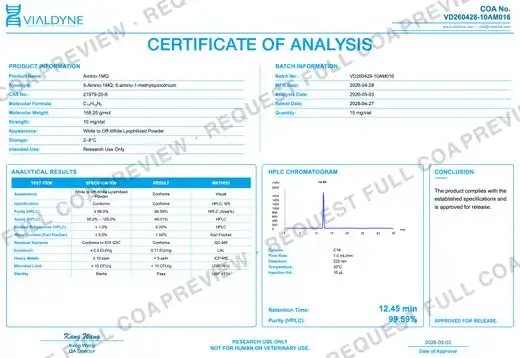
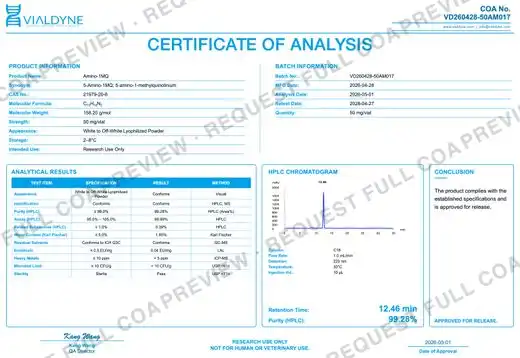
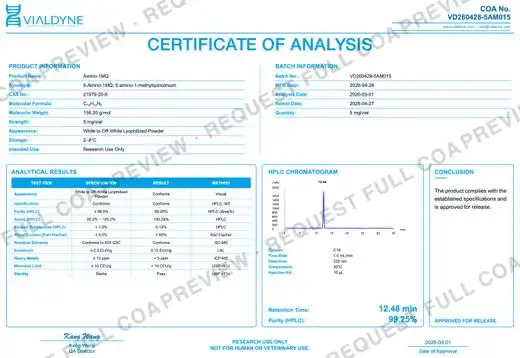
Ask sales for the Certificate of Analysis matched to the offered or supplied lot; it records the tests actually completed, applicable specifications, and reported results.
Review the matching batch COA for the analytical scope and results recorded for that lot.
Matching batch COA available.
FDA PCAC reviews 7 peptides for the 503A bulks list (BPC-157, KPV, TB-500, MOTs-C, Emideltide, Semax, Epitalon). Read our compounder's decision tree. Read our briefing →
FDA PCAC reviews 7 peptides for the 503A bulks list in July. Read →
FDA PCAC: 7 peptides under review. Read →

NNMT-inhibitor small molecule for metabolic research
Overview
Amino-1MQ (5-amino-1-methylquinolinium) is a small-molecule inhibitor of nicotinamide N-methyltransferase (NNMT), the enzyme that methylates nicotinamide using S-adenosyl-methionine as the methyl donor. By inhibiting NNMT, the compound is studied for its reported effects on cellular nicotinamide and NAD+ salvage flux and on adipocyte energy expenditure, which places it in the metabolic and body-composition research literature alongside other metabolism-modulating compounds. It is a quaternary quinolinium small molecule, not a peptide. Vialdyne supplies Amino-1MQ as a research reagent released against an HPLC purity specification with mass-spec identity confirmation; the applicable batch COA lists the tests actually performed and, when included in the agreed scope, can cover HPLC purity, identification, water content, residual solvents, heavy metals, and microbial limits against a small-molecule reagent specification. Because salt form and exact identity vary across the market under the 'Amino-1MQ' label, lot identity is documented on the COA, confirm the intended form at order placement.
Applications & buyer fit
Most buyers in this category are 503A and 503B compounding pharmacies fulfilling metabolic and weight-management protocols, plus research labs investigating GLP-1 / GIP / GCG receptor pharmacology. The procurement decision usually hinges on three things: documented purity at scale, a regulatory team that can respond on destination-market questions in writing, and the ability to supply consistent counter-ion form (acetate by default) across recurring orders.
Sourced for
Buyer fit
Documentation that ships
Procurement note: Supplied as a documented active in acetate counter-ion form by default; the buyer verifies current scheduling and compounding eligibility for the destination market.
Primary buyer fit: academic and contract research laboratories.
Specifications
Certificate of Analysis
Representative COA previews for 5-Amino-1MQ; request the certificate matched to the offered or supplied lot from sales. These are previews — request the full high-resolution certificate for any lot.
VerifiedRequest full COA →5-Amino-1MQ
VD260428-10AM016 · 99.59%
VerifiedRequest full COA →5-Amino-1MQ
VD260428-50AM017 · 99.28%
VerifiedRequest full COA →5-Amino-1MQ
VD260428-5AM015 · 99.25%
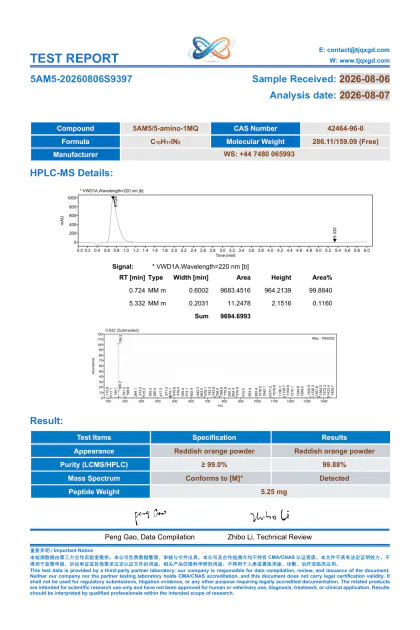
Independent analytical testing
Product- and strength-matched first-page previews are shown separately from Vialdyne's lot-specific Batch COAs. Reference the report number when requesting the complete, high-resolution file from sales.
Third-party testing in Tianjin
Independent HPLC and mass-spectrometry reports from Qorix , the professional, authoritative third-party analytical laboratory at tjqxgd.com, affiliated with the Tianjin International Joint Academy of Biomedicine.
Regulatory note
Research-use-only small-molecule reagent (NNMT inhibitor); not an approved drug in any jurisdiction and not for human or veterinary use.
Selected literature
Frequently asked questions
It inhibits nicotinamide N-methyltransferase (NNMT). NNMT consumes nicotinamide and the universal methyl donor S-adenosyl-methionine (SAM) to produce 1-methylnicotinamide. Research interest centres on the hypothesis that inhibiting NNMT preserves nicotinamide for NAD+ salvage and shifts cellular methylation and energy-expenditure balance, which is why the compound appears in metabolic and adipose-tissue research. These are preclinical research findings; Vialdyne supplies the compound strictly as a research reagent and makes no therapeutic claim.
No, it is a small-molecule quaternary quinolinium compound, not a peptide, so the release follows a small-molecule reagent specification: HPLC purity, mass-spec identity, water, residual solvents, heavy metals, and microbial limits, rather than peptide-style sequence confirmation. Because salt form and exact identity vary across the market under the 'Amino-1MQ' label, the released-batch COA documents the lot identity; confirm the form you need at order placement.
Related peptides