FDA PCAC reviews 7 peptides for the 503A bulks list (BPC-157, KPV, TB-500, MOTs-C, Emideltide, Semax, Epitalon). Read our compounder's decision tree. Read our briefing →
FDA PCAC reviews 7 peptides for the 503A bulks list in July. Read →
FDA PCAC: 7 peptides under review. Read →

Redox coenzyme for cellular-energy research
Overview
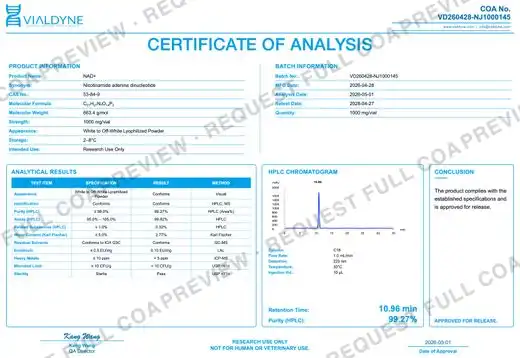
NAD+ (nicotinamide adenine dinucleotide) is a ubiquitous redox coenzyme central to cellular energy metabolism, shuttling electrons through glycolysis, the TCA cycle, and oxidative phosphorylation, and serving as the substrate consumed by sirtuins and PARPs. It is catalogued here as a high-purity research reagent for longevity, mitochondrial, and metabolic research lines rather than as a peptide API. Vialdyne releases lyophilised NAD+ at ≥99.0% HPLC purity. The released-batch COA covers HPLC purity, identification, water content, residual solvents, heavy metals, and microbial limits against the reagent-grade specification appropriate to a small-molecule coenzyme.
Applications & buyer fit
Buyers for longevity-class peptides span research labs working on telomere, collagen, and circadian-rhythm models, plus cosmetic-formulation OEMs incorporating peptides like GHK-Cu into anti-aging finished products. Copper peptides in particular require attention to chelator-free water and EDTA-free buffers in downstream formulation work, incompatibility there is the most common cause of "the peptide didn't work" support tickets in this class.
Sourced for
Buyer fit
Documentation that ships
Procurement note: Copper peptides require chelator-free water and EDTA-free buffers in downstream formulation work.
Primary buyer fit: academic and contract research laboratories.
Specifications
Certificate of Analysis
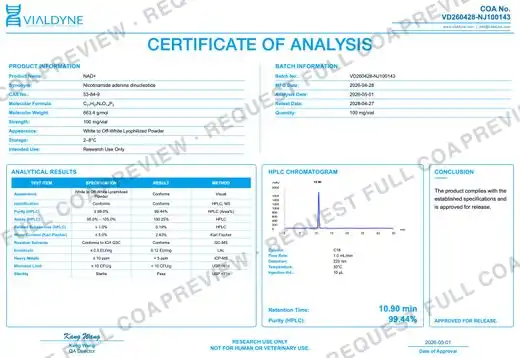
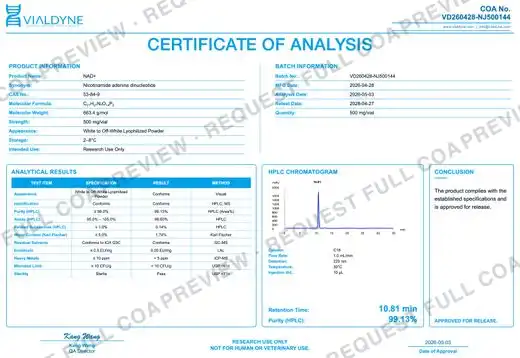
Published released-batch COAs for NAD+ (Nicotinamide Adenine Dinucleotide), every lot HPLC-verified. These are previews — request the full high-resolution certificate for any lot.
Browse all published COAsRegulatory note
Research-use-only reagent (coenzyme, not a peptide); not for human or veterinary use. Verify reagent-grade compliance against the intended research application.
Frequently asked questions
No. NAD+ is a dinucleotide coenzyme (a small molecule, CAS 53-84-9, MW 663.43), not a peptide. It is catalogued alongside our longevity research peptides because it shares the same buyer base, mitochondrial- and longevity-research labs, but the analytical release follows a small-molecule reagent specification (HPLC purity, water, residual solvents, heavy metals, microbial limits) rather than peptide-style mass-spec sequencing.
NAD+ is hygroscopic and degrades on exposure to moisture and heat, so it ships lyophilised and should be held at -20°C, protected from light, and reconstituted immediately before use. Working solutions are best prepared fresh; repeated freeze-thaw of aqueous NAD+ accelerates hydrolysis. The released-batch COA documents water content so a lab can confirm the starting material is dry before reconstitution.
Related peptides