What the label states, the lot delivers — net peptide mass, not gross powder weight, purity reported as measured rather than rounded up, and a Certificate of Analysis for every lot.
Net peptide mass, not powder weight; purity as measured, not rounded up; a COA per lot.
Net peptide + purity not rounded up. COA per lot.
FDA PCAC reviews 7 peptides for the 503A bulks list (BPC-157, KPV, TB-500, MOTs-C, Emideltide, Semax, Epitalon). Read our compounder's decision tree. Read our briefing →
FDA PCAC reviews 7 peptides for the 503A bulks list in July. Read →
FDA PCAC: 7 peptides under review. Read →

Khavinson neuroprotective tripeptide (Glu-Asp-Arg, EDR)
Overview
Pinealon (Glu-Asp-Arg, EDR) is a synthetic tripeptide bioregulator developed by Vladimir Khavinson's team at the St. Petersburg Institute of Bioregulation and Gerontology in Russia. It belongs to the Khavinson family of short peptide bioregulators and traces its research lineage back to work on bovine brain polypeptide complexes (such as Cortexin). It is characterized by low molecular weight and some capacity for cell membrane penetration; research suggests it can interact directly with DNA/chromatin to regulate gene expression, with research focus concentrated on neuroprotection and cognitive function. Nearly all of the evidence base comes from Russian research groups, and independent replication in Western peer-reviewed literature is limited. Note: Cortexin itself is a bovine brain polypeptide extract (a first-generation "Cytomax"-class bioregulator), whereas Pinealon is a structurally defined synthetic short peptide (a second-generation "Cytogen"-class bioregulator) — the two share a research lineage but are different product types. Vialdyne releases Pinealon as a lyophilized tripeptide (linear) against a ≥ 99.0% HPLC main-peak specification, with a batch-specific Certificate of Analysis covering RP-HPLC purity, mass-spec identity, water content, residual solvents, and endotoxin. Sequence / identity confirmation is documented on the released lot.
Applications & buyer fit
Cognitive and neuropeptide buyers are predominantly research labs running in vivo rodent studies. The dominant administration route in the literature is intranasal, these peptides are not meaningfully blood-brain-barrier permeable when delivered systemically. For in vivo workflows, endotoxin and microbial-limit testing is recommended at the COA stage so the bioassay readout is not confounded by contamination unrelated to the test article.
Sourced for
Buyer fit
Documentation that ships
Procurement note: For in vivo workflows, endotoxin and microbial-limit testing on the specific lot is recommended at the COA stage.
Primary buyer fit: academic and contract research laboratories.
Specifications
Certificate of Analysis
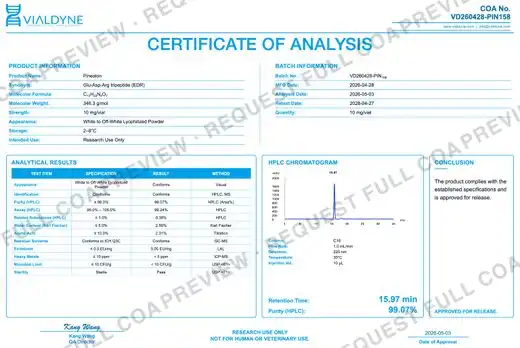
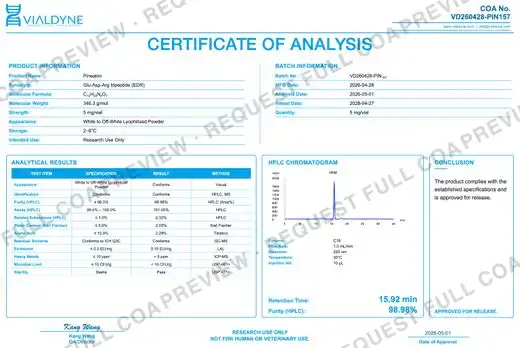
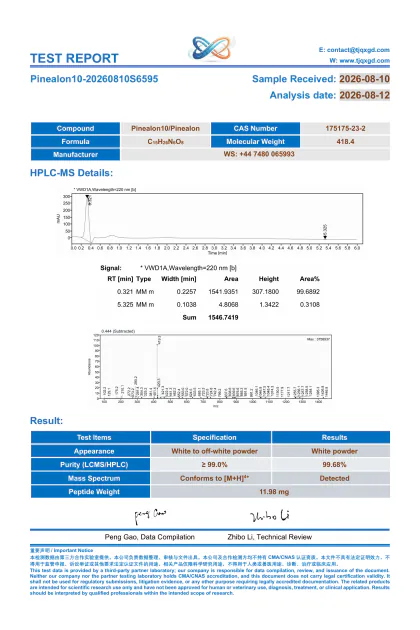
Published released-batch COAs for Pinealon, every lot HPLC-verified. These are previews — request the full high-resolution certificate for any lot.
VerifiedRequest full COA →Pinealon
VD260428-PIN158 · 99.07%
VerifiedRequest full COA →Pinealon
VD260428-PIN157 · 98.98%
Regulatory note
Research-use-only reference material; not for human or veterinary use.
Selected literature
Frequently asked questions
The only route with a real research track record for the EDR tripeptide is subcutaneous, commonly cited as a 5 mg once-daily dose over a 20-day cycle. A much lower oral figure appears in circulation but lacks a traceable primary source, and no intranasal or intramuscular protocol could be independently verified. Before compounding, document the intended route with its supporting primary reference and do not label a preparation for a route you cannot source. Anchoring the batch instruction to a verifiable route protects the lab from preparing material for an unsupported administration path.
Confirm the EDR tripeptide at receipt with an orthogonal check pairing an HPLC purity result against its stated limit with a mass confirmation near the roughly 418 g/mol figure, recording the three-residue sequence assignment rather than trusting the name. Verify salt form, water content, and lyophilizate appearance against the COA. Store at -20 degrees Celsius protected from light and track the assigned re-test interval. Reconstitute in isotonic saline, calculate concentration from the net-peptide assay basis, aliquot into single-use volumes, and hold frozen to limit freeze-thaw loss. Log lot, assay basis, and re-test date for traceability.
Related peptides