PEG-MGF
PEGylated Mechano Growth Factor
Overview
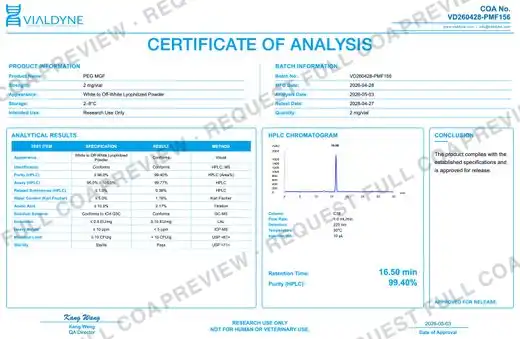
PEG-MGF is a polyethylene-glycol-conjugated derivative of MGF (Mechano Growth Factor, the IGF-1 Ec splice-variant peptide). The conjugation is engineered to push plasma stability well beyond the minutes-scale half-life of unmodified native MGF. The conjugation playbook mirrors what clinical PEG-protein assets like PEG-IFN and PEG-G-CSF have used for decades, attaching a polyethylene glycol polymer to one or more reactive groups on the peptide enlarges hydrodynamic radius, slows renal clearance, and shields the peptide from proteolytic attack. The cross-supplier comparison problem is that the PEG architecture itself varies materially across vendors: PEG MWs range from 5 kDa to 40 kDa, and attachment chemistry can be either site-specific (single-residue) or random (multi-site), with downstream PK consequences across both axes. For research-lab buyers, Vialdyne releases PEG-MGF as a lyophilised conjugate against a ≥99.0% main-peak HPLC specification. Because PEG MW and attachment site jointly govern the conjugate's PK profile, every released batch COA explicitly documents three values: PEG polymer mass, attachment chemistry (site-specific vs random), and PEG-to-peptide ratio. Cross-supplier qualification has to normalise across all three rather than comparing on peptide content alone, two materials sharing the catalogue label 'PEG-MGF' from different sources can differ by 5-10x in functional half-life depending on the PEG architecture choices. The COA structure is built to drop directly into a sponsor's QA file when supplier equivalence has to be defended in writing.
Who buys this, and why
Repair peptides, BPC-157, TB-500, and related sequences, typically ship to research labs studying tissue-repair, gastrointestinal, or tendon-ligament models, and to compounding pharmacies that have validated the bulk active into their workflow. The synthesis itself is reliable, but analytical confirmation is where suppliers differ, buyers qualifying a new source should request sequence verification by tandem MS on the first batch and compare against the labelled sequence directly.
Primary buyer fit: academic and contract research laboratories.
Specifications
- CAS
- 108174-48-7 (verification pending, please confirm via COA)
- Purity (HPLC)
- ≥ 99.0%
- Common vial sizes
- 2 mg, 5 mg, 10 mg
- MOQ
- On request
- Lead time
- 14–21 days
- Storage
- -20°C, protect from light
Documentation available on request
- Certificate of Analysis (COA)
- HPLC Chromatogram
- Mass-spec identity (ESI-MS)
- Sequence verification (LC-MS/MS)
- Water content (Karl Fischer)
- Counter-ion analysis
- SDS / MSDS
- Stability data on request
Regulatory note
PEG conjugate with variable architecture across suppliers. Confirm PEG molecular weight, attachment site, and PEG-to-peptide ratio per batch COA. Pharmacokinetic comparability across supplier sources cannot be assumed.
Frequently asked questions
Why is PEG architecture (MW and attachment chemistry) so critical for PEG-MGF?▾
Because the PEG component is not a passive shield, it actively shapes PK. PEG polymer MW drives both hydrodynamic radius (which sets the renal-clearance threshold) and the overall conjugate molecular weight, both of which determine in vivo half-life. Attachment chemistry (site-specific vs random) drives product consistency, random conjugation produces an isomer mixture, and it also influences residual MGF biological activity because some attachment sites preserve activity better than others. The practical consequence: two PEG-MGF preparations from different suppliers can carry the same nominal label and differ by 5-10x in functional half-life. Any cross-supplier comparison has to be done against PEG MW, attachment site, and PEG-to-peptide ratio rather than against the label alone.
When should I order PEG-MGF instead of unmodified MGF?▾
Two distinct use cases. For in vivo workflows, PEG-MGF is essentially required: native MGF's minute-scale plasma half-life would force impractical dosing frequency, while the PEGylated form extends functional half-life by 10-100x depending on PEG architecture, supporting once-daily or less-frequent dosing protocols. For cell-culture and biochemical-assay work, unmodified MGF is the right choice, the dose is added directly to a defined system, and stability across hours rather than days is sufficient. Published cell-culture studies overwhelmingly use unmodified MGF; published in vivo studies are split between PEG-MGF and other long-acting analogues.