FDA PCAC: 7 peptides under review. Read →

Vialdyne

IGF-1 LR3

Long-Arg3 IGF-1 (long-acting IGF-1 analog)

≥ 99.0%CAS 946870-92-4GH-Axis Peptides

Overview

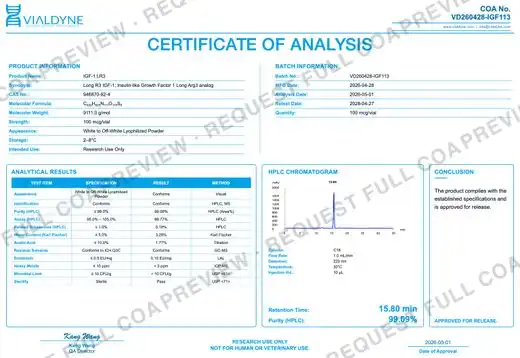
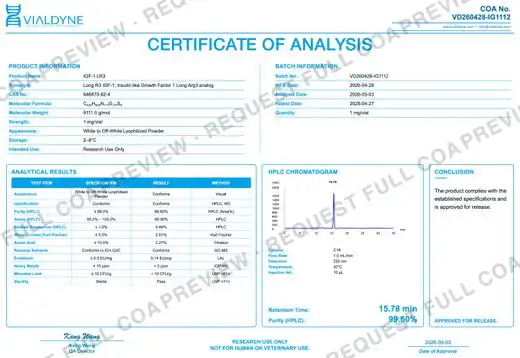
IGF-1 LR3, full name Long R3 IGF-1, is an 83-residue engineered analogue of native IGF-1 built around two specific structural modifications. The first is a 13-residue N-terminal extension that originated serendipitously from an E. coli fusion-protein construct and turned out to dramatically reduce binding affinity for the IGF-binding-protein (IGFBP) family. The second is a single Arg substitution at position 3 (replacing the native Glu3) that further suppresses IGFBP interaction. Together, the two modifications yield a circulating analogue largely freed from IGFBP sequestration. Two practical pharmacology consequences follow: roughly threefold higher biological potency than native IGF-1 in cell-proliferation assays at matched molar concentrations, and an extended functional half-life, since the molecule escapes IGFBP-mediated clearance from circulation. For research-lab buyers, Vialdyne releases recombinant IGF-1 LR3 as a lyophilised powder against a ≥99.0% main-peak HPLC specification. Because IGF-1 LR3 is a recombinant protein expressed in E. coli rather than a chemically synthesised peptide, the release packet pairs chemical-purity testing (RP-HPLC) with biological-product analytics: SDS-PAGE for size confirmation, optional cell-proliferation bioassay (3T3 or MCF-7 cell lines) for activity verification, and LAL endotoxin per USP <85> included by default rather than as an add-on, the E. coli expression process can carry over higher endotoxin loads than synthetic peptide processes, so endotoxin clearance discipline is essential at every release cycle. Three nominal strengths, 100 mcg, 1 mg, and 2 mg, span bench-scale and in vivo research workflows.

Who buys this, and why

GH-axis peptides ship to two main buyer types: compounding pharmacies dispensing under physician supervision, and research labs studying somatotropic-axis pharmacology. Pharmacies typically want sterile-filled vials with the full release packet (sterility, endotoxin, CCI); labs typically want bulk lyophilized powder with sequence verification. Blends (the CJC-1295 / Ipamorelin combination is the canonical example) are usually co-lyophilized rather than solution-mixed for potency stability.

Primary buyer fit: academic and contract research laboratories.

Specifications

CAS
946870-92-4
Purity (HPLC)
≥ 99.0%
Common vial sizes
100 mcg, 1 mg, 2 mg
MOQ
On request
Lead time
14–21 days
Storage
-20°C, protect from light

Documentation available on request

  • Certificate of Analysis (COA)
  • HPLC Chromatogram
  • Mass-spec identity (ESI-MS)
  • Counter-ion (acetate vs TFA)
  • Sterile-fill release pack (sterility, CCI, fill-weight)
  • Bacterial endotoxin (LAL, USP <85>)
  • Stability data on request
  • SDS / MSDS

Regulatory note

Sold as a bulk active for research and for compounding-pharmacy formulation where local regulations permit (notably 503A / 503B in the United States and analogous regimes elsewhere). Not a finished dosage form. Sterile-filled vials are available with full release documentation; the buyer is responsible for verifying scheduling and dispense requirements in the destination market.

Frequently asked questions

Why is IGF-1 LR3 used in research instead of native IGF-1?

IGFBP sequestration is the practical obstacle with native IGF-1. In serum and cell-culture environments, less than 1% of total native IGF-1 is free at any given time, the rest is bound to the IGFBP family. That makes dose-response work and concentration-controlled experiments difficult because the effective free concentration cannot be reliably predicted from the nominal added concentration. IGF-1 LR3's two engineered modifications (N-terminal extension plus Arg3 substitution) dramatically reduce IGFBP binding, producing a more linear and predictable dose-response curve. The practical readout in cell-proliferation work is roughly threefold higher potency relative to native IGF-1 at equivalent molar input, with substantially tighter inter-experiment variability as a bonus.

Is IGF-1 LR3 a peptide or a recombinant protein, and what does that mean for analytics?

At 83 residues, IGF-1 LR3 sits at the boundary between large peptide and small protein, and in practical terms it is produced by recombinant expression in E. coli rather than by solid-phase synthesis. The analytical packet diverges accordingly from a typical synthetic peptide release: RP-HPLC for chemical purity, SDS-PAGE for size confirmation, mass spec (intact-mass or peptide-mapping where appropriate), and a cell-proliferation bioactivity assay because recombinant material's biological activity can vary with folding even when chemical purity is high. LAL endotoxin per USP <85> is essential rather than optional, the E. coli expression system requires disciplined endotoxin clearance throughout purification, and the released-batch COA documents the result on every lot.

How should IGF-1 LR3 be reconstituted and stored?

Reconstitute in 0.6% acetic acid rather than plain water. The mild acidification keeps the protein in monomer form and avoids the aggregation that can occur at neutral pH on dilute reconstitution. Dilute working stocks should then be prepared in cell-culture-grade BSA-containing buffer (0.1% BSA is typical) to prevent adsorption to glass and plastic surfaces at low working concentrations, this is the load-bearing step for cell-culture work at sub-100 ng/mL, where surface adsorption can otherwise silently halve the effective dose. Sub-divide into single-use aliquots and hold at -20 C. The lyophilised product itself rolls under the standard 24-month re-test window.