MGF (Mechano Growth Factor)
IGF-1 Ec splice-variant peptide
Overview
MGF (Mechano Growth Factor) is a 24-residue C-terminal peptide. The peptide is derived from the Ec splice variant of the IGF-1 gene, an alternative splicing outcome that yields an E-domain extension distinct from the more frequently studied IGF-1Ea form. In skeletal muscle, mechanical loading and exercise stress preferentially upregulate the Ec splice variant, the source of the 'Mechano Growth Factor' name. Pharmacologically, current models suggest the C-terminal E-peptide engages a receptor that is not the classical IGF-1 receptor, and that this signalling axis drives satellite-cell proliferation in muscle-repair studies, the substrate of MGF's research interest and the rationale for stocking it in the catalogue alongside the related IGF-1 LR3 SKU. For research-lab buyers, Vialdyne releases unmodified MGF (the synthetic C-terminal E-peptide alone, not the full IGF-1 Ec protein) as a lyophilised 2 mg vial against a ≥99.0% main-peak HPLC specification. Plasma half-life is exceptionally short, on the minutes scale, which is why PEGylated MGF tends to be the more commercially deployed form for in vivo research workflows. Unmodified MGF fits cell-culture biochemical studies where the short half-life is not a limitation because the dose enters a defined system directly. LC-MS/MS sequence verification is the recommended qualification add-on at first-time pharmacy onboarding: because the MGF sequence partially overlaps with IGF-1, positive identity confirmation across supplier sources needs explicit tandem-MS sequencing rather than relying on intact-mass spec alone to rule out IGF-1-derived contaminating species.
Who buys this, and why
GH-axis peptides ship to two main buyer types: compounding pharmacies dispensing under physician supervision, and research labs studying somatotropic-axis pharmacology. Pharmacies typically want sterile-filled vials with the full release packet (sterility, endotoxin, CCI); labs typically want bulk lyophilized powder with sequence verification. Blends (the CJC-1295 / Ipamorelin combination is the canonical example) are usually co-lyophilized rather than solution-mixed for potency stability.
Primary buyer fit: academic and contract research laboratories.
Specifications
- CAS
- (verification pending, please confirm via COA)
- Purity (HPLC)
- ≥ 99.0%
- Common vial sizes
- 2 mg
- MOQ
- On request
- Lead time
- 14–21 days
- Storage
- -20°C, protect from light
Documentation available on request
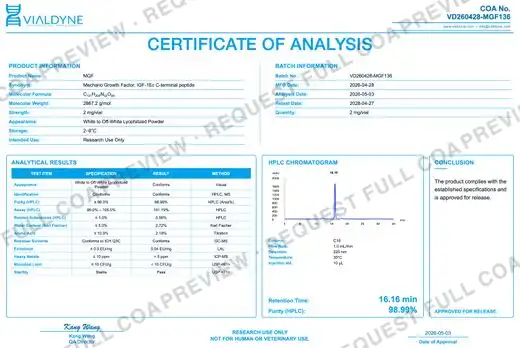
- Certificate of Analysis (COA)
- HPLC Chromatogram
- Mass-spec identity (ESI-MS)
- Counter-ion (acetate vs TFA)
- Sterile-fill release pack (sterility, CCI, fill-weight)
- Bacterial endotoxin (LAL, USP <85>)
- Stability data on request
- SDS / MSDS
Regulatory note
CAS for unmodified MGF is not consistently standardized across suppliers; confirm sequence and PEG status (if any, unmodified MGF should not have PEG) via batch COA.
Frequently asked questions
What's the difference between MGF and IGF-1?▾
Two related but functionally distinct molecules. IGF-1 (Insulin-like Growth Factor 1) is the full-length 70-residue mature growth factor expressed primarily by the liver in response to growth hormone signalling. MGF (Mechano Growth Factor) is a 24-residue C-terminal peptide derived from the IGF-1 Ec splice variant of the IGF-1 gene, preferentially induced in skeletal muscle by mechanical loading. The C-terminal E-peptide is what distinguishes MGF from the more commonly characterised IGF-1Ea form, and it is hypothesised to act through a receptor distinct from the classical IGF-1 receptor. Practically: IGF-1 LR3 is the right tool for IGF-1-receptor pharmacology research, while MGF is the right tool for E-peptide-specific satellite-cell signalling work driving muscle repair.
Why is MGF rarely used in vivo despite the muscle-repair research interest?▾
PK economics. Unmodified MGF has a plasma half-life measured in minutes, which is biologically appropriate, the molecule is meant to function as a local autocrine/paracrine signal in muscle tissue, not as a systemic hormone, but it makes any in vivo workflow that requires sustained exposure across hours or days operationally impractical. PEG-MGF (the PEGylated form) was developed specifically to extend functional half-life into a usable range for in vivo dosing, and is the more commonly chosen form for that context. Unmodified MGF fits cell-culture and short-duration biochemical assays where the minutes-scale stability is sufficient and the experimental design works around it.
Related peptides