Liraglutide
GLP-1 receptor agonist (long-acting)
Overview
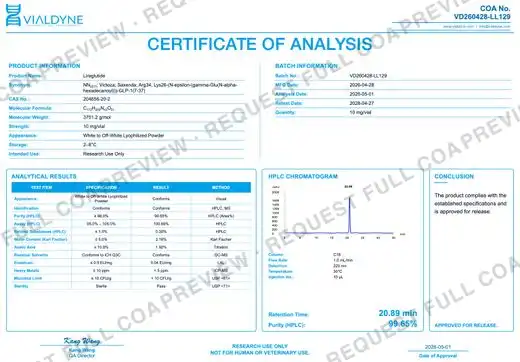
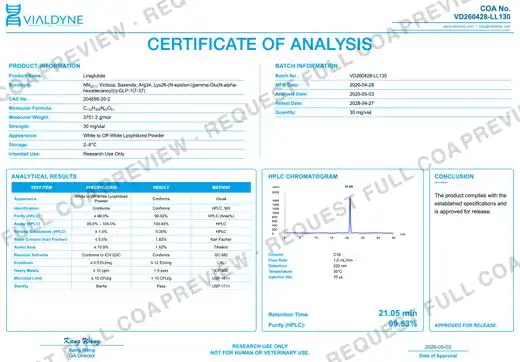
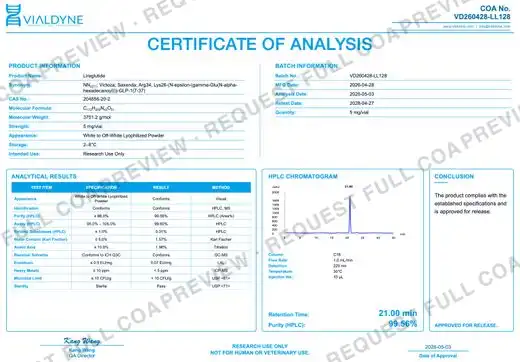
Liraglutide is the original molecule that proved out the lipidation-based half-life-extension strategy that Semaglutide and Tirzepatide later refined and extended. Structurally it is a 31-residue GLP-1 receptor agonist carrying a single C16 palmitic-acid moiety attached to Lys26 through a glutamic-acid (gamma-Glu) spacer, plus an Arg-for-Lys swap at position 34 designed to block off-target lipidation in the synthesis step. The C16 fatty acid is the load-bearing modification: it drives reversible serum-albumin binding that pulls plasma half-life out of the minutes-scale window of native GLP-1 and up to roughly 13 hours, which supports once-daily subcutaneous dosing, the longer C18 and C20 successors push half-life into the weekly range, but Liraglutide stopped at C16 by design. The same API underpins two approved finished drugs: Victoza, with the original 2010 FDA approval for T2DM, and Saxenda, with the subsequent 2014 FDA approval for chronic weight management. Vialdyne releases Liraglutide acetate as a lyophilised powder against a ≥99.0% main-peak HPLC specification. The standard release packet covers RP-HPLC peak integration, ESI-MS at the lipidated 3751.20 g/mol average theoretical mass, Karl Fischer water, and counter-ion. LC-MS/MS sequence verification is the recommended add-on test at first-time pharmacy qualification: the 31-residue sequence with a lipidation modification places this molecule at the more demanding end of routine SPPS, and the diagnostic mass-spec check has to confirm the dominant species sits at the lipidated mass, not at the unmodified GLP-1 mass. Three standard strengths (5, 10, 30 mg) cover compounding-pharmacy dispensing workflows; sterile-filled presentations are scoped under change-control. For the wider pharmacology context across the GLP-1 family of approved and investigational agents, our companion [class comparison article](/insights/glp-1-class-comparison-tirzepatide-retatrutide-mazdutide-survodutide) walks the side-by-side.
Who buys this, and why
Most buyers in this category are 503A and 503B compounding pharmacies fulfilling metabolic and weight-management protocols, plus research labs investigating GLP-1 / GIP / GCG receptor pharmacology. The procurement decision usually hinges on three things: documented purity at scale, a regulatory team that can respond on destination-market questions in writing, and the ability to supply consistent counter-ion form (acetate by default) across recurring orders.
Primary buyer fit: 503A / 503B compounding pharmacies and academic and contract research laboratories.
Specifications
- CAS
- 204656-20-2
- Molecular Formula
- C172H265N43O51
- Molecular Weight
- 3751.20 g/mol
- Appearance
- White lyophilized powder
- Purity (HPLC)
- ≥ 99.0%
- Common vial sizes
- 5 mg, 10 mg, 30 mg
- MOQ
- On request
- Lead time
- 10–18 days
- Storage
- -20°C, protect from light
Documentation available on request
- Certificate of Analysis (COA)
- HPLC Chromatogram
- Mass-spec identity (ESI-MS)
- Counter-ion / residual solvent
- Bacterial endotoxin (LAL, USP <85>)
- Microbial limits (USP <61>/<62>)
- Stability data on request
- 503A / 503B documentation support
Regulatory note
Finished Liraglutide drug products (Victoza for type 2 diabetes, Saxenda for chronic weight management) are approved by FDA, EMA, and other major regulators. The bulk active itself is not on the 503A bulks list; compounding eligibility depends on the destination market's current shortage / regulatory posture, which buyers are responsible for verifying at the time of dispense.
Frequently asked questions
Why is Liraglutide once-daily but Semaglutide and Tirzepatide are once-weekly?▾
All three rely on the same general lipidation playbook, fatty-acid conjugation that drives reversible albumin binding to extend plasma half-life, but with different fatty-acid chain lengths and linker geometries. Liraglutide carries a C16 (palmitic) fatty acid attached via a single gamma-Glu spacer, producing the ~13-hour half-life appropriate for once-daily dosing. Semaglutide uses a C18 diacid with a longer gamma-Glu-2xOEG linker, stretching half-life to roughly a week. Tirzepatide uses a C20 diacid with similar linker chemistry, also supporting weekly dosing. The C16 to C20 progression represents two decades of iterative optimisation across the Novo Nordisk and Eli Lilly pipelines.
When did Liraglutide receive its FDA approvals, and for which indications?▾
The first approval landed in January 2010 as Victoza for type 2 diabetes management, making Liraglutide one of the first commercially successful GLP-1 receptor agonists. A second approval followed in December 2014, when the same molecule at a higher dose was approved as Saxenda for chronic weight management in adults with obesity or overweight plus at least one weight-related comorbidity. A paediatric weight-management extension in 2020 expanded the Saxenda label to ages 12-17. The bulk API Vialdyne releases corresponds to the same molecule as both branded finished products.
What's the analytical-confirmation approach for distinguishing Liraglutide from native GLP-1 fragments?▾
Mass-spec at the lipidated mass is the diagnostic test. Native GLP-1(7-37) is a 31-residue peptide with theoretical MW around 3355 g/mol. Liraglutide is the same 31-residue backbone with one substitution (Arg at position 34) plus one lipid modification (gamma-Glu-palmitoyl at Lys26), which lifts the MW to ~3751.20 g/mol, a +396 Da shift relative to the unmodified GLP-1. ESI-MS at the lipidated mass is the diagnostic identity check at receiving inspection; if the dominant species sits at the unmodified GLP-1 mass, the lipidation step has not completed and the material lacks Liraglutide's defining pharmacology. The standard release packet includes the mass-spec confirmation at the lipidated mass on every lot.
Related peptides