FDA PCAC: 7 peptides under review. Read →

Vialdyne

HGH Fragment 176-191

C-terminal fragment of human growth hormone (176–191)

≥ 99.0%CAS 66004-57-7GH-Axis Peptides

Overview

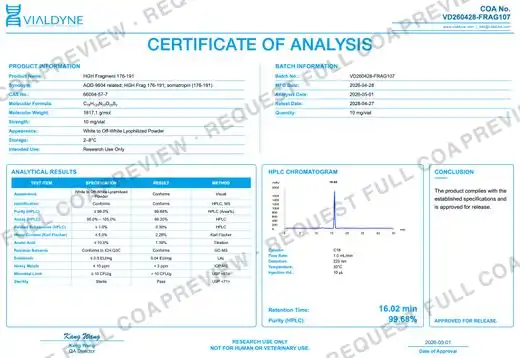
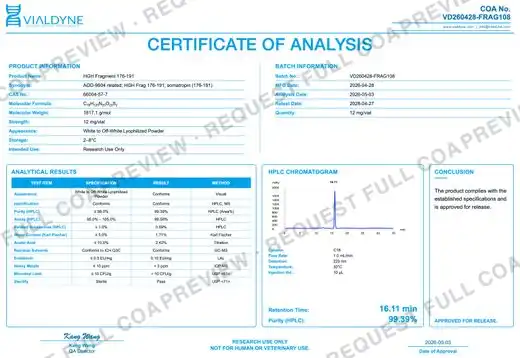
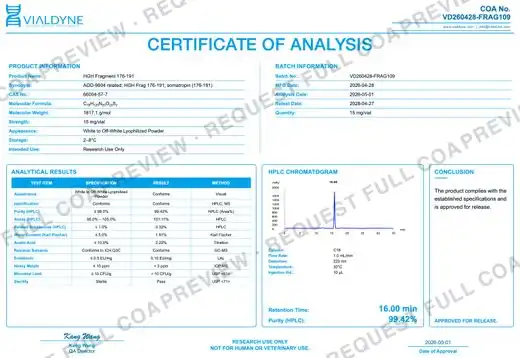
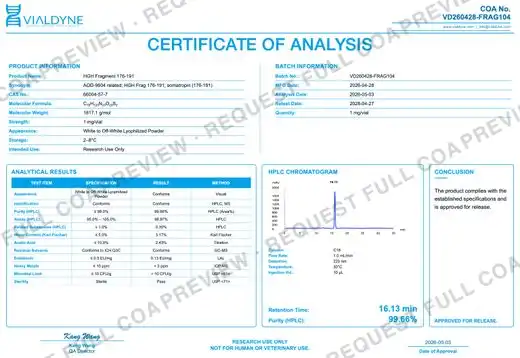
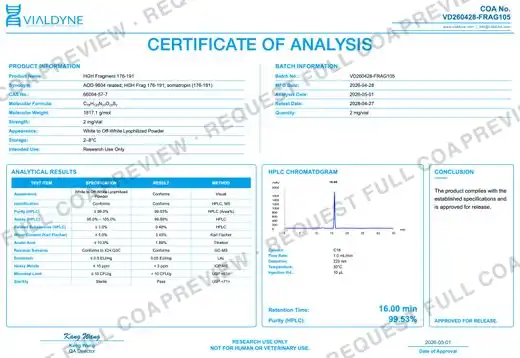
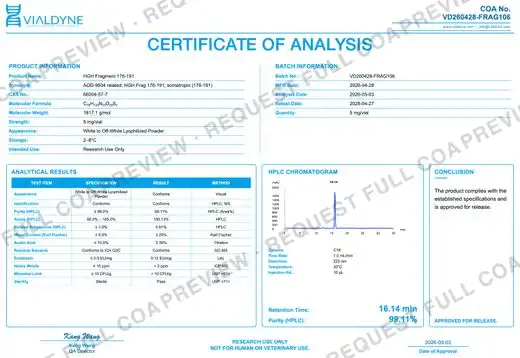
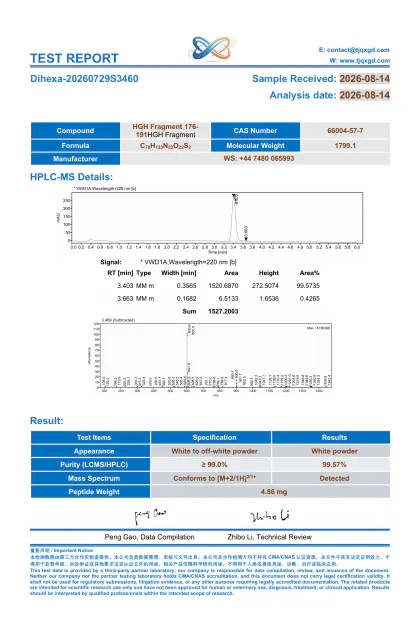
HGH Fragment 176-191 is the unmodified 16-residue C-terminal segment of human growth hormone, lifted directly from positions 176 through 191 of the 191-residue native HGH protein. The fragment preserves C-terminal-region lipolytic activity while leaving behind the central-region anabolic and IGF-1-stimulating effects that are characteristic of the full-length GH molecule. The critical distinction at the procurement-file level is between this SKU, which is the unmodified native sequence, and AOD9604, which appends an N-terminal tyrosine residue originally introduced to support iodination tracking; the two molecules are chemically distinct and produce different ESI-MS signatures, despite a confusingly similar catalogue naming convention across the broader peptide market. Vialdyne releases HGH Fragment 176-191 against a ≥99.0% main-peak HPLC specification, with the full identity stack documented on every released-batch COA. The relevant values: CAS number 66004-57-7, molecular formula C78H123N23O22S2, average MW 1817.1 g/mol, and primary sequence YLRIVQCRSVEGSCGF. The sequence carries two cysteine residues at internal positions 7 and 13, which under oxidative storage conditions can pair into an intramolecular disulfide bridge. This disulfide-bridging behaviour is the most common identity-confirmation concern at receiving inspection: the reduced and oxidised forms differ by 2 Da in ESI-MS and elute at different RP-HPLC retention times. The released-batch COA documents which form the lot represents. Six nominal strengths from 1 to 15 mg cover bench-scale and dispensing-scale workflows.

Who buys this, and why

GH-axis peptides ship to two main buyer types: compounding pharmacies dispensing under physician supervision, and research labs studying somatotropic-axis pharmacology. Pharmacies typically want sterile-filled vials with the full release packet (sterility, endotoxin, CCI); labs typically want bulk lyophilized powder with sequence verification. Blends (the CJC-1295 / Ipamorelin combination is the canonical example) are usually co-lyophilized rather than solution-mixed for potency stability.

Primary buyer fit: academic and contract research laboratories and 503A / 503B compounding pharmacies.

Specifications

CAS
66004-57-7
Molecular Formula
C78H123N23O22S2
Molecular Weight
1817.1 g/mol
Sequence
YLRIVQCRSVEGSCGF
Appearance
White lyophilized powder
Purity (HPLC)
≥ 99.0%
Common vial sizes
1 mg, 2 mg, 5 mg, 10 mg, 12 mg, 15 mg
MOQ
On request
Lead time
10–18 days
Storage
-20°C, protect from light

Documentation available on request

  • Certificate of Analysis (COA)
  • HPLC Chromatogram
  • Mass-spec identity (ESI-MS)
  • Counter-ion (acetate vs TFA)
  • Sterile-fill release pack (sterility, CCI, fill-weight)
  • Bacterial endotoxin (LAL, USP <85>)
  • Stability data on request
  • SDS / MSDS

Regulatory note

Easily confused with AOD9604 (the modified analog with N-terminal tyrosine). Confirm exact fragment identity (unmodified vs. AOD9604-modified) via batch COA before order placement; the two are not chemically equivalent.

Frequently asked questions

How do I distinguish HGH Fragment 176-191 from AOD9604 at the analytical level?

Mass spec at receiving inspection is the diagnostic test. The two molecules differ by exactly one residue, AOD9604 carries an additional N-terminal tyrosine, producing a 17-residue molecule with theoretical MW around 1980 Da, while HGH Fragment 176-191 is the unmodified 16-residue sequence at 1817.1 Da theoretical. The +163 Da delta is unambiguous on an ESI-MS scan and is the test we recommend for first-time supplier qualification when sourcing either form. Secondary confirmation comes from RP-HPLC retention time, the additional hydrophobic tyrosine pushes AOD9604 to a slightly later elution under typical gradient conditions. Either way, never rely on label alone; the released-batch mass must match the ordered form.

What does the intramolecular disulfide bond in HGH Fragment 176-191 mean for handling?

The fragment sequence YLRIVQCRSVEGSCGF contains two cysteines at internal positions 7 and 13. Under reducing conditions during synthesis the cysteines remain as free thiols; under oxidative conditions during downstream storage and reconstitution they can pair into an intramolecular disulfide bridge. The reduced and oxidised species differ by 2 Da in ESI-MS and elute at distinct RP-HPLC retention times, making the form readily distinguishable at QC. Most published research uses the oxidised (disulfide-bridged) form, which is the more stable solid-state species. The released-batch COA documents which form the lot represents, which matters operationally for any protocol that specifies one form or the other.