FDA PCAC: 7 peptides under review. Read →

Vialdyne

AOD9604

Modified HGH fragment 176–191 (anti-obesity drug candidate)

≥ 99.0%CAS 221231-10-3GH-Axis Peptides

Overview

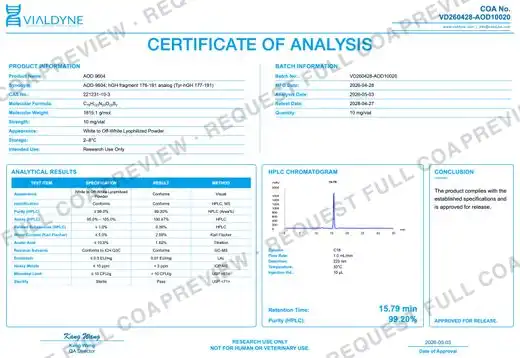
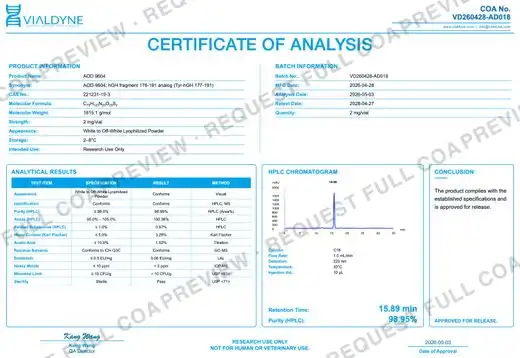
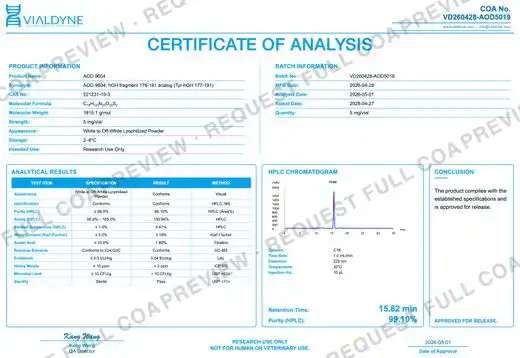
AOD9604 is a modified analogue of the C-terminal 176-191 fragment of human growth hormone, originally developed at Monash University in Australia as a lipolytic anti-obesity clinical-development candidate. Structurally it consists of the native HGH(176-191) sequence plus an additional N-terminal tyrosine residue, the tyrosine was added during the preclinical era specifically to support iodination for tracking studies. Pharmacologically, the molecule preserves the C-terminal-region lipolytic activity that drives the published research interest, hypothesised to act through a non-GH-receptor pathway, while leaving behind the broader anabolic effects that the central GH-receptor-binding region of the full-length protein mediates. The asset advanced through Phase 2b clinical trials for obesity but did not reach regulatory approval as a finished drug; in some jurisdictions it has subsequently transitioned to research and dietary-supplement markets. Vialdyne releases AOD9604 as a lyophilised powder against a ≥99.0% main-peak HPLC specification with a batch COA covering RP-HPLC, ESI-MS, water content, and counter-ion. Because the N-terminal tyrosine is the only structural feature separating AOD9604 from the unmodified HGH Fragment 176-191, and because the two molecules are easy to confuse on a catalogue page, buyers should be explicit about which variant they want at the order-placement stage so the lot is reserved correctly. Three standard fills (2, 5, 10 mg) map onto bench-scale aliquots and small-batch dispensing workflows.

Who buys this, and why

GH-axis peptides ship to two main buyer types: compounding pharmacies dispensing under physician supervision, and research labs studying somatotropic-axis pharmacology. Pharmacies typically want sterile-filled vials with the full release packet (sterility, endotoxin, CCI); labs typically want bulk lyophilized powder with sequence verification. Blends (the CJC-1295 / Ipamorelin combination is the canonical example) are usually co-lyophilized rather than solution-mixed for potency stability.

Primary buyer fit: academic and contract research laboratories and 503A / 503B compounding pharmacies.

Specifications

CAS
221231-10-3
Appearance
White lyophilized powder
Purity (HPLC)
≥ 99.0%
Common vial sizes
2 mg, 5 mg, 10 mg
MOQ
On request
Lead time
10–18 days
Storage
-20°C, protect from light

Documentation available on request

  • Certificate of Analysis (COA)
  • HPLC Chromatogram
  • Mass-spec identity (ESI-MS)
  • Counter-ion (acetate vs TFA)
  • Sterile-fill release pack (sterility, CCI, fill-weight)
  • Bacterial endotoxin (LAL, USP <85>)
  • Stability data on request
  • SDS / MSDS

Regulatory note

Sold as a bulk active for research and for compounding-pharmacy formulation where local regulations permit (notably 503A / 503B in the United States and analogous regimes elsewhere). Not a finished dosage form. Sterile-filled vials are available with full release documentation; the buyer is responsible for verifying scheduling and dispense requirements in the destination market.

Frequently asked questions

Why is AOD9604 considered an 'anti-obesity drug candidate' rather than just a research peptide?

The 'drug candidate' framing reflects the clinical-development history, not current approval status. AOD9604 was developed at Monash University and advanced through a registered Phase 2b clinical trial program for obesity. Those trials produced modest weight-loss signals, much smaller than what GLP-1 agonists have since demonstrated, and the program did not reach regulatory approval as a finished drug in any jurisdiction. After the obesity-drug program was discontinued, the molecule transitioned to research use and to dietary-supplement markets in some jurisdictions under various brand names. Pharmacy buyers should treat AOD9604 as an unapproved active and verify compounding eligibility against their own state-board posture.

Is AOD9604 a GH analog, and does it activate the GH receptor?

Structurally derived from GH, mechanistically not a GH-receptor agonist. The GH-receptor-binding determinants on the full-length 191-residue protein sit in the central region, not the C-terminal fragment that AOD9604 represents. AOD9604's lipolytic activity is hypothesised to act through a separate, non-GH-receptor mechanism. This is the key pharmacological distinction from full-length recombinant HGH: AOD9604 keeps the C-terminal-region lipolytic effects but loses the central-region anabolic and IGF-1-stimulating effects. The net consequence is a substantially narrower pharmacological profile than HGH, and pharmacy QA workflows should not treat the two as interchangeable.