FDA PCAC: 7 peptides under review. Read →

Vialdyne

GHK-Cu

Copper tripeptide-1

≥ 99.0%CAS 89030-95-5Cosmetic & Beauty Peptides

Overview

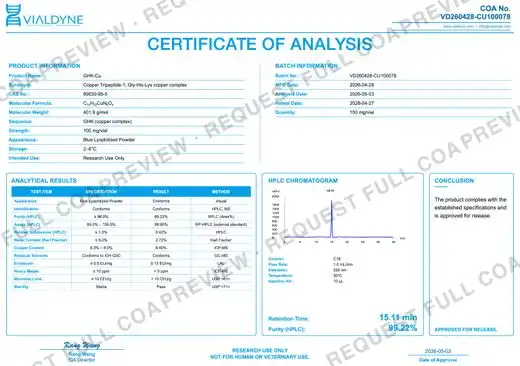
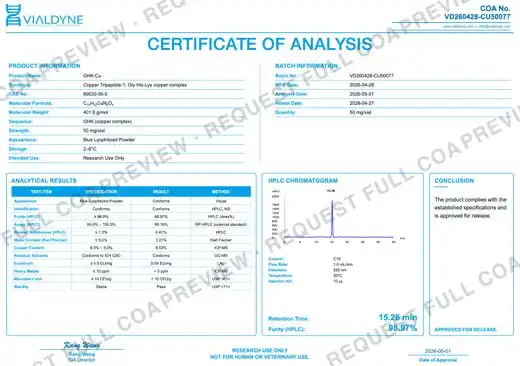
GHK-Cu (INCI: Copper Tripeptide-1) is glycyl-L-histidyl-L-lysine coordinated to a divalent copper ion. First isolated from human plasma in 1973, it is the canonical endogenous copper-peptide complex; plasma concentrations decline with age, and that biology underwrites its use in dermal-repair work and in topical formulation. The lyophilised cake's characteristic blue colour is diagnostic for intact Cu(II) coordination, a colourless or pale reconstituted solution is the first sign the complex has dissociated and the peptide and copper are no longer functioning as the bioactive species. Our companion piece on this molecule, the [GHK-Cu topical-formulation playbook](/insights/ghk-cu-cosmetic-formulation-guide), covers the full ingredient-by-ingredient compatibility breakdown for downstream formulators. Vialdyne releases GHK-Cu against a ≥99.0% main-peak HPLC specification. Because activity tracks intact Cu(II) coordination rather than peptide mass alone, the standard batch packet pairs RP-HPLC and ESI-MS with copper-content verification, performed by atomic absorption spectroscopy or by quantitative HPLC against a copper-saturated reference, whichever the receiving formulator's QA system has historically used. Standard 50 mg and 100 mg lyophilised vials cover bench-scale and pilot use. The SDS reproduces INCI name and CAS on every shipment so the documentation drops cleanly into the cosmetic-finished-product notification workflow (CPNP in the EU, equivalent registries in other jurisdictions).

Who buys this, and why

Cosmetic-peptide buyers fall into two groups: established beauty / med-aesthetic brands extending an existing line, and OEM clients building a private-label catalog from scratch. The first group usually wants bulk active plus stability data in their existing carrier matrix; the second usually wants a finished formulation under their label. Both need INCI naming verified, regulator-specific safety files (CPNP for EU, FDA OTC monograph for US where relevant), and packaging-compatibility data.

Primary buyer fit: medical aesthetic clinics and med spas, regional distributors and re-sellers, and academic and contract research laboratories.

Specifications

CAS
89030-95-5
Sequence
GHK
Appearance
Blue lyophilized powder
Purity (HPLC)
≥ 99.0%
Common vial sizes
50 mg, 100 mg
MOQ
On request (bulk preferred for cosmetic OEM)
Lead time
7–14 days
Storage
Refrigerated, protect from light

Documentation available on request

  • Certificate of Analysis (COA)
  • HPLC Chromatogram
  • Mass-spec identity
  • INCI naming and CAS
  • Cosmetic-grade specification sheet
  • Stability data in carrier formulations
  • Challenge / preservative-efficacy reference
  • SDS / MSDS

Regulatory note

GHK-Cu is supplied as a cosmetic-grade INCI ingredient (Copper Tripeptide-1), not for compounded human-use preparations, it is not on the FDA July 2026 PCAC 503A-bulks agenda. Cosmetic-grade material available for med-spa, beauty OEMs, and finished-product formulators worldwide; INCI name supplied on SDS for cosmetic-notification workflows (CPNP in EU, equivalent registries elsewhere).

Frequently asked questions

Why is the blue color of GHK-Cu important?

The visible blue comes from the d-d electronic transitions of Cu(II) when properly coordinated by the GHK peptide ligand. Without that coordination the colour fades to colourless or pale blue; the peptide and the copper are both still in the vial, but the bioactive complex itself has dissociated. As a receiving-inspection check, this is the single most informative visual QC step for GHK-Cu integrity, the lyophilised cake should be uniformly blue, and the reconstituted solution should retain visible colour. A pale solution warrants a hold pending re-confirmation of the released-batch identity.

What formulation conditions destroy GHK-Cu activity?

Anything that sequesters or chemically alters the bound copper. The usual culprits are: chelators like EDTA (which pull Cu(II) away from the GHK ligand), high-concentration AHA/BHA acid systems (which protonate the histidine and lysine donor atoms and disrupt coordination), and reductive antioxidants (which can convert Cu(II) to Cu(I) and shift the coordination preference). Practical guidance for formulators: use chelator-free water for the aqueous phase, target a near-neutral pH (5.5-7.0 working range), and add the copper peptide downstream of any reductive antioxidants in the formulation order. Compatibility data for the more common topical-base systems is available on request to support qualification work.

What's the difference between cosmetic-grade and research-grade GHK-Cu?

There is no two-tier material. The catalogue release sits at a single ≥99.0% HPLC specification that already clears cosmetic-grade requirements in essentially every jurisdiction, so the same lot serves both topical-formulation and laboratory use. What changes is the documentation packet attached to the shipment: topical-formulation orders include INCI name, CAS, and the cosmetic-grade specification sheet for notification submissions; laboratory orders that involve parenteral use typically add LAL endotoxin per USP <85> and microbial limits per USP <61>/<62> on the same lot. The peptide itself is identical across the two.