What the label states, the lot delivers — net peptide mass, not gross powder weight, purity reported as measured rather than rounded up, and a Certificate of Analysis for every lot.
Net peptide mass, not powder weight; purity as measured, not rounded up; a COA per lot.
Net peptide + purity not rounded up. COA per lot.
FDA PCAC reviews 7 peptides for the 503A bulks list (BPC-157, KPV, TB-500, MOTs-C, Emideltide, Semax, Epitalon). Read our compounder's decision tree. Read our briefing →
FDA PCAC reviews 7 peptides for the 503A bulks list in July. Read →
FDA PCAC: 7 peptides under review. Read →

D-retro-inverso FOXO4 / p53 interaction blocker · senolytic peptide
Overview
FOXO4-DRI (FOXO4-D-Retro-Inverso, also known as Proxofim) is a synthetic 46-amino-acid D-retro-inverso peptide designed to selectively clear senescent cells — the "zombie cells" that accumulate with age and secrete harmful inflammatory factors (the senescence-associated secretory phenotype, or SASP). The peptide is built entirely from D-amino acids in a reversed sequence order, which confers resistance to protease degradation while preserving its target-binding function. It was first reported in 2017 in the journal Cell by Dr. Peter de Keizer's team at Erasmus University Medical Center in the Netherlands. All efficacy data to date come from animal and cell-culture studies; no human clinical trial data exist. Vialdyne releases FOXO4-DRI as a lyophilized d-retro-inverso fusion peptide (46-mer: 34-residue d-amino-acid foxo4 p53-binding domain, reversed sequence, fused via linker to a 12-residue retro-inverso hiv-tat cell-penetrating shuttle) against a ≥ 99.0% HPLC main-peak specification, with a batch-specific Certificate of Analysis covering RP-HPLC purity, mass-spec identity, water content, residual solvents, and endotoxin. Sequence / identity confirmation is documented on the released lot.
Applications & buyer fit
Buyers for longevity-class peptides span research labs working on telomere, collagen, and circadian-rhythm models, plus cosmetic-formulation OEMs incorporating peptides like GHK-Cu into anti-aging finished products. Copper peptides in particular require attention to chelator-free water and EDTA-free buffers in downstream formulation work, incompatibility there is the most common cause of "the peptide didn't work" support tickets in this class.
Sourced for
Buyer fit
Documentation that ships
Procurement note: Copper peptides require chelator-free water and EDTA-free buffers in downstream formulation work.
Primary buyer fit: academic and contract research laboratories.
Specifications
Certificate of Analysis
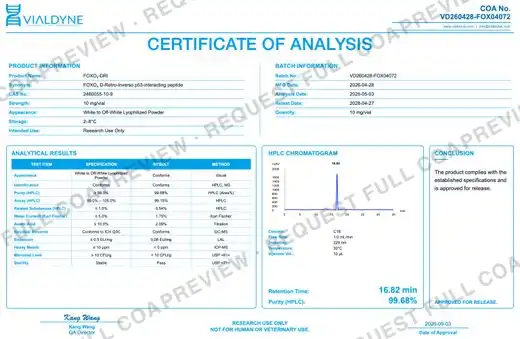
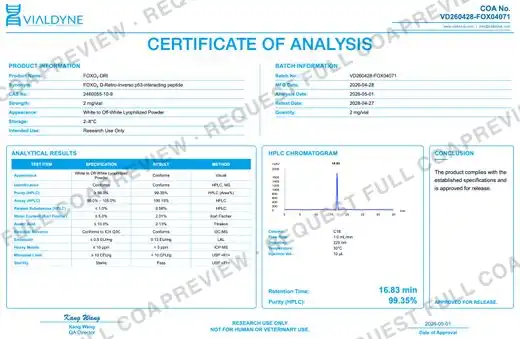
Published released-batch COAs for FOXO4-DRI, every lot HPLC-verified. These are previews — request the full high-resolution certificate for any lot.
VerifiedRequest full COA →FOXO4-DRI
VD260428-FOXO4072 · 99.68%
VerifiedRequest full COA →FOXO4-DRI
VD260428-FOXO4071 · 99.35%
Regulatory note
Research-use-only reference material; not for human or veterinary use.
Selected literature
Frequently asked questions
The defining structural feature is that every residue is a D-amino acid and the sequence is reversed relative to the natural peptide, so identity confirmation cannot stop at total mass. A DRI construct and its natural counterpart share the same molecular weight, meaning mass spectrometry alone cannot prove the chirality inversion. Accept a lot only against sequence-level confirmation covering the intended residues, supported by RP-HPLC purity showing a single dominant species and quantifying related-substance impurities. Also confirm net-peptide content and the counter-ion and water contributions, since those separate true peptide mass from salt and moisture in the vial.
Supplied lyophilized, it is best kept sealed, desiccated, and frozen until needed, with aliquoting used to avoid repeated freeze-thaw once a stock is in solution. The D-retro-inverso backbone confers strong resistance to proteolytic degradation, which helps in cell and in-vivo systems but does not exempt the material from ordinary aggregation or oxidation on the bench, so minimize time at room temperature and protect working solutions accordingly. Reconstitute in a vehicle matched to its solubility, record the preparation date, and treat prolonged storage of dissolved peptide as the main risk to a consistent intracellular exposure across experiments.
Related peptides