What the label states, the lot delivers — net peptide mass, not gross powder weight, purity reported as measured rather than rounded up, and a Certificate of Analysis for every lot.
Net peptide mass, not powder weight; purity as measured, not rounded up; a COA per lot.
Net peptide + purity not rounded up. COA per lot.
FDA PCAC reviews 7 peptides for the 503A bulks list (BPC-157, KPV, TB-500, MOTs-C, Emideltide, Semax, Epitalon). Read our compounder's decision tree. Read our briefing →
FDA PCAC reviews 7 peptides for the 503A bulks list in July. Read →
FDA PCAC: 7 peptides under review. Read →

Single-chain relaxin-2 mimetic · biased RXFP1 agonist
Overview
Single-chain relaxin-2 mimetic · biased RXFP1 agonist Vialdyne releases B7-33 as a lyophilized heptacosapeptide (linear, disulfide-free) against a ≥ 99.0% HPLC main-peak specification, with a batch-specific Certificate of Analysis covering RP-HPLC purity, mass-spec identity, water content, residual solvents, and endotoxin. Sequence / identity confirmation is documented on the released lot.
Applications & buyer fit
Repair peptides, BPC-157, TB-500, and related sequences, typically ship to research labs studying tissue-repair, gastrointestinal, or tendon-ligament models, and to compounding pharmacies that have validated the active material into their workflow. The synthesis itself is reliable, but analytical confirmation is where suppliers differ, buyers qualifying a new source should request sequence verification by tandem MS on the first batch and compare against the labelled sequence directly.
Sourced for
Buyer fit
Documentation that ships
Procurement note: Buyers qualifying a new source typically request tandem-MS sequence verification on the first lot, compared against the labelled sequence.
Primary buyer fit: academic and contract research laboratories.
Specifications
Certificate of Analysis
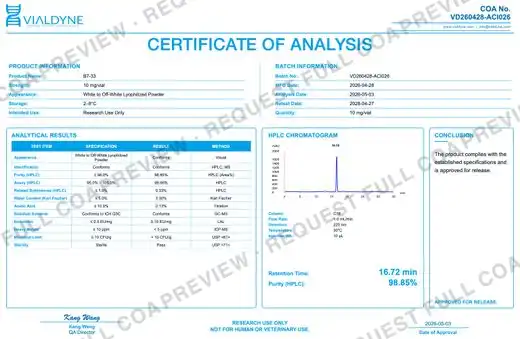
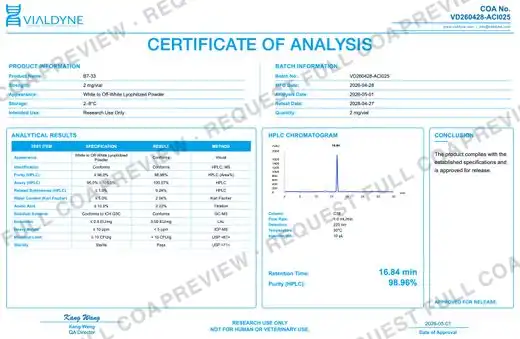
Published released-batch COAs for B7-33, every lot HPLC-verified. These are previews — request the full high-resolution certificate for any lot.
VerifiedRequest full COA →B7-33
VD260428-ACI026 · 98.85%
VerifiedRequest full COA →B7-33
VD260428-ACI025 · 98.96%
Regulatory note
Research-use-only reference material; not for human or veterinary use.
Frequently asked questions
Native relaxin-2 is a two-chain molecule held together by interchain and intrachain disulfide bonds, and making it requires oxidative folding that yields a background of scrambled disulfide isomers, forcing acceptance criteria to police correct folding. As a single 27-residue chain carrying no disulfide bonds at all, B7-33 avoids that entire class of misfolded-isomer impurities and its qualification reduces to standard linear-peptide checks: identity by mass spectrometry, purity by RP-HPLC to an area-percent limit, and a synthesis-related related-substances profile. This makes the acceptance file simpler and the batch-to-batch consistency easier to demonstrate for a qualifying buyer.
The certificate should confirm identity by mass spectrometry against the theoretical mass of the 27-residue linear peptide and report purity by RP-HPLC against a defined area-percent acceptance limit, with the impurity profile reflecting synthesis-derived species. Net peptide content, counterion identity, water content, and residual solvents belong on the release file so that potency calculations rest on assayed material rather than nominal vial mass, and endotoxin and microbial limits round out a compounding-oriented packet. Because the molecule is valued for its biased RXFP1 agonism, accurate identity confirmation is the load-bearing acceptance parameter rather than a formality.