If a supplied lot fails agreed specifications, we’ll replace it at no cost or refund its purchase price in full.
Quality test failed? Free replacement or full refund.
Off-spec? Free replacement or full refund.
FDA PCAC reviews 7 peptides for the 503A bulks list (BPC-157, KPV, TB-500, MOTs-C, Emideltide, Semax, Epitalon). Read our compounder's decision tree. Read our briefing →
FDA PCAC reviews 7 peptides for the 503A bulks list in July. Read →
FDA PCAC: 7 peptides under review. Read →

Mitochondria-targeted tetrapeptide (Szeto-Schiller)
Overview
SS-31, also known as Elamipretide (MTP-131, Bendavia), is a cell-permeable Szeto-Schiller tetrapeptide that concentrates selectively in the inner mitochondrial membrane through reversible association with cardiolipin. By stabilising cardiolipin-cytochrome-c interactions it is studied for its effect on electron-transport-chain efficiency and reactive-oxygen-species generation, which is why mitochondrial, cardiac, and neurodegeneration research models are the dominant demand context. Vialdyne releases lyophilised SS-31 acetate at ≥99.0% HPLC main-peak, with a batch COA available from sales. Depending on the agreed procurement scope, supporting records can cover RP-HPLC purity, peptide-content assay, related substances, water (Karl Fischer), counter-ion, residual solvents, and endotoxin. ESI-MS identity and the raw chromatogram are documented on the same lot for labs assembling a CMC or reference-standard dossier.
Applications & buyer fit
Mitochondrial-targeted peptides ship primarily to research labs studying OXPHOS, ROS biology, and mitochondrial dysfunction in disease models. The lipophilic / cationic character that drives mitochondrial accumulation also makes these peptides somewhat oxidation-prone in solution, working stocks should be prepared fresh or held at -80 °C rather than -20 °C when the workflow permits.
Sourced for
Buyer fit
Documentation that ships
Procurement note: The cationic / lipophilic character makes these peptides oxidation-prone in solution; working stocks are best held cold and prepared fresh.
Primary buyer fit: academic and contract research laboratories.
Specifications
Certificate of Analysis
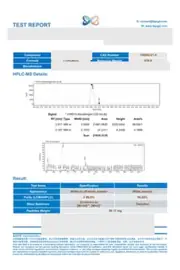
Representative COA previews for SS-31 / Elamipretide; request the certificate matched to the offered or supplied lot from sales. These are previews — request the full high-resolution certificate for any lot.
VerifiedRequest full COA →SS-31 / Elamipretide
VD260428-2S10190 · 99.04%
VerifiedRequest full COA →SS-31 / Elamipretide
VD260428-2S50191 · 99.11%
VerifiedRequest full COA →SS-31 / Elamipretide
VD260428-2S189 · 99.57%
Independent analytical testing
Product- and strength-matched first-page previews are shown separately from Vialdyne's lot-specific Batch COAs. Reference the report number when requesting the complete, high-resolution file from sales.
Third-party testing in Tianjin
Independent HPLC and mass-spectrometry reports from Qorix , the professional, authoritative third-party analytical laboratory at tjqxgd.com, affiliated with the Tianjin International Joint Academy of Biomedicine.
Regulatory note
Investigational compound; not approved as a finished drug in any jurisdiction. Sold as a research-use-only reference material, not for human or veterinary use.
Selected literature
Frequently asked questions
SS-31 carries an alternating aromatic-cationic motif (the Szeto-Schiller design) that lets the peptide cross the plasma membrane and then concentrate in the inner mitochondrial membrane through reversible binding to cardiolipin, a phospholipid unique to that membrane. This targeting is what separates SS-31 from peptides that act at the cell surface, and it is the basis for its use in mitochondrial-bioenergetics research.
Yes. SS-31 is the original Szeto-Schiller laboratory designation; Elamipretide (MTP-131) is the international nonproprietary name used in clinical development, and Bendavia is a former development code. All refer to the same D-Arg-Dmt-Lys-Phe-NH2 tetrapeptide (Dmt = 2,6-dimethyltyrosine). The released-batch COA lists CAS 736992-21-5 and the ESI-MS identity so the molecule can be cross-referenced unambiguously.
Related peptides