FDA PCAC: 7 peptides under review. Read →

Vialdyne

HMG (Human Menopausal Gonadotropin / Menotropins)

FSH / LH-active gonadotropin · heavily regulated

≥ 99.0%CAS 9002-68-0Custom Blends & OEM

Overview

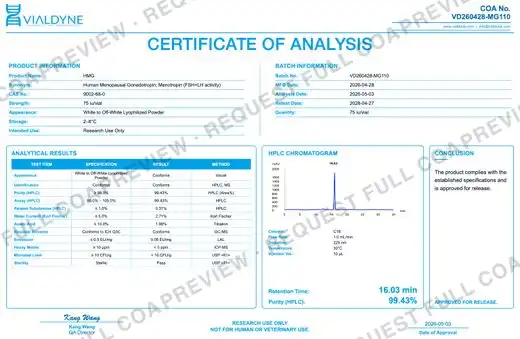
Human Menopausal Gonadotropin, generic name Menotropins and abbreviated as HMG, is a mixed-gonadotropin biological purified from postmenopausal-female urine. The source biology works because postmenopausal physiology excretes elevated pituitary gonadotropins as a consequence of lost ovarian feedback inhibition, making the urinary source viable at commercial scale. Historically the released material carries roughly equal FSH and LH bioactivity per IU, and the resulting drug class is approved across ovulation-induction and assisted-reproductive-technology indications under brand names that include Menopur, Repronex, and a small set of biosimilars. The product's distinctive niche inside the gonadotropin category comes from carrying both FSH and LH activity in a single ampoule, which supports follicular development through the FSH arm and luteal-phase progesterone production through the LH arm in a single dispense; recombinant FSH-only alternatives like Gonal-F and Follistim require an LH-source administered separately. For compounding pharmacy and distributor buyers, Vialdyne distributes HMG only to qualified accounts holding the right import-and-dispense licensing for assisted-reproductive or compounding use in the receiving jurisdiction; every order goes through upfront compliance screening before any lot reservation is made. The 75 IU catalogue fill matches the historical Menopur ampoule format around which the clinical-practice ecosystem has built its dosing and inventory infrastructure. As with HCG, the release packet leans on biological activity (FSH IU plus LH IU per ampoule, determined by bioassay) rather than chromatographic purity alone, the urinary source means the released material is a mixed-glycoprotein population, not a single defined molecule, so RP-HPLC purity is necessary but never sufficient as the quality criterion.

Who buys this, and why

Custom-blend buyers are almost always OEM clients building a branded product around a specific ratio of two or more peptides. The development workflow is collaborative: ratio target, analytical method to verify it, stability protocol in the chosen carrier, and packaging selection are all defined in the OEM brief before the first commercial run. Sample-stage volumes are usually 5-10 g of finished blend; commercial MOQ depends on the components.

Primary buyer fit: 503A / 503B compounding pharmacies and regional distributors and re-sellers.

Specifications

CAS
9002-68-0
Purity (HPLC)
≥ 99.0%
Common vial sizes
75 IU
MOQ
On request
Lead time
21–45 days
Storage
-20°C, protect from light

Documentation available on request

  • Certificate of Analysis (COA)
  • Ratio-verification HPLC
  • Mass-spec identity of each component
  • Stability of the blend (matrix-specific)
  • Bacterial endotoxin (LAL, USP <85>)
  • Sterile-fill documentation (where applicable)
  • SDS / MSDS
  • Private-label / OEM specification sheet

Regulatory note

Highly regulated urine-derived gonadotropin biological. Sold only to qualified buyers with appropriate licensing in their jurisdiction. Order requires compliance review.

Frequently asked questions

What's the difference between HMG and recombinant FSH (Gonal-F, Follistim)?

Activity composition is the headline difference. HMG is a urine-derived mixed-gonadotropin preparation containing both FSH and LH activity in roughly 1:1 ratio per IU. Recombinant FSH preparations (Gonal-F, Follistim) contain FSH activity only, with no LH component. Clinically, the dual FSH+LH activity of HMG supports follicular development through the FSH arm and luteal-phase progesterone synthesis through the LH arm inside a single dispense, while recombinant FSH-only protocols typically need a separate LH source (HCG or recombinant LH) administered during the luteal-phase window. The HMG-vs-recombinant-FSH choice depends on the specific assisted-reproductive-technology protocol, patient population, and prescriber preference; both are widely used and supported by extensive clinical data.

Why is HMG still widely used despite being a urine-derived rather than recombinant product?

Two reasons, one clinical and one economic. Clinically, urinary-derived HMG (under brand names Menopur, Repronex, and biosimilars) has been used since the 1950s with extensive accumulated safety and efficacy data, and the published comparison studies between urinary and recombinant alternatives have generally shown modest outcome differences. Economically, sourcing from postmenopausal-women urine remains less expensive per IU than recombinant cell-culture production. The net result is that many assisted-reproductive-technology centres continue to use HMG protocols specifically because the depth of accumulated clinical experience with the urinary-derived preparation is hard to displace.

How is the 75 IU standard fill used in typical assisted-reproductive-technology protocols?

The 75 IU HMG ampoule is the historical clinical-dose unit, sized to match the typical daily injection dose in ovulation-induction protocols. A standard IVF cycle uses 1-4 ampoules (75-300 IU) per daily dose, titrated to the patient's follicular response by ultrasound and serum estradiol monitoring. Total cycle exposure typically runs 8-14 days at 1-4 ampoules per day before the HCG trigger injection induces final follicular maturation. The 75 IU fill format predates and shaped the broader gonadotropin-injection ecosystem, most clinics' inventory management and dosing protocols are built around this unit size, so even where alternative formats exist the 75 IU ampoule remains the workhorse.