HCG (Human Chorionic Gonadotropin)
Gonadotropin glycoprotein hormone · heavily regulated
Overview
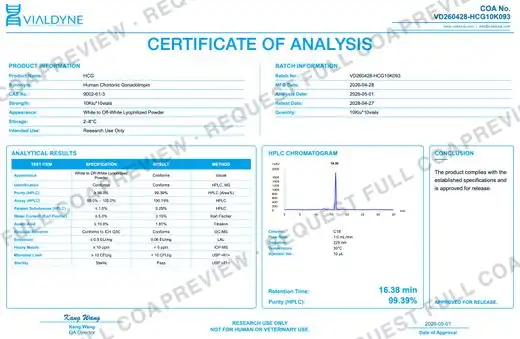
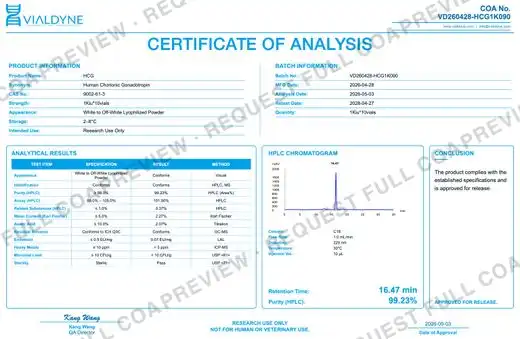
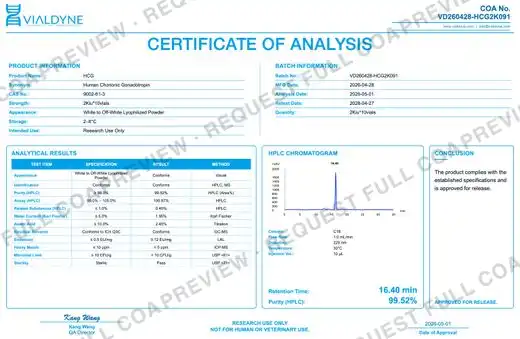
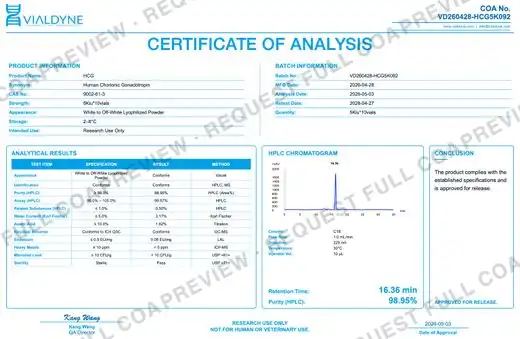
Human Chorionic Gonadotropin (HCG) is a heterodimeric glycoprotein hormone, produced natively by placental syncytiotrophoblast cells during pregnancy. The structural make-up is a 92-residue alpha-subunit (shared across FSH, LH, and TSH) non-covalently associated with a 145-residue HCG-specific beta-subunit; both subunits carry extensive glycosylation. Functionally, the molecule mimics LH activity at the LH/HCG receptor and carries prescription-drug approval across three clinical indications: ovulation induction, hypogonadotropic hypogonadism in males, and paediatric cryptorchidism. Bulk material is sourced through one of two routes, purification from pregnancy urine (the historical method) or recombinant cell-culture expression, and the two sources diverge in glycosylation pattern, requiring source-specific identity confirmation at the receiving QA step. For compounding pharmacy and distributor buyers, Vialdyne distributes HCG only to qualified buyers carrying appropriate import and dispensing licensing in the destination jurisdiction; every order routes through upfront compliance review before lot reservation. Eight catalogue fills span both IU-based presentations (1000-10000 IU range) and mass-based presentations (1-10 mg range) to accommodate the dual dosing conventions used across clinical and research workflows. The release packet leans on biological activity (IU per mg, determined by bioassay) rather than chromatographic purity alone, this is essential because heterodimer integrity and glycosylation pattern jointly affect potency in ways that RP-HPLC purity simply cannot capture.
Who buys this, and why
Custom-blend buyers are almost always OEM clients building a branded product around a specific ratio of two or more peptides. The development workflow is collaborative: ratio target, analytical method to verify it, stability protocol in the chosen carrier, and packaging selection are all defined in the OEM brief before the first commercial run. Sample-stage volumes are usually 5-10 g of finished blend; commercial MOQ depends on the components.
Primary buyer fit: 503A / 503B compounding pharmacies and regional distributors and re-sellers.
Specifications
- CAS
- 9002-61-3
- Purity (HPLC)
- ≥ 99.0%
- Common vial sizes
- 1000 IU, 2000 IU, 5000 IU, 10000 IU, 1 mg, 2 mg, 5 mg, 10 mg
- MOQ
- On request
- Lead time
- 21–45 days
- Storage
- -20°C, protect from light
Documentation available on request
- Certificate of Analysis (COA)
- Ratio-verification HPLC
- Mass-spec identity of each component
- Stability of the blend (matrix-specific)
- Bacterial endotoxin (LAL, USP <85>)
- Sterile-fill documentation (where applicable)
- SDS / MSDS
- Private-label / OEM specification sheet
Regulatory note
Highly regulated heterodimeric glycoprotein hormone. Sold only to qualified buyers with appropriate licensing in their jurisdiction. Order requires compliance review.
Frequently asked questions
Why does HCG have IU and mg dosing units, and how do they convert?▾
Glycoprotein-hormone biology forces the dual convention. The biological activity of HCG depends on glycosylation pattern as much as on protein mass, so the same mass of HCG from different sources can carry different biological activity. The International Unit (IU) is a bioassay-defined unit that captures activity directly, which is why clinical dosing standardises on IU. The conventional conversion factor for recombinant HCG is approximately 1 mg = 6000 IU, but the operative number is always the batch-specific bioassay-determined IU/mg printed on the released-batch COA. The catalogue ships both unit conventions, IU-based fills serve clinical and 503A workflows, mass-based fills serve research workflows where the IU convention is not operationally needed.
What's the difference between urinary-derived HCG and recombinant HCG?▾
Source and glycan profile, not protein backbone. Urinary HCG (uHCG) is purified from the urine of pregnant women and has been the historical source of HCG since the 1930s. Recombinant HCG (rHCG) is produced by recombinant cell-culture expression. The protein backbone is identical between the two, but the glycosylation pattern diverges: uHCG carries heavier glycosylation because the kidneys preferentially excrete the more-glycosylated isoforms during pregnancy, while rHCG carries a more uniform glycan profile from controlled cell-culture conditions. The PK consequence is a slightly longer plasma half-life for uHCG. Both forms are approved prescription drugs in major markets; the selection between them comes down to specific clinical protocol and supply availability at dispense time.
What are the typical clinical indications and dosing ranges for HCG in approved use?▾
HCG is approved for several distinct clinical indications with materially different dosing protocols. **Ovulation induction**: 5,000-10,000 IU IM single-dose to trigger follicular rupture after FSH/HMG priming. **Hypogonadotropic hypogonadism in males**: 1,000-4,000 IU IM 2-3x weekly to stimulate testicular testosterone production. **Cryptorchidism (undescended testicles)**: 500-4,000 IU IM 2-3x weekly for 2-6 weeks in paediatric patients. **Assisted reproductive technology**: variable protocols depending on the specific cycle and patient response. The 1,000 IU, 2,000 IU, 5,000 IU, and 10,000 IU catalogue fills span these clinical dose ranges directly. The mass-based fills (1-10 mg) target research workflows and compounding contexts where mass-based dosing is the operational standard rather than IU.
Related peptides