GHRP-6
Growth-hormone-releasing peptide-6
Overview
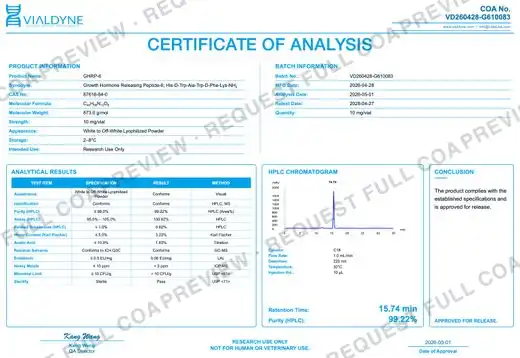
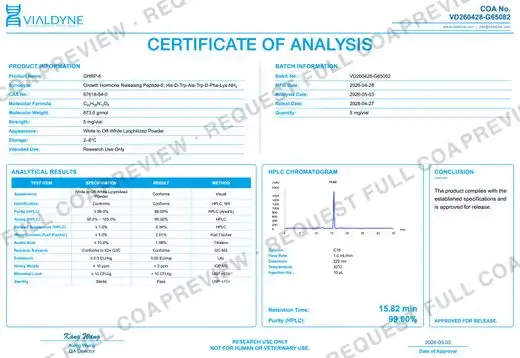
GHRP-6 is a synthetic hexapeptide GHSR agonist within the GHRP family. What distinguishes it from its siblings (GHRP-2, Ipamorelin, Hexarelin) is a pronounced appetite-stimulating effect that runs alongside the GH-release activity. The appetite signal traces to GHRP-6's binding profile at the GHSR sitting in the hypothalamic arcuate nucleus, native ghrelin is the body's endogenous hunger hormone, and GHSR agonists at higher doses partially recapitulate the appetite-driving activity that ghrelin natively delivers. The published research therefore covers two distinct lanes: GH-release pharmacology and orexigenic applications, making this molecule the right tool when both effects are desired and the wrong tool when either is a confounder. Vialdyne releases GHRP-6 as a lyophilised powder against a ≥99.0% main-peak HPLC specification. SPPS access to the hexapeptide is straightforward, so the standard release packet centres on peak-integration RP-HPLC plus ESI-MS identity. Catalogue strengths are 5 mg and 10 mg, sized to typical bench-scale research workflows. Selection rule: appetite-pharmacology endpoints point to GHRP-6 as the cleanest GHRP-family choice; clean GH-selective work points to Ipamorelin instead, both the appetite and cortisol-axis effects of GHRP-6 become contamination in that context.
Who buys this, and why
GH-axis peptides ship to two main buyer types: compounding pharmacies dispensing under physician supervision, and research labs studying somatotropic-axis pharmacology. Pharmacies typically want sterile-filled vials with the full release packet (sterility, endotoxin, CCI); labs typically want bulk lyophilized powder with sequence verification. Blends (the CJC-1295 / Ipamorelin combination is the canonical example) are usually co-lyophilized rather than solution-mixed for potency stability.
Primary buyer fit: academic and contract research laboratories.
Specifications
- CAS
- 87616-84-0
- Appearance
- White lyophilized powder
- Purity (HPLC)
- ≥ 99.0%
- Common vial sizes
- 5 mg, 10 mg
- MOQ
- On request
- Lead time
- 10–18 days
- Storage
- -20°C, protect from light
Documentation available on request
- Certificate of Analysis (COA)
- HPLC Chromatogram
- Mass-spec identity (ESI-MS)
- Counter-ion (acetate vs TFA)
- Sterile-fill release pack (sterility, CCI, fill-weight)
- Bacterial endotoxin (LAL, USP <85>)
- Stability data on request
- SDS / MSDS
Regulatory note
Sold as a bulk active for research and for compounding-pharmacy formulation where local regulations permit (notably 503A / 503B in the United States and analogous regimes elsewhere). Not a finished dosage form. Sterile-filled vials are available with full release documentation; the buyer is responsible for verifying scheduling and dispense requirements in the destination market.
Frequently asked questions
What distinguishes GHRP-6 from GHRP-2 and Ipamorelin within the GHRP family?▾
Appetite stimulation is the defining feature. At typical research doses, GHRP-6 produces measurable orexigenic activity that GHRP-2 carries in smaller magnitude and Ipamorelin essentially lacks. The mechanism is binding at the hypothalamic-arcuate-nucleus GHSR, the same receptor through which endogenous ghrelin drives hunger signalling. The trade-off is a less GH-selective pharmacology than Ipamorelin: any cellular or in vivo readout sensitive to appetite-axis effects or cortisol-axis effects will pick up confounding signal from GHRP-6 that Ipamorelin would not contribute. The practical decision: appetite-pharmacology research points to GHRP-6, clean GH-selective work points to Ipamorelin.
How is GHRP-6 reconstituted and stored for research workflows?▾
For multi-use stocks, reconstitute in bacteriostatic water for injection (BWFI); for single-use preparation, use sterile water for injection (SWFI). The hexapeptide goes into solution within 30-60 seconds with a gentle swirl. Never vortex, the foaming entrains air and accelerates surface-mediated aggregation, which can show up as quiet potency loss the standard release HPLC will not flag. Sub-divide the reconstituted solution into single-use aliquots immediately and hold at -20 C with strict thaw-count discipline; as with the rest of the GHRP family, freeze-thaw cycle count dominates measured-potency loss in routine use, much more than slow temperature drift. Working-stock concentrations of 1-5 mg/mL are typical; for in vivo administration the working concentration is further diluted to the protocol-specified dose volume.