FDA PCAC: 7 peptides under review. Read →

Vialdyne

GHRP-2

Growth-hormone-releasing peptide-2 · Pralmorelin

≥ 99.0%CAS 158861-67-7GH-Axis Peptides

Overview

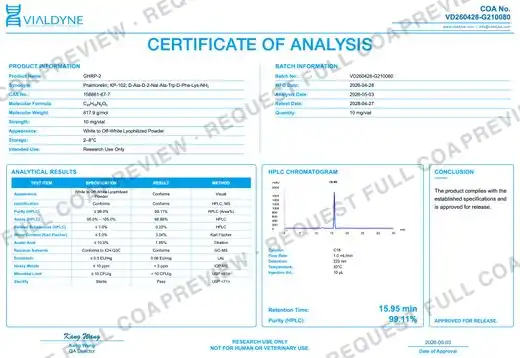
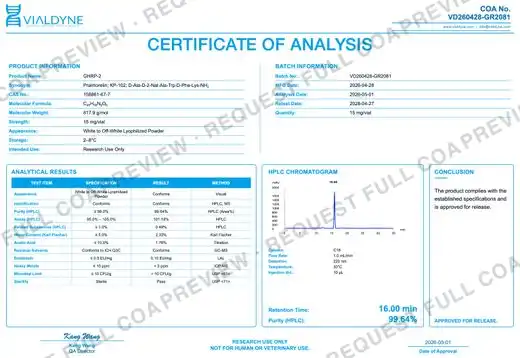
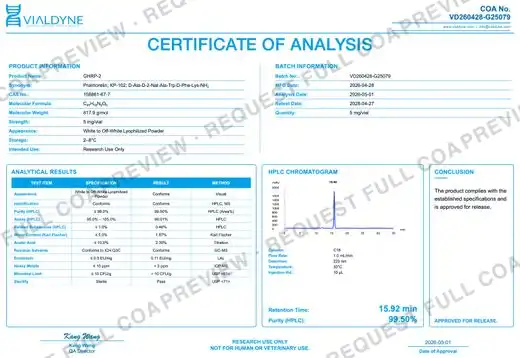
GHRP-2, also catalogued as Pralmorelin, is a synthetic hexapeptide secretagogue acting at the ghrelin / growth-hormone secretagogue receptor (GHSR) within the broader GHRP family. The peptide sequence is sometimes reported with minor variants across the literature; the standard form supplied here is Ala-D-Lys-Ala-Trp-D-Phe-Lys-NH2. Pharmacology produces robust GH release, which is what underwrote the historical Japanese approval of Pralmorelin as a diagnostic agent for evaluating GH-secretory capacity. The trade-off relative to Ipamorelin (the GH-selective member of the family) is broader receptor coverage, GHRP-2 engages the cortisol and prolactin axes at higher doses, which is a real confounder for any cellular or in vivo readout that touches those secondary axes. For compounding pharmacy buyers, Vialdyne releases GHRP-2 as a lyophilised powder against a ≥99.0% main-peak HPLC specification. SPPS access to the hexapeptide is straightforward, so the standard release packet centres on peak-integration RP-HPLC plus ESI-MS identity. Catalogue strengths are 5 mg and 10 mg, sized to typical bench-scale and research-dispensing workflows. The selection rule between GHRP-2 and Ipamorelin is mechanism-based: clean GH selectivity points to Ipamorelin; maximum GH-release amplitude with tolerable secondary-axis effects points to GHRP-2.

Who buys this, and why

GH-axis peptides ship to two main buyer types: compounding pharmacies dispensing under physician supervision, and research labs studying somatotropic-axis pharmacology. Pharmacies typically want sterile-filled vials with the full release packet (sterility, endotoxin, CCI); labs typically want bulk lyophilized powder with sequence verification. Blends (the CJC-1295 / Ipamorelin combination is the canonical example) are usually co-lyophilized rather than solution-mixed for potency stability.

Primary buyer fit: academic and contract research laboratories.

Specifications

CAS
158861-67-7
Appearance
White lyophilized powder
Purity (HPLC)
≥ 99.0%
Common vial sizes
5 mg, 10 mg
MOQ
On request
Lead time
10–18 days
Storage
-20°C, protect from light

Documentation available on request

  • Certificate of Analysis (COA)
  • HPLC Chromatogram
  • Mass-spec identity (ESI-MS)
  • Counter-ion (acetate vs TFA)
  • Sterile-fill release pack (sterility, CCI, fill-weight)
  • Bacterial endotoxin (LAL, USP <85>)
  • Stability data on request
  • SDS / MSDS

Regulatory note

Sold as a bulk active for research and for compounding-pharmacy formulation where local regulations permit (notably 503A / 503B in the United States and analogous regimes elsewhere). Not a finished dosage form. Sterile-filled vials are available with full release documentation; the buyer is responsible for verifying scheduling and dispense requirements in the destination market.

Frequently asked questions

How does GHRP-2 differ from Ipamorelin in receptor selectivity?

Both engage the GHSR (ghrelin receptor), but the selectivity envelopes diverge meaningfully. Ipamorelin is sharply selective for GHSR over the receptors driving cortisol, prolactin, and ACTH release, making it the cleanest GH-selective member of the GHRP family. GHRP-2 has broader receptor coverage, producing larger absolute GH-release magnitudes but with measurable secondary effects on cortisol and prolactin axes at higher doses. Practical guidance: clean GH selectivity (avoiding cortisol-axis confounders in cellular or in vivo readouts) points to Ipamorelin; maximum GH-release amplitude as the primary endpoint points to GHRP-2. Both pair productively with CJC-1295 in dual-pathway protocols, but the canonical co-lyophilised commercial blend is built around Ipamorelin.

What's the regulatory history of GHRP-2 as Pralmorelin?

Pralmorelin was approved in Japan in 2006 (GHRP Kaken brand) as a diagnostic agent for evaluating growth-hormone-secretory capacity in suspected adult GH deficiency. The approval rationale was the molecule's reliable GH-release response in subjects with intact pituitary function and the absence of response in subjects with GH deficiency, giving clinicians a binary diagnostic readout. That diagnostic indication remains the only approved use of GHRP-2 in any major jurisdiction. The molecule is widely deployed as a research tool for GHSR-pathway work but lacks therapeutic-use approval outside the Japanese diagnostic context, so pharmacy buyers should treat it as a research-use compound in all other markets.