What the label states, the lot delivers — net peptide mass, not gross powder weight, purity reported as measured rather than rounded up, and a Certificate of Analysis for every lot.
Net peptide mass, not powder weight; purity as measured, not rounded up; a COA per lot.
Net peptide + purity not rounded up. COA per lot.
FDA PCAC reviews 7 peptides for the 503A bulks list (BPC-157, KPV, TB-500, MOTs-C, Emideltide, Semax, Epitalon). Read our compounder's decision tree. Read our briefing →
FDA PCAC reviews 7 peptides for the 503A bulks list in July. Read →
FDA PCAC: 7 peptides under review. Read →

Delta sleep-inducing peptide
Overview
DSIP (delta sleep-inducing peptide) is a naturally occurring nonapeptide (Trp-Ala-Gly-Gly-Asp-Ala-Ser-Gly-Glu) first observed in 1974 and formally isolated and characterized in 1977 by the Schoenenberger-Monnier group in Switzerland from the cerebral venous blood of sleeping rabbits. It was initially identified for its sleep-promoting properties, and subsequent research has explored other possible neuromodulatory roles, including stress reduction, pain modulation, endocrine regulation, and early clinical exploration as an adjunct in opioid/alcohol withdrawal. Importantly, despite decades of study, DSIP's exact physiological role as a "sleep-inducing factor," its endogenous receptor, and its mechanism of action remain unresolved (described in the field as a "still unresolved riddle" — see Kovalzon & Strekalova, J Neurochem 2006, 97:303-309, peer-reviewed review). Most existing human evidence comes from small, early, uncontrolled studies that fall well short of modern clinical trial standards. Regulatory context (as of this verification): the U.S. FDA's Pharmacy Compounding Advisory Committee is scheduled to discuss Emideltide (DSIP), among several other peptides, at a July 23-24, 2026 meeting regarding potential inclusion on the Section 503A bulk drug substances list for compounding, with DSIP/Emideltide specifically on the July 24 agenda — confirmed via FDA.gov and publicly available Federal Register documentation. As of this writing the outcome of that meeting has not been published, and this does not represent any approval of DSIP for human therapeutic use. Vialdyne releases DSIP as a lyophilized nonapeptide (linear) against a ≥ 99.0% HPLC main-peak specification, with a batch-specific Certificate of Analysis covering RP-HPLC purity, mass-spec identity, water content, residual solvents, and endotoxin. Sequence / identity confirmation is documented on the released lot.
Applications & buyer fit
Cognitive and neuropeptide buyers are predominantly research labs running in vivo rodent studies. The dominant administration route in the literature is intranasal, these peptides are not meaningfully blood-brain-barrier permeable when delivered systemically. For in vivo workflows, endotoxin and microbial-limit testing is recommended at the COA stage so the bioassay readout is not confounded by contamination unrelated to the test article.
Sourced for
Buyer fit
Documentation that ships
Procurement note: For in vivo workflows, endotoxin and microbial-limit testing on the specific lot is recommended at the COA stage.
Primary buyer fit: academic and contract research laboratories.
Specifications
Certificate of Analysis
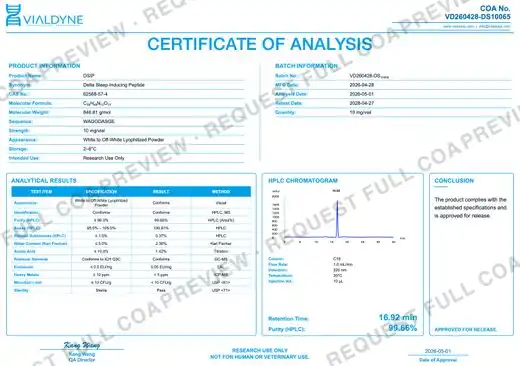
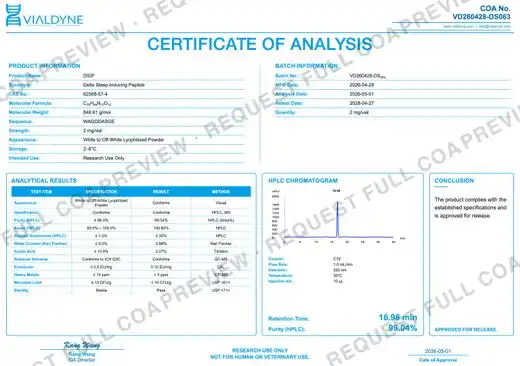
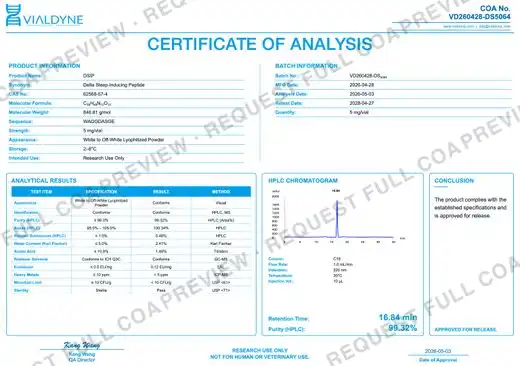
Published released-batch COAs for DSIP, every lot HPLC-verified. These are previews — request the full high-resolution certificate for any lot.
VerifiedRequest full COA →DSIP
VD260428-DS10065 · 99.66%
VerifiedRequest full COA →DSIP
VD260428-DS063 · 99.04%
VerifiedRequest full COA →DSIP
VD260428-DS5064 · 99.32%
Regulatory note
Research-use-only reference material; not for human or veterinary use.
Selected literature
Frequently asked questions
The DSIP lyophilizate takes up ambient moisture faster than most short peptides because its sequence is unusually polar with few hydrophobic anchors, so the SOP should minimize open-vial time, reconstitute promptly after first opening, and blanket partially used vials under dry nitrogen or argon. Because water uptake shifts the effective concentration of any later reconstitution by a few percent and accelerates hydrolytic degradation in storage, document weighing conditions and consider low-humidity handling. Record water content on intake and calculate doses from the net-peptide assay so moisture-driven concentration drift is accounted for in preparation math.
Identity qualification is chemical and does not depend on mechanism, which for DSIP remains unsettled with no definitively identified receptor. Confirm the compound at intake with an HPLC purity result against the stated acceptance limit and a mass measurement consistent with the declared sequence, recording the sequence assignment rather than relying on the product name. Verify salt form, water content, and appearance of the lyophilizate against the COA. Retain a reference sample and log lot, assay basis, and re-test date. The orphan-receptor status affects research design, not the identity and purity controls required for acceptance.
Related peptides