What the label states, the lot delivers — net peptide mass, not gross powder weight, purity reported as measured rather than rounded up, and a Certificate of Analysis for every lot.
Net peptide mass, not powder weight; purity as measured, not rounded up; a COA per lot.
Net peptide + purity not rounded up. COA per lot.
FDA PCAC reviews 7 peptides for the 503A bulks list (BPC-157, KPV, TB-500, MOTs-C, Emideltide, Semax, Epitalon). Read our compounder's decision tree. Read our briefing →
FDA PCAC reviews 7 peptides for the 503A bulks list in July. Read →
FDA PCAC: 7 peptides under review. Read →

AMPK pathway activator · exercise mimetic research compound
Overview
AICAR (5-aminoimidazole-4-carboxamide ribonucleoside, also known as Acadesine) is a synthetic adenosine analog/nucleotide precursor and a classic activator of AMP-activated protein kinase (AMPK), widely used to study cellular energy-metabolism pathways. Intracellularly, it is phosphorylated by adenosine kinase into the active metabolite ZMP (AICA ribotide, PubChem CID 65110), which mimics AMP binding to activate AMPK. The compound is well known in the research community for its "exercise mimetic" effect: a 2008 study by Narkar et al. published in Cell ("AMPK and PPARδ Agonists Are Exercise Mimetics," Cell 134:405-415) showed that 4 weeks of AICAR treatment in untrained, sedentary mice increased treadmill running distance by roughly 44% (and running duration by roughly 23%) versus controls — a finding that was the key scientific basis for the World Anti-Doping Agency (WADA) adding AICAR to its Prohibited List in 2009. Under the current (2026) WADA Prohibited List, AICAR is classified under S4 "Hormone and Metabolic Modulators," specifically the AMPK-activator subclass S4.4.1 (this subclass was renumbered from S4.5.1, with MOTS-c added as an additional example substance in the 2025 list); it is banned both in and out of competition. AICAR also progressed to Phase III clinical trials (RED-CABG, cardiac surgery protection) and Phase I/II trials (under the trademark Acadra™, for CLL leukemia treatment), but was never approved for marketing in either indication. This product is for research use only (RUO) and must not be administered to humans. Vialdyne releases AICAR as a lyophilized small molecule (nucleoside/ampk-activator analog) against a ≥ 99.0% HPLC main-peak specification, with a batch-specific Certificate of Analysis covering RP-HPLC purity, mass-spec identity, water content, residual solvents, and endotoxin. Sequence / identity confirmation is documented on the released lot.
Applications & buyer fit
Mitochondrial-targeted peptides ship primarily to research labs studying OXPHOS, ROS biology, and mitochondrial dysfunction in disease models. The lipophilic / cationic character that drives mitochondrial accumulation also makes these peptides somewhat oxidation-prone in solution, working stocks should be prepared fresh or held at -80 °C rather than -20 °C when the workflow permits.
Sourced for
Buyer fit
Documentation that ships
Procurement note: The cationic / lipophilic character makes these peptides oxidation-prone in solution; working stocks are best held cold and prepared fresh.
Primary buyer fit: academic and contract research laboratories.
Specifications
Certificate of Analysis
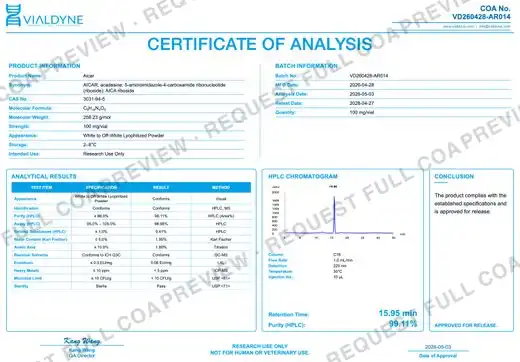
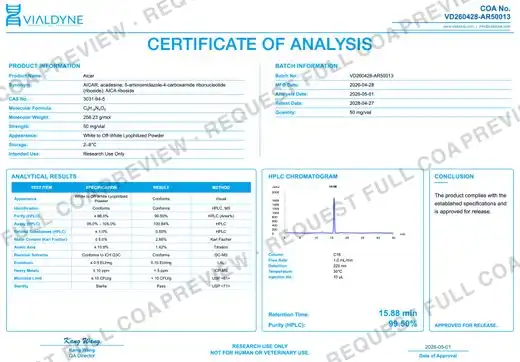
Published released-batch COAs for AICAR, every lot HPLC-verified. These are previews — request the full high-resolution certificate for any lot.
VerifiedRequest full COA →Aicar
VD260428-AR014 · 99.11%
VerifiedRequest full COA →Aicar
VD260428-AR50013 · 99.50%
Regulatory note
Research-use-only reference material; not for human or veterinary use.
Selected literature
Frequently asked questions
AICAR is a ribonucleotide small molecule, so its release file is built on small-molecule methods: identity and purity by RP-HPLC against an area-percent limit, characteristic UV absorbance for identity confirmation, water content, and residual-solvent profiling. Because it is not a peptide, mass-spec sequence verification does not apply and the impurity profile reflects synthetic-route byproducts rather than deletion sequences. A buyer qualifying the material should confirm which chemical form the certificate describes, since the nucleoside and nucleotide forms differ, and should map incoming acceptance to a small-molecule template rather than a peptide one.
Cellular AMPK studies use AICAR at high working concentrations because the molecule must enter cells and be converted to its active monophosphate before engaging the kinase, so it is supplied in tens-of-milligrams to hundred-milligram fills rather than the microgram scale typical of peptides. A qualification file should account for this by verifying net compound content on the certificate for accurate molar solution preparation and by confirming solubility in the intended diluent at the concentrations a protocol demands. Because dose-response is not universal across model systems, buyers should tie handling and concentration decisions to the specific protocol being replicated.
Related peptides