What the label states, the lot delivers — net peptide mass, not gross powder weight, purity reported as measured rather than rounded up, and a Certificate of Analysis for every lot.
Net peptide mass, not powder weight; purity as measured, not rounded up; a COA per lot.
Net peptide + purity not rounded up. COA per lot.
FDA PCAC reviews 7 peptides for the 503A bulks list (BPC-157, KPV, TB-500, MOTs-C, Emideltide, Semax, Epitalon). Read our compounder's decision tree. Read our briefing →
FDA PCAC reviews 7 peptides for the 503A bulks list in July. Read →
FDA PCAC: 7 peptides under review. Read →

ActRIIB-Fc decoy receptor fusion protein · myostatin pathway
Overview
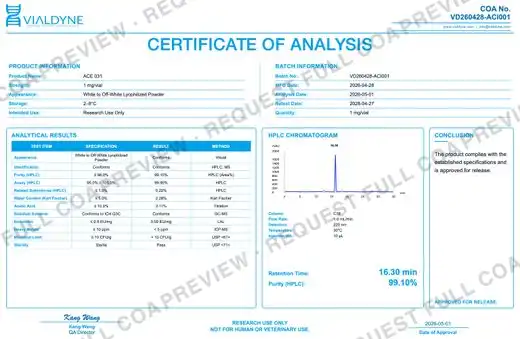
ACE-031 (generic name ramatercept, USAN code YY-125) is a recombinant fusion protein developed by Acceleron Pharma that joins the extracellular ligand-binding domain of the human activin receptor type IIB (ActRIIB/ACVR2B) to the Fc region of human IgG1 via a short glycylglycylglycine linker (per the official NCATS Inxight Drugs description), forming a soluble homodimeric "decoy receptor." It was designed to competitively bind and neutralize TGF-beta superfamily ligands — including myostatin (GDF-8), GDF-11, and activins — thereby blocking their negative regulation of muscle growth. The compound was studied in Phase II trials for Duchenne muscular dystrophy (DMD) and for sarcopenia in postmenopausal women. Clinical dosing was halted in 2011 after vascular-related adverse events (epistaxis, gingival bleeding, facial telangiectasias) — most sources place the dosing halt in February 2011, with the public announcement following in April 2011; following preclinical evaluation, Acceleron and partner Shire jointly announced permanent discontinuation of the program in May 2013. It has no approved indication today (both the KEGG DRUG database, entry D10347, and NCATS Inxight Drugs, UNII 42HQC6QLEK, list its status as discontinued/investigational, never advanced). It now exists only within RUO/gray-market supply chains and anti-doping detection literature; new preclinical marmoset research and black-market product authenticity studies continued to be published in 2025-2026, indicating ongoing interest in both research and anti-doping contexts. Vialdyne releases ACE-031 as a lyophilized fusion protein (actriib receptor-fc) against a ≥ 99.0% HPLC main-peak specification, with a batch-specific Certificate of Analysis covering RP-HPLC purity, mass-spec identity, water content, residual solvents, and endotoxin. Sequence / identity confirmation is documented on the released lot.
Applications & buyer fit
GH-axis peptides ship to two main buyer types: compounding pharmacies dispensing under physician supervision, and research labs studying somatotropic-axis pharmacology. Pharmacies typically want sterile-filled vials with the full release packet (sterility, endotoxin, CCI); labs typically want loose-format lyophilized powder with sequence verification. Blends (the CJC-1295 / Ipamorelin combination is the canonical example) are usually co-lyophilized rather than solution-mixed for potency stability.
Sourced for
Buyer fit
Documentation that ships
Procurement note: Sterile-filled vials are available with the full release packet (sterility, endotoxin, CCI); loose lyophilized powder ships with sequence verification.
Primary buyer fit: academic and contract research laboratories.
Specifications
Certificate of Analysis
Published released-batch COAs for ACE-031, every lot HPLC-verified. These are previews — request the full high-resolution certificate for any lot.
Browse all published COAsRegulatory note
Research-use-only reference material; not for human or veterinary use.
Selected literature
Frequently asked questions
ACE-031 is a soluble ActRIIB extracellular domain fused to IgG1 Fc, roughly 90 kDa, so its qualification differs from a synthetic peptide. Require identity and purity data appropriate to a recombinant protein, such as SDS-PAGE or size-exclusion purity and a mass or intact-protein confirmation, plus endotoxin and, where relevant, bioburden results on the batch record. Handle under cold chain: single-use aliquots stored at -80 degrees Celsius is the conservative approach, with freeze-thaw cycling minimized. Log lot, concentration, buffer composition, and re-test date, and confirm the buffer suits your downstream working-solution preparation.
For a recombinant fusion protein used at low-nanomolar working levels, surface adsorption is a real loss pathway, so prepare working solutions in cell-culture-grade buffer with a carrier protein such as 0.1 percent BSA to limit binding to tube and plate surfaces. Base dilutions on the stated protein concentration and the roughly 90 kDa mass when converting between molar and mass units. Prepare from a thawed single-use aliquot rather than repeatedly cycling a stock, and avoid vortex-induced foaming. Document buffer, carrier, target concentration, and the aliquot used so each preparation is reproducible and traceable.
Related peptides