What the label states, the lot delivers — net peptide mass, not gross powder weight, purity reported as measured rather than rounded up, and a Certificate of Analysis for every lot.
Net peptide mass, not powder weight; purity as measured, not rounded up; a COA per lot.
Net peptide + purity not rounded up. COA per lot.
FDA PCAC reviews 7 peptides for the 503A bulks list (BPC-157, KPV, TB-500, MOTs-C, Emideltide, Semax, Epitalon). Read our compounder's decision tree. Read our briefing →
FDA PCAC reviews 7 peptides for the 503A bulks list in July. Read →
FDA PCAC: 7 peptides under review. Read →

p53-HDM2-binding · penetratin-fused research peptide
Overview
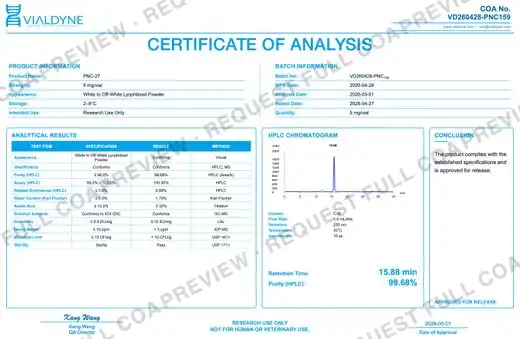
PNC-27 is a 32-amino-acid chimeric anticancer peptide developed in 2000 at SUNY Downstate Medical Center by Dr. Matthew Pincus and Dr. Joseph Michl using computer modeling. It is built from the HDM-2-binding domain of the p53 tumor suppressor protein (residues 12-26) fused to a membrane-penetrating peptide (MRP) derived from the Drosophila Antennapedia penetratin sequence. It works by selectively binding to HDM-2 protein that is overexpressed on cancer cell membranes, while normal cells are spared because they lack membrane-bound HDM-2. The FDA has explicitly warned about contamination risk and the product's unapproved status, and no peer-reviewed human clinical trial data exist; a published case report also describes a patient who died after severe gastrointestinal hemorrhage following experimental PNC-27 treatment (causation unproven — see Safety section). Vialdyne releases PNC-27 as a lyophilized dotriacontapeptide (linear, p53-hdm2-binding domain fused to penetratin cell-penetrating sequence) against a ≥ 99.0% HPLC main-peak specification, with a batch-specific Certificate of Analysis covering RP-HPLC purity, mass-spec identity, water content, residual solvents, and endotoxin. Sequence / identity confirmation is documented on the released lot.
Applications & buyer fit
Buyers for longevity-class peptides span research labs working on telomere, collagen, and circadian-rhythm models, plus cosmetic-formulation OEMs incorporating peptides like GHK-Cu into anti-aging finished products. Copper peptides in particular require attention to chelator-free water and EDTA-free buffers in downstream formulation work, incompatibility there is the most common cause of "the peptide didn't work" support tickets in this class.
Sourced for
Buyer fit
Documentation that ships
Procurement note: Copper peptides require chelator-free water and EDTA-free buffers in downstream formulation work.
Primary buyer fit: academic and contract research laboratories.
Specifications
Certificate of Analysis
Published released-batch COAs for PNC-27, every lot HPLC-verified. These are previews — request the full high-resolution certificate for any lot.
Browse all published COAsRegulatory note
Research-use-only reference material; not for human or veterinary use.
Selected literature
Frequently asked questions
PNC-27 is a long fusion joining an HDM-2-binding stretch to a penetratin transduction domain, so both segments must be verified as supplied. Total mass by mass spectrometry establishes the overall construct, but for a peptide this length request sequence-level confirmation and an RP-HPLC purity profile that resolves truncated or deletion species, which are the common failure modes in longer syntheses. Confirm net-peptide content alongside counter-ion and moisture, since a highly basic sequence can carry substantial salt. A lot that is mostly truncation product would compromise both the binding and the cell-penetration behavior the tool depends on.
Supplied lyophilized, it should be stored sealed, desiccated, and frozen, then aliquoted after reconstitution to avoid freeze-thaw cycles that can nucleate aggregation in an amphipathic, membrane-interacting peptide. Prepare working solutions fresh where possible and keep them cold, because self-association in stock solution can shift the effective concentration reaching cells and confound comparisons across plates. Match the reconstitution vehicle to the compound's documented solubility rather than defaulting to a buffer that promotes precipitation, and record preparation dates so any drift in membrane activity can be traced to solution age rather than to lot identity.