What the label states, the lot delivers — net peptide mass, not gross powder weight, purity reported as measured rather than rounded up, and a Certificate of Analysis for every lot.
Net peptide mass, not powder weight; purity as measured, not rounded up; a COA per lot.
Net peptide + purity not rounded up. COA per lot.
FDA PCAC reviews 7 peptides for the 503A bulks list (BPC-157, KPV, TB-500, MOTs-C, Emideltide, Semax, Epitalon). Read our compounder's decision tree. Read our briefing →
FDA PCAC reviews 7 peptides for the 503A bulks list in July. Read →
FDA PCAC: 7 peptides under review. Read →

Methionine / inositol / choline + B-vitamin multi-component preparation
Overview
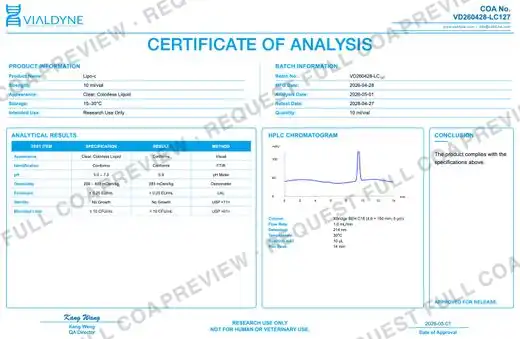
Lipo-C (also called MIC Injection or MICC) is a lipotropic compounded injection containing methionine, inositol, choline, and B-vitamins (usually B12, with some formulations adding B6/B1). It is prepared by prescription compounding pharmacies and commonly marketed as an adjunct to weight-management programs and for liver metabolic support. These ingredients are believed to act together as methyl donors and fat-transport cofactors. Importantly, there is currently no well-designed randomized controlled trial demonstrating that the Lipo-C formulation itself — as a whole product — produces an independent, attributable weight-loss effect; the supportive evidence that exists comes from studies of individual ingredients (choline, inositol, carnitine, etc.) rather than from trials of the Lipo-C blend as a whole. Formulations are also not standardized across compounding pharmacies — ingredient lists and concentrations vary considerably between vendors (a common formula uses Methionine/Inositol/Choline Chloride/L-Carnitine/Thiamine HCl/Dexpanthenol at roughly 15/50/50/50/15/5 mg/mL, but this varies by supplier). The product is not FDA-approved for any indication. Vialdyne releases Lipo-C as a lyophilized peptide/vitamin blend (multiple independently characterized components) against a ≥ 99.0% HPLC main-peak specification, with a batch-specific Certificate of Analysis covering RP-HPLC purity, mass-spec identity, water content, residual solvents, and endotoxin. Sequence / identity confirmation is documented on the released lot.
Applications & buyer fit
Most buyers in this category are 503A and 503B compounding pharmacies fulfilling metabolic and weight-management protocols, plus research labs investigating GLP-1 / GIP / GCG receptor pharmacology. The procurement decision usually hinges on three things: documented purity at scale, a regulatory team that can respond on destination-market questions in writing, and the ability to supply consistent counter-ion form (acetate by default) across recurring orders.
Sourced for
Buyer fit
Documentation that ships
Procurement note: Supplied as a documented active in acetate counter-ion form by default; the buyer verifies current scheduling and compounding eligibility for the destination market.
Primary buyer fit: academic and contract research laboratories.
Specifications
Certificate of Analysis
Published released-batch COAs for Lipo-C, every lot HPLC-verified. These are previews — request the full high-resolution certificate for any lot.
Browse all published COAsRegulatory note
Research-use-only reference material; not for human or veterinary use.
Selected literature
Frequently asked questions
Identity is established component by component rather than as a single entity: each small-molecule component is confirmed by the appropriate HPLC and mass-spec identity check, the exact B-vitamin form is confirmed and stated, and the documented formulation is reported against the specification on the COA. Buyers should confirm each component and the B-vitamin form by COA or label before use.
B-12 occurs in several forms (cyanocobalamin, methylcobalamin, hydroxocobalamin, adenosylcobalamin) that are not interchangeable for all purposes, so the specific form in a given Lipo-C lot is stated on the COA rather than assumed. Peprimo can configure the form on the preparation; specify the required form at order placement.