What the label states, the lot delivers — net peptide mass, not gross powder weight, purity reported as measured rather than rounded up, and a Certificate of Analysis for every lot.
Net peptide mass, not powder weight; purity as measured, not rounded up; a COA per lot.
Net peptide + purity not rounded up. COA per lot.
FDA PCAC reviews 7 peptides for the 503A bulks list (BPC-157, KPV, TB-500, MOTs-C, Emideltide, Semax, Epitalon). Read our compounder's decision tree. Read our briefing →
FDA PCAC reviews 7 peptides for the 503A bulks list in July. Read →
FDA PCAC: 7 peptides under review. Read →

Metastin (45-54) · HPG-axis research peptide
Overview
Kisspeptin-10 (KP-10) is a member of the neuropeptide family encoded by the KISS1 gene — the 10-amino-acid active C-terminal fragment of the 145-amino-acid kisspeptin precursor protein, also known as Metastin (45-54). Regarded as a "master regulator" of the reproductive system, KP-10 is the endogenous ligand for hypothalamic GnRH neurons and is essential for the onset of puberty, fertility, and reproductive function. Current research is exploring its therapeutic potential in infertility, low sexual desire, and reproductive disorders. Vialdyne releases Kisspeptin-10 as a lyophilized decapeptide (linear) against a ≥ 99.0% HPLC main-peak specification, with a batch-specific Certificate of Analysis covering RP-HPLC purity, mass-spec identity, water content, residual solvents, and endotoxin. Sequence / identity confirmation is documented on the released lot.
Applications & buyer fit
GH-axis peptides ship to two main buyer types: compounding pharmacies dispensing under physician supervision, and research labs studying somatotropic-axis pharmacology. Pharmacies typically want sterile-filled vials with the full release packet (sterility, endotoxin, CCI); labs typically want loose-format lyophilized powder with sequence verification. Blends (the CJC-1295 / Ipamorelin combination is the canonical example) are usually co-lyophilized rather than solution-mixed for potency stability.
Sourced for
Buyer fit
Documentation that ships
Procurement note: Sterile-filled vials are available with the full release packet (sterility, endotoxin, CCI); loose lyophilized powder ships with sequence verification.
Primary buyer fit: academic and contract research laboratories.
Specifications
Certificate of Analysis
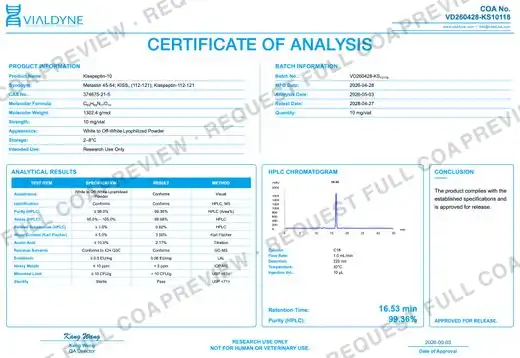
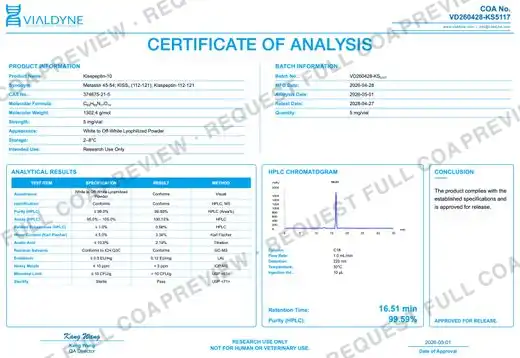
Published released-batch COAs for Kisspeptin-10, every lot HPLC-verified. These are previews — request the full high-resolution certificate for any lot.
VerifiedRequest full COA →Kisspeptin-10
VD260428-KS10118 · 99.36%
VerifiedRequest full COA →Kisspeptin-10
VD260428-KS5117 · 99.59%
Regulatory note
Research-use-only reference material; not for human or veterinary use.
Selected literature
Frequently asked questions
A defensible qualification packet lists identity by mass spectrometry against the theoretical mass of the C-terminal decapeptide, purity by RP-HPLC with an area-percent acceptance limit, and confirmation of the intact RFamide C-terminus since that motif governs GPR54 binding. Because Kisspeptin-10 is produced by solid-phase synthesis rather than fragment processing, the impurity profile is dominated by synthesis-related species, so the COA should report a related-substances profile alongside net peptide content, counterion identity, water content, and residual solvents. Endotoxin and microbial limits complete the release file for a compounding-oriented buyer.
The lyophilized solid is the stable form and should be held desiccated and cold, with the sealed vial equilibrated to room temperature before opening to prevent condensation onto hygroscopic powder. The net-peptide value on the certificate, not gross vial weight, is the correct basis for calculating reconstitution volume. In solution the decapeptide is far less stable than in the solid state, so working aliquots should be prepared and either used promptly or frozen once, avoiding repeated freeze-thaw. Documenting reconstitution diluent, concentration, and date supports traceability back to the released batch.