Crystagen is a synthetic short-chain peptide bioregulator developed by Prof. Vladimir Khavinson's team at the St. Petersburg Institute of Bioregulation and Gerontology. Its active substance is the "AC-6 peptide complex," whose core sequence is glutamic acid-aspartic acid-proline (Glu-Asp-Pro, abbreviated EDP, H-Glu-Asp-Pro-OH). It was originally isolated as one of the principal active short peptides within Thymalin, a bovine-thymus-extract preparation approved in Russia in 1982, and is documented in US Patent 8057810B2 ("Peptide substance revealing an immunogeroprotective effect"). This independent re-verification (third pass, with the full patent text re-fetched directly from Google Patents and checked word-for-word) confirmed the sequence H-Glu-Asp-Pro-OH, molecular formula C14H21N3O8, and molecular weight 359.33 — but the patent text itself never uses the name "Crystagen" or "AC-6." The only route to that trade-name linkage is an indirect one via the patent-listing page on Khavinson's official site (khavinson.info): this pass fetched that page directly and found its glutamyl-aspartyl-proline entry is actually a related national-phase patent, Israeli patent IL 194499 (same inventors, same underlying invention as US8057810B2, filed in a different country) — and that page likewise does not attach the "Crystagen" or "AC-6" brand name to the entry. This link should be read as indirect (via a sister patent plus an official-site association) rather than a direct textual confirmation, stated here explicitly for transparency. The peptide belongs to Khavinson's synthetic "Cytogen" series (paired with the natural-extract "Cytomax" series, e.g., Thymalin/Vladonix), and the original product is sold in Russia and some overseas channels (CosmicNootropic, antiaging-systems.com, ipept.com) as an oral capsule or sublingual drop under the brand Crystagen®, positioned as a synthetic counterpart to a natural thymic extract. It is currently sold through RUO channels as synthetic peptide powder/pre-mixed solution, for laboratory research use only — not for human or animal clinical use. Importantly: sequence labeling confusion in the RUO market is significant. Beyond the previously identified mislabels — Thr-Lys-Asp (TKD, actually Thymogen's sequence) and Lys-Glu-Asp (KED, actually Vesugen's sequence) — this pass again independently confirmed two further conflicting labels in circulation: peptidedistro.com lists Pro-Gln-Asn (proline-glutamine-asparagine), and antiaging-systems.com lists a composition of "glycine, glutamic acid, and aspartic acid" (which also doesn't fully match yet another independent source, peptide-products.com, describing AC-6 as composed of "proline, glutamic acid, aspartic acid" — market labeling is inconsistent across many variants). Cross-checked directly against the full text of US Patent 8057810B2, Glu-Asp-Pro (EDP) should be treated as the correct sequence; all other labels found are market mislabeling, and buyers should require batch-specific COA confirmation (ESI-MS + HPLC) from suppliers.
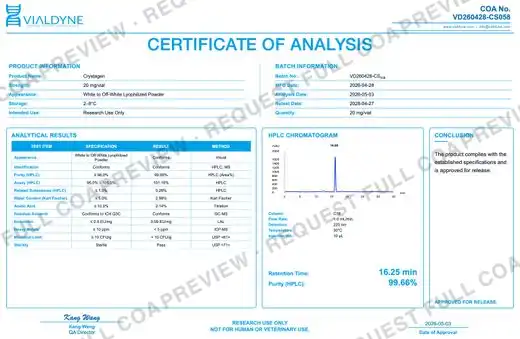
Vialdyne releases Crystagen as a lyophilized tripeptide (linear) against a ≥99.0% HPLC main-peak specification, with a batch-specific Certificate of Analysis covering RP-HPLC purity and mass-spec identity; water content, residual solvents and endotoxin are available on request and listed on the COA when tested. Sequence / identity confirmation is documented on the released lot.
Applications & buyer fit
Buyers for longevity-class peptides span research labs working on telomere, collagen, and circadian-rhythm models, plus cosmetic-formulation OEMs incorporating peptides like GHK-Cu into anti-aging finished products. Copper peptides in particular require attention to chelator-free water and EDTA-free buffers in downstream formulation work, incompatibility there is the most common cause of "the peptide didn't work" support tickets in this class.
How Crystagen is sourced
Sourced for
Research into telomere, collagen, and circadian-rhythm models
Cosmetic-formulation OEM work incorporating peptides such as GHK-Cu
Buyer fit
academic and contract research laboratories
Documentation that ships
Certificate of Analysis (COA)
HPLC Chromatogram
Mass-spec identity (ESI-MS)
Copper-content verification (Cu-peptides only)
Stability in finished-formulation matrix
INCI naming for cosmetic use
SDS / MSDS
Sequence verification on request
Procurement note: Copper peptides require chelator-free water and EDTA-free buffers in downstream formulation work.
Primary buyer fit: academic and contract research laboratories.
Specifications
CAS
(research compound · identity on COA)
Molecular Formula
C14H21N3O8
Molecular Weight
359.33 g/mol
Sequence
Glu-Asp-Pro
Appearance
White to off-white lyophilized powder
Purity (HPLC)
≥ 99.0%
Strength
20 mg
Packaging
10 vials/box · base pack (multiples of 10)
Half-life
≈ 30 minutes
MOQ
On request
Lead time
14–21 days
Storage
2–8°C, protect from light
Certificate of Analysis
Representative COA previews for Crystagen; request the certificate matched to the offered or supplied lot from sales. These are previews — request the full high-resolution certificate for any lot.
Research-use-only reference material; not for human or veterinary use.
Selected literature
Khavinson VKh, Grigoriev EI, Malinin VV, Ryzhak GA. Peptide substance revealing an immunogeroprotective effect, pharmaceutical composition on its base and the method of its application. US Patent 8,057,810 B2. Granted November 15, 2011.
Frequently asked questions
Crystagen, Thymalin, and Thymulin span different compositional classes, so what must the COA state before acceptance?▾
These thymic-immune materials are not interchangeable: Thymulin is a defined nine-residue zinc-binding peptide with a registered CAS, Thymalin is a multi-peptide bovine-thymus extract, and Crystagen is a defined Khavinson-class short peptide. The released COA must state which compositional class the shipped material represents, single defined peptide versus complex extract, plus the analytical method used to confirm it. For Crystagen specifically, require a sequence assignment and an HPLC purity result against its acceptance limit. Confirm the stated class matches your order at receipt, since class mismatch here cannot be caught by inspection alone.
What intake and storage parameters should a lab log for a Crystagen lot?▾
Log the lot number, net-peptide assay basis, salt form, water content, and re-test date, then verify identity with an orthogonal check pairing an HPLC purity determination with mass confirmation against the COA. Store the lyophilizate at -20 degrees Celsius protected from light and track the assigned re-test interval so shelf-life is auditable. Reconstitute in isotonic saline at near-neutral pH and calculate working concentration from the net-peptide figure rather than gross fill. Aliquot into single-use volumes immediately and hold frozen, since freeze-thaw cycling is the main in-lab degradation route for short peptides.