What the label states, the lot delivers — net peptide mass, not gross powder weight, purity reported as measured rather than rounded up, and a Certificate of Analysis for every lot.
Net peptide mass, not powder weight; purity as measured, not rounded up; a COA per lot.
Net peptide + purity not rounded up. COA per lot.
FDA PCAC reviews 7 peptides for the 503A bulks list (BPC-157, KPV, TB-500, MOTs-C, Emideltide, Semax, Epitalon). Read our compounder's decision tree. Read our briefing →
FDA PCAC reviews 7 peptides for the 503A bulks list in July. Read →
FDA PCAC: 7 peptides under review. Read →

Khavinson cortical bioregulator tetrapeptide (Ala-Glu-Asp-Pro, AEDP)
Overview
Cortagen is a synthetic tetrapeptide (H-Ala-Glu-Asp-Pro-OH, AEDP) developed by the St. Petersburg Institute of Bioregulation and Gerontology (the Khavinson group). It was designed by directed synthesis based on amino acid composition analysis of Cortexin, a bovine brain cortex extract preparation, representing one of the sequences within Cortexin believed to carry neurotrophic activity (note: Cortexin itself is a mixture extract containing dozens of peptide fragments; Cortagen is a synthetic representative of one defined sequence within it, not something physically isolated from Cortexin). It belongs to the brain-cortex-tissue-specific branch of Khavinson's "cytogen" short-peptide family and is used mainly in basic research on neuroprotection, nerve regeneration, and gene expression regulation. The product is RUO (research use only) grade, is not approved by the FDA or EMA as a drug, and — unlike a small number of other Khavinson-family peptides registered as prescription drugs in Russia (e.g., Thymalin, Thymogen, Epithalamin) — Cortagen circulates mainly as a supplement/research reagent rather than a registered pharmaceutical. Vialdyne releases Cortagen as a lyophilized tetrapeptide (linear) against a ≥ 99.0% HPLC main-peak specification, with a batch-specific Certificate of Analysis covering RP-HPLC purity, mass-spec identity, water content, residual solvents, and endotoxin. Sequence / identity confirmation is documented on the released lot.
Applications & buyer fit
Buyers for longevity-class peptides span research labs working on telomere, collagen, and circadian-rhythm models, plus cosmetic-formulation OEMs incorporating peptides like GHK-Cu into anti-aging finished products. Copper peptides in particular require attention to chelator-free water and EDTA-free buffers in downstream formulation work, incompatibility there is the most common cause of "the peptide didn't work" support tickets in this class.
Sourced for
Buyer fit
Documentation that ships
Procurement note: Copper peptides require chelator-free water and EDTA-free buffers in downstream formulation work.
Primary buyer fit: academic and contract research laboratories.
Specifications
Certificate of Analysis
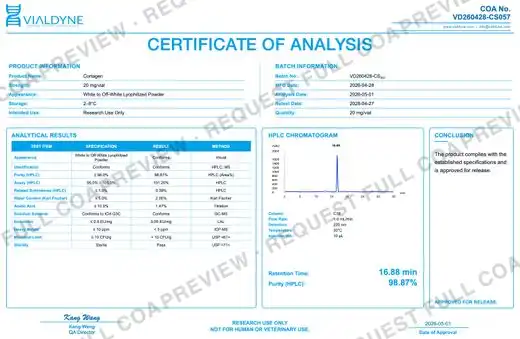
Published released-batch COAs for Cortagen, every lot HPLC-verified. These are previews — request the full high-resolution certificate for any lot.
Browse all published COAsRegulatory note
Research-use-only reference material; not for human or veterinary use.
Selected literature
Frequently asked questions
Cortagen is a single defined AEDP tetrapeptide isolated from Cortexin, whereas Cortexin is a complex multi-peptide cortical extract, so the purchase order must name the exact SKU and compositional class rather than relying on the shared naming. State explicitly that you require the defined tetrapeptide, and require that the released COA declares the material as a single molecule with a sequence assignment rather than an extract. On receipt, verify that documentation matches the ordered class before acceptance. Mismatched compositional class is the primary receiving risk here and cannot be resolved by appearance.
The two differ only at the C-terminal residue, proline versus glycine, so intake control must confirm the actual sequence, not just mass, which sits close between the two. Require sequence-verification data on the batch record and, where a reference is retained, compare chromatographic retention, since the rigid proline-induced backbone kink gives AEDP a distinct conformation and elution behavior from the flexible glycine-terminated AEDG. Record the purity figure against its stated limit, the assay basis, salt form, and re-test date. Release the lot into a workflow only after the AEDP assignment is documented.