What the label states, the lot delivers — net peptide mass, not gross powder weight, purity reported as measured rather than rounded up, and a Certificate of Analysis for every lot.
Net peptide mass, not powder weight; purity as measured, not rounded up; a COA per lot.
Net peptide + purity not rounded up. COA per lot.
FDA PCAC reviews 7 peptides for the 503A bulks list (BPC-157, KPV, TB-500, MOTs-C, Emideltide, Semax, Epitalon). Read our compounder's decision tree. Read our briefing →
FDA PCAC reviews 7 peptides for the 503A bulks list in July. Read →
FDA PCAC: 7 peptides under review. Read →

Khavinson cartilage / connective-tissue bioregulator
Overview
Cartalax (AED peptide, T-31) is a synthetic tripeptide developed by Professor Vladimir Khavinson's team at the St. Petersburg Institute of Bioregulation and Gerontology, Russia. Its amino acid sequence is alanine-glutamic acid-aspartic acid (H-Ala-Glu-Asp-OH), and it belongs to the Khavinson bioregulator peptide (Cytogen) family. This sequence also occurs within a region related to the alpha-1 chain of type XI collagen. In Russia it is developed and marketed as an oral capsule (brand name Cartalax, also available as sublingual drops) targeted at degenerative cartilage and connective-tissue conditions, with each capsule containing roughly 0.1 mg (100 mcg) of the AC-4 peptide complex. The compound is not FDA-approved, human clinical evidence is limited, and most of what exists comes from domestic Russian use plus a small number of cell-culture and animal studies; independent (non-Khavinson-affiliated) peer-reviewed replication is very scarce. Note: some vendor websites mislabel Cartalax as a tetrapeptide (variously AEDL, AEDK, or AEDG); this appears to stem from confusion with AEDG, a separate but related Khavinson tetrapeptide studied in the same research lineage. PubChem's official database entry (CID 87815447) explicitly lists "Cartalax" as a synonym for the tripeptide H-Ala-Glu-Asp-OH, so the tetrapeptide claims are incorrect. Vialdyne releases Cartalax as a lyophilized tripeptide (linear) against a ≥ 99.0% HPLC main-peak specification, with a batch-specific Certificate of Analysis covering RP-HPLC purity, mass-spec identity, water content, residual solvents, and endotoxin. Sequence / identity confirmation is documented on the released lot.
Applications & buyer fit
Buyers for longevity-class peptides span research labs working on telomere, collagen, and circadian-rhythm models, plus cosmetic-formulation OEMs incorporating peptides like GHK-Cu into anti-aging finished products. Copper peptides in particular require attention to chelator-free water and EDTA-free buffers in downstream formulation work, incompatibility there is the most common cause of "the peptide didn't work" support tickets in this class.
Sourced for
Buyer fit
Documentation that ships
Procurement note: Copper peptides require chelator-free water and EDTA-free buffers in downstream formulation work.
Primary buyer fit: academic and contract research laboratories.
Specifications
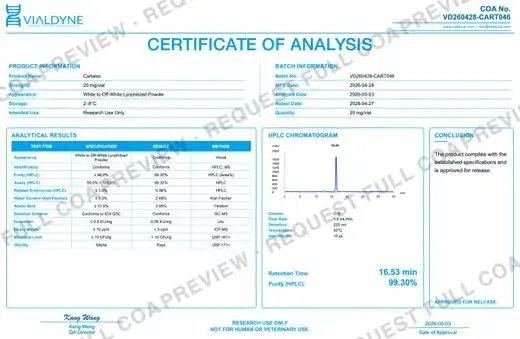
Certificate of Analysis
Published released-batch COAs for Cartalax, every lot HPLC-verified. These are previews — request the full high-resolution certificate for any lot.
Browse all published COAsRegulatory note
Research-use-only reference material; not for human or veterinary use.
Selected literature
Frequently asked questions
The batch file should state the lyophilized storage condition and the re-test interval, typically a 24-month window at -20 degrees Celsius protected from light, so shelf-life tracking is auditable. Ask for the appearance specification of the cake, water content, and salt form, since residual moisture drives long-term hydrolytic degradation of short peptides. Once reconstituted, the dominant in-lab loss pathway is freeze-thaw cycling, so records should document single-use aliquoting at near-neutral pH and hold temperature. Capturing these parameters lets the lab justify assigned expiry and reconstitution handling under its own qualification procedures.
At intake, verify the chondrocyte-targeting peptide against its COA with an orthogonal check: an HPLC purity determination against the stated acceptance limit plus a mass confirmation, with the sequence assignment recorded rather than inferred from the brand name. Isotonic saline at near-neutral pH is the appropriate reconstitution vehicle for typical Khavinson-class preparations. From the 20 mg fill, calculate the resulting concentration from the net-peptide assay figure, not the gross fill weight, and split the solution into single-use aliquots immediately. Retain a sample and log lot, assay basis, and re-test date for traceability.