What the label states, the lot delivers — net peptide mass, not gross powder weight, purity reported as measured rather than rounded up, and a Certificate of Analysis for every lot.
Net peptide mass, not powder weight; purity as measured, not rounded up; a COA per lot.
Net peptide + purity not rounded up. COA per lot.
FDA PCAC reviews 7 peptides for the 503A bulks list (BPC-157, KPV, TB-500, MOTs-C, Emideltide, Semax, Epitalon). Read our compounder's decision tree. Read our briefing →
FDA PCAC reviews 7 peptides for the 503A bulks list in July. Read →
FDA PCAC: 7 peptides under review. Read →

Khavinson cardiovascular short-peptide bioregulator
Overview
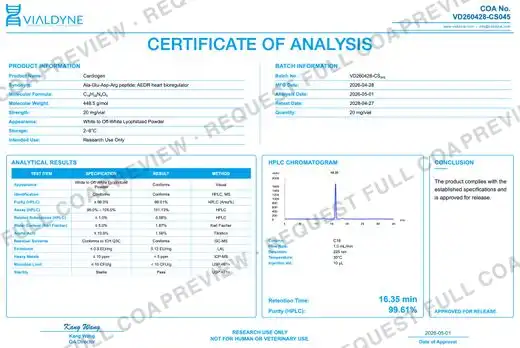
Cardiogen (Ala-Glu-Asp-Arg / AEDR) is a synthetic tetrapeptide bioregulator developed by Professor Vladimir Khavinson's team at the St. Petersburg Institute of Bioregulation and Gerontology, part of the Khavinson short-peptide family targeting cardiac tissue. Its proposed mechanism involves modulating fibroblast proliferation, suppressing cardiomyocyte apoptosis via p53 downregulation, and upregulating cytoskeletal/nuclear matrix protein expression; a separate in vitro study from the same research group also found that AEDR specifically binds wheat histones (H1, H2B, H3, H4) and their deoxyribooligonucleotide complexes (confirmed via fluorescence quenching). All published research to date is limited to in vitro cell culture and animal models (mice/rats); no human clinical trial data exist, and pricing/dosing protocols circulating among vendors are community-derived and have not been formally validated. Vialdyne releases Cardiogen as a lyophilized tetrapeptide (linear) against a ≥ 99.0% HPLC main-peak specification, with a batch-specific Certificate of Analysis covering RP-HPLC purity, mass-spec identity, water content, residual solvents, and endotoxin. Sequence / identity confirmation is documented on the released lot.
Applications & buyer fit
Buyers for longevity-class peptides span research labs working on telomere, collagen, and circadian-rhythm models, plus cosmetic-formulation OEMs incorporating peptides like GHK-Cu into anti-aging finished products. Copper peptides in particular require attention to chelator-free water and EDTA-free buffers in downstream formulation work, incompatibility there is the most common cause of "the peptide didn't work" support tickets in this class.
Sourced for
Buyer fit
Documentation that ships
Procurement note: Copper peptides require chelator-free water and EDTA-free buffers in downstream formulation work.
Primary buyer fit: academic and contract research laboratories.
Specifications
Certificate of Analysis
Published released-batch COAs for Cardiogen, every lot HPLC-verified. These are previews — request the full high-resolution certificate for any lot.
Browse all published COAsRegulatory note
Research-use-only reference material; not for human or veterinary use.
Selected literature
Frequently asked questions
Because Cardiogen is not consistently defined across upstream sources and carries no registered CAS, the released batch paperwork must state the explicit sequence of the material actually shipped, not the brand name alone. Require whether the lot is a single tetrapeptide or a short-peptide mixture, the analytical method used to confirm composition, and a purity figure tied to that method. Ask for the assay basis, salt form, and water content so dosing math is anchored correctly. Without an explicit released-sequence statement, the lot cannot be treated as a defined compound and should not enter a qualified workflow.
Since the two are marketed as complementary but target different tissues, myocardium versus endothelium, they must be handled as distinct SKUs with no shared labeling. Give each its own lot record, retained sample, and reconstitution instruction sheet, and keep vials physically separated to prevent mix-ups during combined-protocol work. The Vesugen line carries a defined KED sequence and known mass; the Cardiogen line requires its released sequence confirmed per lot. Label each container with compound name, lot, assay basis, and re-test date, and never rely on visual appearance alone to tell reconstituted solutions apart.