What the label states, the lot delivers — net peptide mass, not gross powder weight, purity reported as measured rather than rounded up, and a Certificate of Analysis for every lot.
Net peptide mass, not powder weight; purity as measured, not rounded up; a COA per lot.
Net peptide + purity not rounded up. COA per lot.
FDA PCAC reviews 7 peptides for the 503A bulks list (BPC-157, KPV, TB-500, MOTs-C, Emideltide, Semax, Epitalon). Read our compounder's decision tree. Read our briefing →
FDA PCAC reviews 7 peptides for the 503A bulks list in July. Read →
FDA PCAC: 7 peptides under review. Read →

Khavinson bioregulator tetrapeptide (Ala-Glu-Asp-Leu, AEDL)
Overview
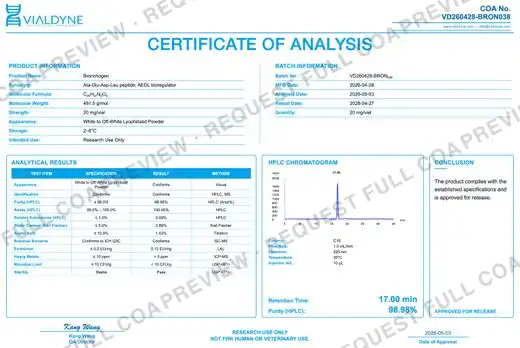
Bronchogen is a synthetic tetrapeptide bioregulator with the amino acid sequence Ala-Glu-Asp-Leu (AEDL, H-Ala-Glu-Asp-Leu-OH), developed by Professor Vladimir Khavinson's team at the St. Petersburg Institute of Bioregulation and Gerontology in Russia. It belongs to the Khavinson short-peptide (cytogen) family, specifically the member associated with bronchial-pulmonary tissue. The compound is listed in PubChem (CID 11690869, independently re-confirmed to exist in this pass; molecular formula C18H30N4O9); the molecular weight has been cross-checked and matches between PubChem (approximately 446.5 Da via the PUG-REST data interface) and independent third-party vendor technical data sheets (e.g., NovoProLabs, listing 446.44 Da). Note: PubChem also carries a second entry, CID 471572; independent structural verification (InChIKey comparison) in this pass found its N-terminus is glutamic acid rather than alanine (H-Glu-Asp-Leu-Ala-OH) — a distinct isomer with the same molecular formula but a different residue order, not a duplicate naming of the same compound. This entry is unrelated to any of Bronchogen's three core publications and may reflect a vendor-sourced mix-up; it should not be treated as an equivalent entry for Bronchogen. This class of short peptides is hypothesized to regulate gene expression by binding specific DNA motifs, and has been studied in vitro and in animal models for tissue-specific effects on bronchial epithelial cell differentiation. There are currently three core peer-reviewed publications (a 2011 DNA-binding mechanism study, a 2012 cell differentiation study, and a 2015 rat COPD model study), all independently re-verified to exist via PubMed/Springer Nature Link in this pass. All three originate from the Khavinson team and Russian/St. Petersburg research institutions; the evidence base remains limited in scale, and no double-blind human trials have been reported in the English-language literature. Vialdyne releases Bronchogen as a lyophilized tetrapeptide (linear) against a ≥ 99.0% HPLC main-peak specification, with a batch-specific Certificate of Analysis covering RP-HPLC purity, mass-spec identity, water content, residual solvents, and endotoxin. Sequence / identity confirmation is documented on the released lot.
Applications & buyer fit
Buyers for longevity-class peptides span research labs working on telomere, collagen, and circadian-rhythm models, plus cosmetic-formulation OEMs incorporating peptides like GHK-Cu into anti-aging finished products. Copper peptides in particular require attention to chelator-free water and EDTA-free buffers in downstream formulation work, incompatibility there is the most common cause of "the peptide didn't work" support tickets in this class.
Sourced for
Buyer fit
Documentation that ships
Procurement note: Copper peptides require chelator-free water and EDTA-free buffers in downstream formulation work.
Primary buyer fit: academic and contract research laboratories.
Specifications
Certificate of Analysis
Published released-batch COAs for Bronchogen, every lot HPLC-verified. These are previews — request the full high-resolution certificate for any lot.
Browse all published COAsRegulatory note
Research-use-only reference material; not for human or veterinary use.
Selected literature
Frequently asked questions
Intranasal preparations of the AEDL tetrapeptide should use isotonic saline as the vehicle at a mildly acidic-to-neutral pH, roughly 5.5 to 7.0, to keep the peptide soluble without harsh conditions. Avoid benzalkonium chloride and related quaternary-ammonium preservatives, which can interact with short peptide sequences and compromise the preparation. Because Bronchogen is also used intramuscularly in published work, document which route a given preparation supports so labeling matches intended use. Record the vehicle, pH, and target concentration derived from the net-peptide assay so each batch is reproducible and traceable.
The three tetrapeptides share the Ala-Glu-Asp core and sit within a roughly 50 Da mass span, so a mass value alone on the paperwork is not a sufficient identity control and a mislabeled lot could pass unnoticed. At receipt, require batch documentation carrying full sequence-verification data that resolves the C-terminal residue, Leucine for Bronchogen versus Glycine or Proline for the siblings. Confirm against a retained reference by chromatographic retention where possible. This is most important when qualifying a new supplier, log the lot, assay basis, and sequence confirmation before release into any preparation.