FDA PCAC: 7 peptides under review. Read →

Vialdyne

BAC Water (Bacteriostatic Water for Injection)

0.9% benzyl-alcohol bacteriostatic water

≥ 99.0% (component-wise for blends)CAS (blend, components: benzyl alcohol 100-51-6, water 7732-18-5)Custom Blends & OEM

Overview

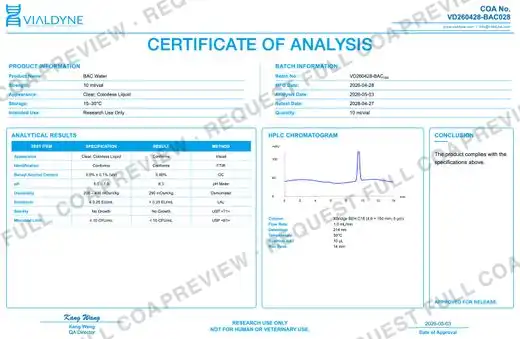
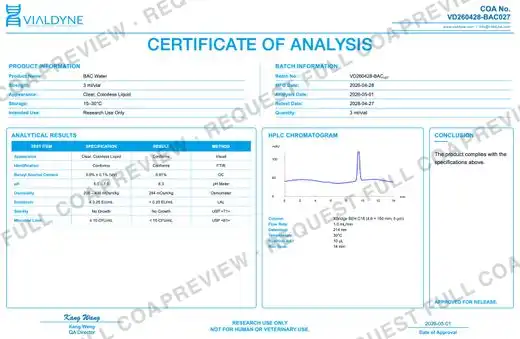
Bacteriostatic Water for Injection, catalogued here as BAC Water, is preserved sterile water for injection that carries 0.9% benzyl alcohol as the antimicrobial agent. The presentation is purpose-built as a multi-use reconstitution medium for peptides and related sterile injectable preparations. Once the rubber septum has been pierced, the benzyl-alcohol preservative holds microbial growth in check across the USP-compendial 28-day window, which is the standard expectation for preserved injectable solutions. For peptides documented as preservative-compatible, this is the workhorse diluent in 503A compounding pharmacy workflows: a single vial supports many small doses across multiple weeks without forcing single-use sterile preparation on every dispense. Vialdyne releases BAC Water in 3 ml and 10 ml sterile vial presentations, manufactured from pharmaceutical-grade benzyl alcohol and Water for Injection. Compatibility is the load-bearing caveat for the receiving pharmacy: BAC Water is not appropriate for every peptide. Some short peptides interact with benzyl alcohol or with the preservative system in ways that can erode potency or contaminate downstream assays, and the right alternative for those is preservative-free Sterile Water for Injection (SWFI) in single-use aliquot preparation. The benzyl-alcohol content is reproduced on the product label and on the released-batch COA for every shipment, so the pharmacy can match the diluent to the peptide stability data on file.

Who buys this, and why

Custom-blend buyers are almost always OEM clients building a branded product around a specific ratio of two or more peptides. The development workflow is collaborative: ratio target, analytical method to verify it, stability protocol in the chosen carrier, and packaging selection are all defined in the OEM brief before the first commercial run. Sample-stage volumes are usually 5-10 g of finished blend; commercial MOQ depends on the components.

Primary buyer fit: 503A / 503B compounding pharmacies, medical aesthetic clinics and med spas, and regional distributors and re-sellers.

Specifications

CAS
(blend, components: benzyl alcohol 100-51-6, water 7732-18-5)
Purity (HPLC)
≥ 99.0% (component-wise for blends)
Common vial sizes
3 ml, 10 ml
MOQ
On request
Lead time
7–14 days
Storage
Room temperature, protect from light

Documentation available on request

  • Certificate of Analysis (COA)
  • Ratio-verification HPLC
  • Mass-spec identity of each component
  • Stability of the blend (matrix-specific)
  • Bacterial endotoxin (LAL, USP <85>)
  • Sterile-fill documentation (where applicable)
  • SDS / MSDS
  • Private-label / OEM specification sheet

Regulatory note

Reconstitution diluent containing benzyl-alcohol preservative. Verify sterility, endotoxin, and injectable-grade compliance with target market regulations. Not universally compatible with all peptides, some peptides require preservative-free SWFI.

Frequently asked questions

When should I use BAC Water vs. preservative-free Sterile Water for Injection?

Three operational triggers point to **BAC Water**: the peptide is documented preservative-compatible, the dispensing workflow benefits from multi-use vial preservation, and a single vial needs to support many small doses over 2-4 weeks, the typical 503A compounding-pharmacy pattern. The 0.9% benzyl alcohol holds microbial growth in check after multiple septum punctures. Three opposite triggers point to **SWFI**: the peptide is preservative-incompatible (some short peptides interact with benzyl alcohol), the preparation is intended for single use within hours of reconstitution, or the downstream product specifies preservative-free chemistry (some sterile-filled finished products). The product page and the released-batch COA for each peptide SKU document the recommended diluent.

Is the 28-day multi-use window for BAC Water-reconstituted vials a hard rule?

The 28-day window is the USP-compendial expectation for preserved injectable solutions and is the conservative operational ceiling that most 503A compounding pharmacies use. Actual stability is peptide-dependent and storage-condition-dependent: peptides with shorter aqueous-solution half-lives may need 7-14 day use windows, while particularly stable peptides may tolerate 4-6 weeks. The 28-day default is appropriate for the majority of GLP-1, repair, and GH-axis peptides reconstituted in BAC Water and held refrigerated. For pharmacies building extended-stability programs, peptide-specific stability data in the relevant diluent can be developed under a project-specific change-control with ICH-Q1A commitment.