Acetic Acid (Glacial / Concentrated Solvent)
Acidification solvent · process auxiliary
Overview
Concentrated, or glacial, acetic acid is catalogued here as a process-auxiliary solvent for compounding pharmacy and research workflows that need to prepare acidic-pH peptide reconstitution diluents in-house at custom concentrations. The catalogue's pre-mixed 0.6% Acetic Acid Water diluent handles the most common acidic-pH reconstitution case, but some peptide-stability profiles call for alternative acetic-acid concentrations (0.1%, 0.3%, and 1.0% are the typical custom dilutions), and the upstream starting material for in-house preparation of those is concentrated anhydrous acetic acid at ≥99.7% purity. Glacial refers to the anhydrous, concentrated form that crystallises below 16.6 C. Vialdyne stocks glacial acetic acid as a ≥99.0% HPLC-purity reagent in 10 ml sealed packaging. This SKU is catalogued as a process auxiliary rather than a peptide API, so the analytical workflow follows the standard solvent-grade specification, GC, water content, and residual impurities, rather than peptide-style HPLC plus mass spec. Pharmacies preparing in-house diluents should follow the relevant local pharmacopoeia requirements for solvent quality and must terminally sterilise the resulting diluent before any injectable-grade use, the parent solvent is not itself terminally sterile.
Who buys this, and why
Custom-blend buyers are almost always OEM clients building a branded product around a specific ratio of two or more peptides. The development workflow is collaborative: ratio target, analytical method to verify it, stability protocol in the chosen carrier, and packaging selection are all defined in the OEM brief before the first commercial run. Sample-stage volumes are usually 5-10 g of finished blend; commercial MOQ depends on the components.
Primary buyer fit: academic and contract research laboratories and 503A / 503B compounding pharmacies.
Specifications
- CAS
- 64-19-7
- Molecular Formula
- C2H4O2
- Molecular Weight
- 60.05 g/mol
- Purity (HPLC)
- ≥ 99.0%
- Common vial sizes
- 10 ml
- MOQ
- On request
- Lead time
- 7–14 days
- Storage
- Room temperature, sealed
Documentation available on request
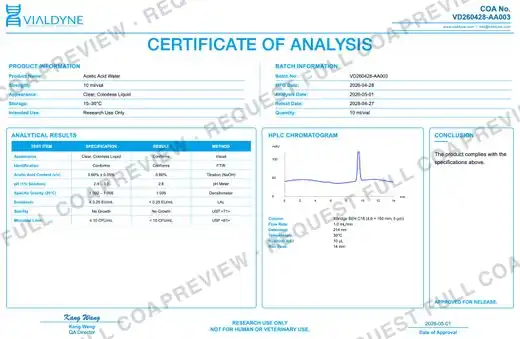
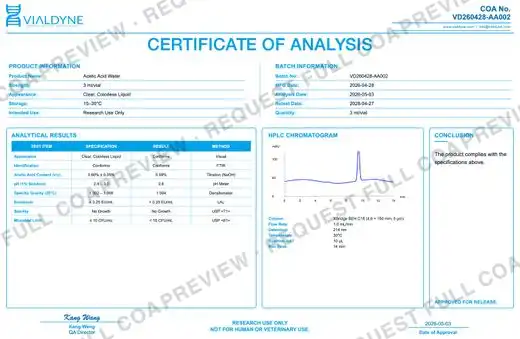
- Certificate of Analysis (COA)
- Ratio-verification HPLC
- Mass-spec identity of each component
- Stability of the blend (matrix-specific)
- Bacterial endotoxin (LAL, USP <85>)
- Sterile-fill documentation (where applicable)
- SDS / MSDS
- Private-label / OEM specification sheet
Regulatory note
Sold as a multi-peptide active for research and for OEM-formulated finished products under the receiving brand's regulatory framework. Blend composition, finished-product safety, labeling claims, and notification responsibilities remain with the brand owner. Component-level analytical data is supplied for every batch.
Frequently asked questions
Is glacial acetic acid the same as vinegar or food-grade acetic acid?▾
No. Glacial acetic acid is the anhydrous, concentrated (≥99% pure) form of acetic acid, a fundamentally different material from food-grade vinegar (typically 4-7% acetic acid in water) or laboratory dilute acetic acid (10-50% in water). The 'glacial' name refers to the crystalline appearance of pure acetic acid below its freezing point of 16.6 C, where pure anhydrous acetic acid forms ice-like crystals at typical winter temperatures. Glacial acetic acid is a solvent and process auxiliary, not a peptide API; it is supplied as a starting material for in-house preparation of custom acidic-pH reconstitution diluents at the receiving pharmacy's target dilution. Never substitute food-grade vinegar in research or compounding contexts where glacial acetic acid is specified, the impurity profile is fundamentally different and would compromise the downstream peptide preparation.
What's the safe-handling guidance for glacial acetic acid in a peptide-research lab?▾
Glacial acetic acid is corrosive: direct contact causes chemical burns, and the vapour irritates mucous membranes at concentrations above roughly 10 ppm. Safe handling requires four controls. First, a fume hood for any operation that involves opening the container or transferring volumes. Second, appropriate PPE, chemical-resistant gloves, splash-proof goggles, and a lab coat. Third, a compatible storage container, glass or specific corrosion-resistant plastics such as Teflon work; standard polypropylene degrades over time and should not be used for long-term storage. Fourth, segregation from strong oxidisers and bases in the storage area. The 10 mL fill is sized to typical compounding-pharmacy and research consumption: small enough to limit exposure in the event of a breached container, large enough to support routine in-house diluent preparation. Spills should be neutralised with sodium bicarbonate before any water-cleanup step.